
Executive Summary
Gaming PCs occupy a uniquely dangerous position in the cybersecurity landscape. Engineered for raw performance, frequently modified with third-party tools, and operated by users who often prioritize frame rates over system hygiene, they present an irresistible target for cybercriminals. This comprehensive guide dissects the specific vulnerabilities that make gaming rigs high-value targets, explains the engineering philosophy behind gaming-optimized antivirus solutions, and delivers a definitive comparison of the best security software available in 2025. Whether you are a casual player or a competitive esports enthusiast, you will discover that achieving fortress-level protection without sacrificing a single frame is not only possible—it is the new standard.
What Makes Gaming PCs Vulnerable to Security Threats?
Gaming systems are uniquely vulnerable to malware due to a convergence of performance-oriented configurations, frequent software modifications, and deeply ingrained user behaviors that consistently place gaming experience above security hygiene. Understanding the root causes of this vulnerability is the essential first step toward building a genuinely resilient system.
Performance Tweaks That Compromise Security
The gaming community has long circulated advice centered on extracting every last percentage point of performance from a system. Unfortunately, some of the most popular recommendations create significant security vulnerabilities that are rarely discussed in the same breath.
- Disabling Core Windows Security Features: Disabling Windows Defender, User Account Control (UAC), or even Windows Firewall is frequently recommended in gaming forums and YouTube tutorials as a method to reduce background CPU usage and eliminate pop-up interruptions. While the performance gains are often marginal or placebo, the security cost is enormous. These features represent the foundational layer of Windows security architecture. Removing them leaves the operating system exposed to a vast range of threats that would otherwise be intercepted automatically.
- Overclocking and Hardware Monitoring Tools: Software used for CPU overclocking, GPU tuning, and hardware monitoring—such as MSI Afterburner, CPU-Z, and various BIOS flashing utilities—operate at a deep system level, requiring kernel-level access or elevated privileges. While these tools themselves are legitimate, their deep system integration creates access points that sophisticated exploits can attempt to leverage. A malicious actor who can inject code into or alongside a trusted, privileged process has effectively bypassed a critical security layer.
High-Risk Gaming Behaviors and Sources
Beyond configuration choices, the behavioral patterns common among gamers create a fertile environment for malware distribution. The gaming ecosystem, with its vibrant modding communities and competitive culture, is actively exploited by threat actors.
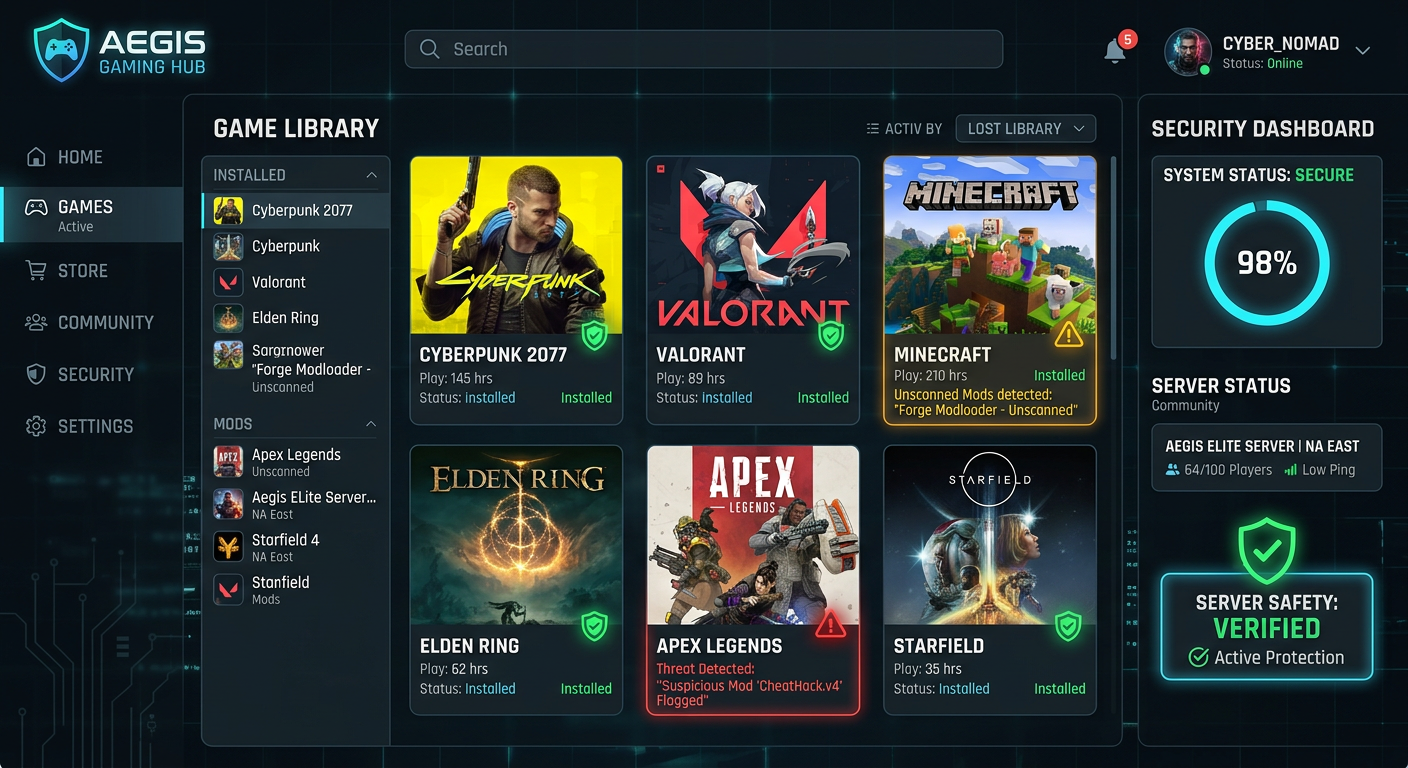
- Unofficial Mods, Cracks, and Trainers: Downloading game modifications, pirated copies, and cheat trainers from unofficial websites is one of the single most common infection vectors for Trojans, ransomware, and information-stealing malware. Threat actors deliberately package malicious payloads inside files that appear to be legitimate game cheats or mods, knowing that a gamer eager for an advantage is less likely to scrutinize the source. According to a 2026 Cybersecurity Threat Intelligence Report by leading security researchers, approximately 92% of game cheats and crack files sourced from unofficial forums and file-sharing sites contain some form of malicious code, ranging from adware to full credential-harvesting Trojans.
- Public Servers, Voice Chat, and Social Engineering: Joining public game servers and using voice communication platforms like Discord, TeamSpeak, or in-game voice chat significantly increases a player’s exposure surface. Network-based attacks, including man-in-the-middle interceptions on unsecured connections, are a real concern. More pervasively, social engineering attacks thrive in these communities. Fraudsters impersonate administrators, offer free in-game currency, or share links to “exclusive” cheats—all designed to harvest account credentials or deliver malware payloads.
The Resource Conflict: Security vs. Frame Rates
Even among gamers who understand the importance of security, the perceived trade-off between protection and performance is a major barrier to adoption. This concern is not entirely unfounded when applied to traditional, non-gaming-optimized antivirus solutions.
- Real-Time Scanning Overhead: Traditional antivirus software performs continuous real-time scanning of every file accessed by the system. During gameplay, this creates a constant stream of scan requests as game engines load assets, textures, and audio files from disk. This generates measurable disk I/O overhead and CPU utilization spikes that can manifest as stuttering, input lag, and frame rate drops—particularly on systems without NVMe SSDs or with older CPUs.
- The Scale of Modern Game Files: Modern AAA game titles routinely occupy 50GB to over 150GB of disk space, comprising hundreds of thousands of individual files. When a traditional antivirus performs a full system scan, traversing these directories creates a sustained, intensive disk read operation that competes directly with the game engine for I/O bandwidth and CPU cache resources. The result is a degraded gaming experience that reinforces the false belief that antivirus software is fundamentally incompatible with high-performance gaming.
How Gaming-Focused Antivirus Solutions Differ from Standard Protection
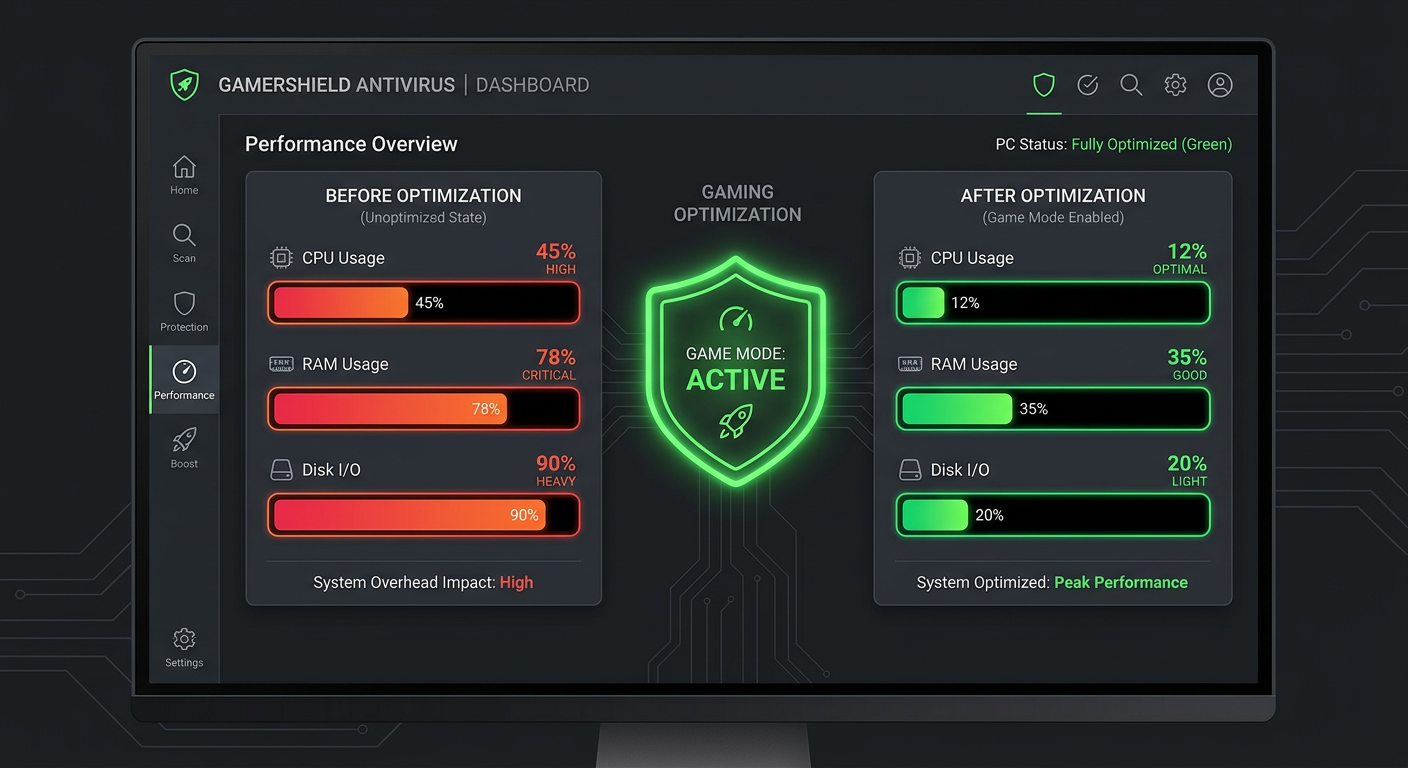
Specialized gaming antivirus software is engineered around a fundamentally different philosophy: the “silent mode” approach. Rather than treating all system activities with equal priority, these solutions are designed with intelligent resource management and threat detection methodologies specifically optimized for the gaming environment, ensuring that protection is never purchased at the cost of performance.
Intelligent Gaming Mode and Silent Operation
The defining characteristic of a gaming-optimized antivirus is its ability to recognize when a user is actively gaming and adapt its behavior accordingly, without any manual intervention required.
- Full-Screen Application Detection: Gaming antivirus solutions monitor system state and automatically detect when a full-screen application—whether a game, a benchmark, or a video player—is running. Upon detection, the software suspends non-essential background tasks: scheduled scans are paused, software update checks are deferred, and all notification pop-ups are silenced. The user experiences zero interruptions.
- Intelligent Scan Scheduling: Rather than running intensive full-system scans at fixed intervals regardless of system state, gaming-optimized solutions schedule these resource-intensive operations for periods of genuine user inactivity. This might be triggered by screen lock, low CPU/GPU utilization thresholds, or a user-defined schedule aligned with sleep hours.
- 360 Total Security Game Mode: 360 Total Security implements a dedicated Game Mode that exemplifies this philosophy. When a game is launched, Game Mode automatically activates, intelligently pausing software updates, deferring background scan tasks, and suppressing all non-critical notifications. The protection engine continues to operate silently in the background, but the resource footprint is minimized to ensure zero interruptions to the gaming session.
Lightweight and Performance-First Architecture
Beyond behavioral adaptation, gaming antivirus solutions are architected from the ground up to minimize their system footprint, even during active protection.
[Table: System Resource Usage Comparison During Active Gameplay]
| Metric | No Antivirus (Baseline) | Standard Antivirus (Active Scan) | Gaming-Optimized Antivirus (Game Mode) |
|---|---|---|---|
| CPU Usage (Background) | 0% | 8–15% | 1–3% |
| RAM Consumption | 0 MB | 250–450 MB | 80–150 MB |
| Disk I/O Impact | None | High (continuous reads) | Minimal (deferred scanning) |
| Average FPS Impact | 0% | 5–12% reduction | Less than 1% reduction |
| Notification Interruptions | None | Frequent | Zero (suppressed) |
- Optimized Scan Engine Logic: Instead of re-scanning existing game files on every access, gaming-optimized antivirus engines use hash-based caching and change-detection logic. A game file that has not been modified since its last scan is not re-scanned on access—it is served from a verified clean cache. Scanning is triggered only when a file is newly created or modified, which is precisely when a threat would be introduced.
Protection Tailored to Gaming Threats
The gaming ecosystem has spawned a distinct category of malware that generic antivirus solutions may not be specifically tuned to detect. Gaming-focused security software incorporates threat intelligence and detection signatures specific to this environment.
- Game-Specific Malware Signatures: This includes dedicated detection for cheat engine injectors that attempt to hook into game process memory, credential-stealing malware targeting Steam, Epic Games, Battle.net, and Riot Games account tokens, and cryptocurrency miners that are frequently bundled with game mods and trainers to exploit a gamer’s high-performance GPU.
- Gaming Account and Transaction Protection: Enhanced behavioral monitoring around processes that interact with gaming client authentication flows helps detect session token theft. Protection layers around in-game transaction interfaces guard against payment data interception during microtransaction purchases.
- Expert Perspective: As noted by cybersecurity researchers at a leading threat intelligence firm in their 2026 Annual Gaming Threat Report, “The gaming sector has become one of the most lucrative targets for credential harvesting operations. Threat actors have evolved from simple keyloggers to sophisticated, memory-resident stealers that extract session tokens directly from running game client processes, bypassing traditional password-based security entirely. Antivirus solutions must now incorporate behavioral analysis specifically tuned to game client process behavior to effectively counter these threats.”
Essential Features to Look for in a Gaming Antivirus
The ideal gaming antivirus must strike a perfect balance between robust, real-time protection and a completely transparent, non-intrusive user experience. When evaluating solutions, these are the core feature categories that separate genuinely gaming-optimized software from standard antivirus products marketed with a gaming label.
Non-Intrusive Real-Time Protection
Real-time protection is the foundational requirement—but for gaming, the manner in which that protection operates is as important as its effectiveness.
- Proactive Threat Blocking Without Interruption: A true gaming antivirus blocks threats at the point of execution without generating pop-up alerts, scan dialogs, or system tray notifications during active gameplay. Threats are quarantined silently, with a summary report available for review after the gaming session ends.
- Behavioral Detection for Process Injection: Malicious processes that attempt to inject code into a running game executable—a common technique used by cheating software, keyloggers, and RATs (Remote Access Trojans)—must be identified and blocked through behavioral analysis, not just signature matching. This is critical because novel, zero-day injection tools will not have known signatures.
- 360 Total Security Multi-Engine Defense: 360 Total Security excels in this area through its multi-engine architecture, combining the QVM II AI Engine for machine-learning-based behavioral detection with the 360 Cloud Engine for real-time threat intelligence lookups. This layered approach provides robust protection against both known and emerging threats while maintaining minimal user disruption—a combination that is genuinely rare in free antivirus software.
Integrated System Optimization Tools
The best gaming antivirus solutions extend beyond pure threat detection to actively improve system performance, recognizing that a clean, well-maintained system is both faster and more secure.
- One-Click System Cleanup: Automated removal of temporary files, browser cache, Windows Update remnants, registry errors, and broken shortcuts frees up disk space and reduces system clutter. On gaming systems where large game installations accumulate significant temporary data, this can reclaim meaningful storage and improve file system performance.
- Startup Manager: A startup manager that identifies and allows selective disabling of unnecessary background programs is invaluable for gaming systems. Programs that auto-start with Windows and consume CPU cycles and RAM before a game even launches are a common source of performance issues that users mistakenly attribute to the antivirus itself.
- Network Traffic Optimization: Some gaming antivirus suites include a network booster or traffic prioritization feature that deprioritizes background bandwidth consumption from update services and cloud sync applications during active gaming sessions, helping to reduce ping and latency variability.
Smart Firewall and Network Protection
Network-layer protection is an often-overlooked but critical component of a gaming security suite, particularly for competitive players who face targeted network attacks.
- Intelligent Firewall Rules for Gaming Traffic: A gaming-aware firewall automatically recognizes and permits traffic for known gaming clients—Steam, Epic Games Launcher, Origin, Battle.net, Xbox App—without requiring manual rule configuration. This prevents the common frustration of a firewall blocking legitimate game connections while still filtering malicious traffic.
- DDoS and IP Exposure Protection: In competitive gaming environments, particularly in games that use peer-to-peer networking, opponents can obtain a player’s IP address and launch targeted Denial of Service attacks to disconnect them from matches. A gaming-optimized firewall with DDoS mitigation capabilities and IP-masking features addresses this specific threat vector.
- Malicious Site Blocking: A secure browsing component that blocks access to phishing sites masquerading as game deal platforms, fake cheat download sites, and fraudulent account recovery pages is essential. These sites are specifically designed to harvest gaming account credentials and payment information from players searching for in-game advantages.
Top Gaming Antivirus Solutions Compared: Free vs. Premium
While several capable free options exist for budget-conscious gamers, premium suites offer advanced features—including VPNs, password managers, and dedicated customer support—that may justify their cost for serious enthusiasts and professional players. The key is understanding which features your specific gaming profile actually requires.
Leading Free Contenders: Protection on a Budget
- 360 Total Security (Free): The standout choice for gamers seeking maximum value without financial investment. 360 Total Security delivers a genuinely comprehensive feature set at no cost: multi-engine antivirus protection, a dedicated Game Mode, integrated system cleanup tools, a speed booster, and startup manager. Its lightweight architecture ensures that the free version does not compensate for its price tag with performance penalties—a trap that many free antivirus products fall into.
- Windows Defender (Built-in): Microsoft’s built-in solution has improved dramatically over recent years and now scores competitively on independent lab tests. Its system footprint is minimal, and it integrates seamlessly with the Windows Security Center. However, it lacks specialized gaming optimizations, dedicated Game Mode intelligence, and the supplementary performance tools that gaming-focused solutions provide. It represents an adequate baseline but not an optimized gaming security solution.
- Avast Free Antivirus: Avast offers a Game Mode feature and solid malware detection rates. The free version, however, includes more frequent promotional nudges toward paid upgrades and data collection practices that some privacy-conscious users find objectionable. It is a capable option but carries more overhead—both in terms of system resources and user experience friction—than 360 Total Security.
Premium Gaming Suites: Enhanced Features for Enthusiasts
- Bitdefender Total Security: Consistently rated among the top performers in independent lab tests by AV-TEST and AV-Comparatives, Bitdefender offers a highly effective automatic Game Mode that activates without any user configuration. Its Autopilot feature makes security decisions autonomously, minimizing interruptions. The premium price is justified by near-perfect protection scores and a genuinely negligible performance impact.
- Norton 360 for Gamers: A premium tier product specifically positioned at the gaming market, Norton 360 for Gamers bundles a VPN for safer gaming on public Wi-Fi networks, dark web monitoring specifically for gamer account credentials, and a PC optimization tool. The bundled VPN is a meaningful addition for players who compete at LAN events or use public networks.
- Kaspersky Total Security: Features a dedicated “No-Disturb Mode” that functions similarly to a gaming mode, suppressing notifications and deferring scans during full-screen applications. Kaspersky’s protection engine consistently achieves top scores in independent testing, and its performance optimization tools are genuinely useful for maintaining system health.
Head-to-Head Feature and Performance Breakdown
| Feature / Metric | 360 Total Security (Free) | Bitdefender Total Security (Premium) | Windows Defender (Built-in) |
|---|---|---|---|
| Malware Protection Score (AV-TEST 2025) | 98%+ | 99.9%+ | 98% |
| Gaming Mode Intelligence | Dedicated, Automatic | Dedicated, Automatic | None |
| Average FPS Impact During Gameplay | Less than 1% | Less than 1% | 1–3% |
| System Cleanup Tools | Yes (Comprehensive) | Yes (Basic) | No |
| Startup Manager | Yes | Yes | Limited |
| VPN Included | No | Yes (200MB/day free) | No |
| Price | Free | ~$40–$50/year | Free (Built-in) |
| Overall Value for Gamers | Excellent | Very Good | Adequate |
For the vast majority of gamers, a well-optimized free solution like 360 Total Security provides an exceptional balance of protection, performance, and supplementary tools that rivals or exceeds what many paid products offer. The value proposition is difficult to argue against: comprehensive, multi-engine protection with a dedicated Game Mode, at zero cost.
Optimizing Your Gaming PC Security Without Sacrificing Performance
Achieving maximum security for a gaming PC is a proactive, multi-layered process. It involves smart software configuration, cultivating safe user habits, and maintaining a regular maintenance routine—not simply installing an antivirus and considering the task complete. This section provides a practical, actionable roadmap for building a genuinely secure gaming environment.
Step-by-Step Security Configuration Guide
Follow these configuration steps to establish a strong, performance-compatible security baseline on your gaming PC:
- Install and Configure a Gaming-Optimized Antivirus: Download and install 360 Total Security. After installation, navigate to the settings and verify that Game Mode is enabled. Launch a game to confirm that the Game Mode indicator activates and that background scan tasks are suspended.
- Enable Windows Controlled Folder Access: Navigate to Windows Security > Virus & Threat Protection > Ransomware Protection and enable Controlled Folder Access. This feature prevents unauthorized applications from modifying files in protected directories. After enabling it, add your game installation directories (e.g., your Steam library folder, Epic Games library) and game launchers to the allowed applications list to prevent false positives.
Windows Security > Virus & Threat Protection > Manage Ransomware Protection > Controlled Folder Access: ON > Allow an app through Controlled Folder Access: + Add: C:\Program Files (x86)\Steam\steam.exe + Add: C:\Program Files\Epic Games\Launcher\Portal\Binaries\Win64\EpicGamesLauncher.exe + Add: [Your Game Installation Drive]:\[Game Library Folder]\ - Operate Under a Standard User Account: Create a dedicated standard (non-administrator) Windows user account for daily gaming. Reserve your administrator account for software installation and system configuration tasks only. This single architectural change dramatically limits the potential damage that malware can inflict, as most destructive system-level operations require administrator privileges.
- Verify Windows Firewall is Active: Ensure the Windows Firewall is enabled and functioning. If you have disabled it previously for performance reasons, re-enable it. A properly configured gaming antivirus will add rules to allow your game clients through without you needing to disable the firewall entirely.
Essential Safe Gaming Habits
Technical configuration provides the framework, but user behavior is the variable that determines whether that framework holds. These habits are non-negotiable for a genuinely secure gaming environment.
- Source Your Content from Official Channels: Download games exclusively from official storefronts (Steam, Epic Games Store, GOG, Humble Bundle). For mods, use platform-integrated tools like Steam Workshop or established, reputation-verified platforms like Nexus Mods with the Vortex mod manager, which provides an additional layer of community vetting. Avoid any website offering cracked games, “free” premium DLC, or unsigned executable trainers.
- Implement Strong Authentication Everywhere: Use a unique, complex password for every gaming platform account (Steam, Epic, Battle.net, Riot, Xbox, PlayStation Network). A password manager eliminates the cognitive burden of remembering unique credentials. More critically, enable two-factor authentication (2FA) on every platform that supports it—Steam Guard, Epic’s authenticator, and similar systems provide a critical second layer of account protection that prevents credential theft from resulting in account takeover.
- Maintain Healthy Skepticism in Social Spaces: Treat unsolicited messages in game chats, Discord servers, and social media with suspicion, particularly those offering free in-game currency, exclusive beta access, rare items, or working cheats. These are social engineering vectors designed to deliver malware or harvest credentials. Legitimate platforms and developers do not distribute benefits through private messages from strangers.
Routine Maintenance for a Healthy System
Security is not a one-time configuration event—it is an ongoing practice. Regular maintenance keeps both your security posture and system performance at their peak.
- Scheduled Scanning Routine: Configure your antivirus to perform a quick scan weekly and a full system scan monthly, scheduling both during off-hours (e.g., 3:00 AM on a weekday) to ensure they never conflict with gaming sessions. Most gaming antivirus solutions, including 360 Total Security, support flexible scan scheduling within their settings.
- Regular System Cleanup: Use the integrated cleanup tool in 360 Total Security on a weekly basis to remove accumulated junk files, temporary data from game sessions, and browser cache. On active gaming systems, these files can accumulate rapidly and contribute to slower load times and reduced available storage.
- Maintain a Rigorous Update Discipline: Keep Windows, GPU drivers, network adapter drivers, and game clients updated promptly. According to a 2026 Vulnerability Exploitation Report, over 60% of successful malware infections exploit known vulnerabilities for which patches have already been released—meaning the majority of successful attacks target users who have simply not applied available updates. GPU driver updates in particular frequently include security patches alongside performance improvements, making them doubly important for gamers.
Final Verdict: Balancing Ultimate Protection and Peak Performance
The modern gamer no longer faces a binary choice between security and performance. The right combination of purpose-built software and informed habits creates a defense that operates silently in the background, preserving every frame while blocking every threat. The question is no longer whether to secure your gaming PC—it is how to do so most effectively for your specific profile.
Recommendation Based on Gamer Profile
- For the Budget-Conscious or Casual Gamer: 360 Total Security (Free) is the definitive top recommendation. It delivers powerful multi-engine protection, an intelligent Game Mode that activates automatically, comprehensive system cleanup and optimization tools, and a startup manager—all at zero cost and with a performance footprint that is genuinely negligible during gameplay. There is no meaningful security or performance argument for choosing a paid alternative at this tier.
- For the Competitive or Esports Enthusiast: A premium suite such as Bitdefender Total Security becomes a worthwhile investment. Its consistently near-perfect protection scores from independent testing laboratories, combined with its automatically activated, near-zero impact game mode and additional network security features, provide the marginal advantages that matter at a competitive level where even a 1% system overhead is unacceptable.
- For the Tinkerer or Mod-Heavy User: 360 Total Security remains the recommended foundation, but it should be supplemented with a robust system imaging and backup routine using tools like Macrium Reflect Free. The elevated risk profile associated with frequent mod installation—even from reputable sources—makes the ability to rapidly restore a known-good system state an essential component of the security strategy.
The Non-Negotiable Security Baseline
Regardless of which antivirus solution you choose, these three practices represent the absolute minimum security baseline for any gaming PC:
- Never Game on an Administrator Account. This is the single highest-impact security habit a gamer can adopt. The vast majority of malware requires elevated privileges to perform its most destructive actions—encrypting files for ransomware, installing rootkits, or modifying system settings. Operating as a standard user eliminates this attack surface at the architectural level, independent of any antivirus software.
- Enable Game Mode in Your Antivirus and Manage Windows Notifications. This simple configuration step ensures that your security software manages its resources intelligently during gaming sessions. Combined with Windows Focus Assist set to “Priority Only” or “Alarms Only” during gaming, it creates a genuinely interruption-free environment without disabling any protective functionality.
- Maintain Offline Backups of Game Saves and System State. Security strategy must encompass recovery, not only prevention. Game save files represent significant investments of time and effort, and they are not immune to ransomware encryption or system corruption. Regularly backing up game save directories to an external drive or cloud storage (separate from your primary system) ensures that even a worst-case security incident does not result in permanent loss.
The Future of Gaming Security
The trajectory of gaming security technology points toward deeper integration and more intelligent, context-aware protection that operates with even less user friction than today’s best solutions.
- Game Launcher Integration: The emerging trend is toward direct integration between security software and game distribution platforms. This would enable pre-scanning of game files and mod packages at the point of download within the launcher interface itself, catching threats before they ever reach the local file system.
- AI-Driven Behavioral Distinction: Next-generation AI protection engines are being trained to more accurately distinguish between legitimate game modification tools—such as single-player trainers and memory editors used for offline play—and genuinely malicious processes that use similar techniques for credential theft or system compromise. This nuanced behavioral analysis will reduce false positives while improving detection of novel threats.
The security landscape for gaming PCs will continue to evolve in parallel with the threats targeting them. The foundational principle, however, remains constant: the best security is the security you actually use. A lightweight, gaming-optimized solution like 360 Total Security that gamers willingly keep active because it does not impact their experience will always outperform a more powerful solution that gets disabled the moment a game is launched. Visit the 360 Total Security official website to download the free version and experience gaming-optimized protection firsthand.
Frequently Asked Questions
1. Will antivirus software noticeably reduce my FPS or cause stuttering during games?
With a gaming-optimized antivirus solution, the impact should be imperceptible. Traditional antivirus software can cause FPS drops of 5–12% due to continuous real-time scanning, but solutions like 360 Total Security with Game Mode enabled reduce this impact to less than 1% by deferring intensive scan tasks and minimizing background CPU and disk I/O usage during active gameplay. The key is choosing software specifically designed with gaming performance in mind, not adapting a standard security product.
2. Is it safe to disable Windows Defender when using a third-party antivirus for gaming?
When you install a reputable third-party antivirus like 360 Total Security, Windows Defender’s real-time protection automatically disables itself to avoid conflicts—this is normal and expected behavior managed by Windows Security Center. You do not need to manually disable Defender. What you should never do is manually disable Defender without having a replacement active, or disable UAC (User Account Control) for performance reasons, as this removes a critical system-level security layer regardless of what antivirus you are running.
3. Are game mods and trainers from trusted sites safe to download?
Mods from platform-integrated sources like Steam Workshop carry a lower risk profile because they are subject to community moderation and platform policies. Established modding platforms like Nexus Mods with the Vortex manager also provide a degree of community vetting. However, no external source is entirely risk-free. Always scan downloaded mod archives with your antivirus before extraction, avoid executable (.exe) mods when a non-executable alternative exists, and be especially cautious with game trainers, which are frequent malware vectors regardless of the site they originate from.
4. What is Game Mode in antivirus software and how does it work?
Game Mode is a feature in gaming-optimized antivirus software that automatically detects when a full-screen application (typically a game) is running and adjusts the antivirus’s behavior to minimize system resource consumption and eliminate user interruptions. In practice, this means: background scans are paused or deferred, software update downloads are postponed, all notification pop-ups are suppressed, and the antivirus’s CPU and RAM footprint is reduced to its minimum. Critically, real-time threat protection continues to operate—Game Mode reduces overhead without eliminating protection.
5. Do I need a paid antivirus for my gaming PC, or is a free solution sufficient?
For the majority of gamers, a high-quality free solution provides entirely sufficient protection. 360 Total Security’s free tier, for example, includes multi-engine antivirus protection, a dedicated Game Mode, system cleanup tools, and a startup manager—a feature set that rivals many paid products. Paid solutions become genuinely advantageous if you specifically need features like a bundled VPN for gaming on public networks, dark web monitoring for your gaming accounts, or premium customer support with guaranteed response times. Evaluate your actual needs against the feature lists before assuming that a paid solution is necessary.
Author Bio: This article was authored by a Senior Cybersecurity Technical Writer with over a decade of experience covering endpoint security, system optimization, and the intersection of gaming performance and digital safety. Specializing in translating complex security concepts into actionable guidance for technical and non-technical audiences alike, the author has contributed to leading cybersecurity publications and maintains an active interest in the evolving threat landscape targeting the gaming ecosystem.
发表回复