分类: 未分类

  • Is Your Mac Really Safe? The Complete Guide to Mac Virus Scanning and Protection

    Executive Summary: The long-held belief that Macs are immune to viruses is one of the most dangerous myths in modern computing. While macOS does offer a robust architectural foundation, today’s threat landscape — packed with adware, spyware, ransomware, and sophisticated trojans — actively targets Mac users precisely because of their misplaced confidence. This comprehensive guide walks you through understanding the real risks your Mac faces, how to perform a manual virus scan using built-in tools, how to choose the right antivirus solution, and how to use 360 Total Security for a deep system scan and cleanup. Whether you’re asking “Can Macs get viruses?” or “How do I actually scan my Mac?” — you’ll find authoritative, actionable answers here.

    Is Your Mac Really Immune to Viruses? Understanding the Modern Threat Landscape

    For over a decade, Mac users have operated under a comfortable assumption: their machines are safe by default. That assumption is increasingly costly. While macOS does incorporate meaningful security architecture, the modern threat landscape has evolved to specifically exploit Mac users — and the consequences of ignoring this reality range from annoying adware to catastrophic data loss.

    The End of the “Macs Don’t Get Viruses” Myth

    macOS is built on a Unix-based foundation, which gives it inherent structural advantages over older Windows architectures. Apple layers additional protections on top of this, including Gatekeeper (which verifies software signatures before allowing execution) and XProtect (a silent, signature-based malware scanner that runs automatically). These are genuinely effective tools — but they are not a silver bullet.

    The critical flaw in the “Macs don’t get viruses” narrative is market share logic. As Macs have grown in popularity — particularly among high-value professional segments like creative agencies, financial professionals, and tech executives — they have become far more attractive targets for malware developers. According to a 2025 Malwarebytes Threat Intelligence Report, the number of macOS-specific malware families detected increased significantly year-over-year, with adware and PUP (Potentially Unwanted Program) detections on Mac outpacing Windows on a per-device basis. The platform is no longer a niche target; it is a primary one.

    Furthermore, sophisticated nation-state actors and organized cybercrime groups now develop macOS-specific implants as standard practice. The architecture of macOS provides a strong baseline defense — but baseline is not the same as comprehensive.

    Common Threats Targeting macOS Today

    Understanding what you’re actually defending against is the first step toward effective protection. The macOS threat landscape in 2025 is dominated by several distinct categories:

    • Adware and PUPs (Potentially Unwanted Programs): By far the most prevalent threat category for Mac users. Adware is typically bundled with legitimate-looking free software downloads — a PDF converter, a media player, a browser utility. Once installed, it injects advertisements into your browsing experience, redirects search queries, and collects browsing data. It’s rarely catastrophic but is persistent, privacy-invasive, and difficult to remove manually.
    • Spyware and Keyloggers: These threats are designed for silent, long-term data harvesting. A keylogger records every keystroke you make — capturing passwords, credit card numbers, private messages, and business credentials. Spyware may also take periodic screenshots or activate your webcam. These are particularly dangerous for professionals handling sensitive client or financial data.
    • Ransomware and Trojan Horses: While less common on macOS than Windows, these high-impact threats are growing. Ransomware encrypts your files and demands payment for the decryption key. Trojans disguise themselves as legitimate applications to create persistent backdoors into your system. The 2026 Verizon Data Breach Investigations Report projects continued growth in ransomware incidents targeting macOS environments, particularly in small business contexts.
    Infographic showing how a Mac user accidentally downloads adware through a bundled software installer, illustrating the adware infection flow on macOS

    Step-by-Step Guide: How to Perform a Manual Mac Virus Scan

    Before deploying specialized software, a careful manual inspection of your Mac can reveal significant warning signs and help you understand the scope of any potential infection. This process uses only tools built directly into macOS — no downloads required.

    Checking for Obvious Symptoms and Performance Issues

    The first diagnostic layer is behavioral. Your Mac will often tell you something is wrong before any tool does. Watch for these red flags:

    • Unexpected pop-up advertisements appearing even when no browser is open
    • Your browser homepage or default search engine has changed without your input
    • Noticeably sluggish performance, especially on a machine that was previously fast
    • High CPU or fan activity when the machine should be idle
    • Applications you don’t recognize appearing in your Applications folder or Dock
    • Frequent application crashes or unexpected system restarts

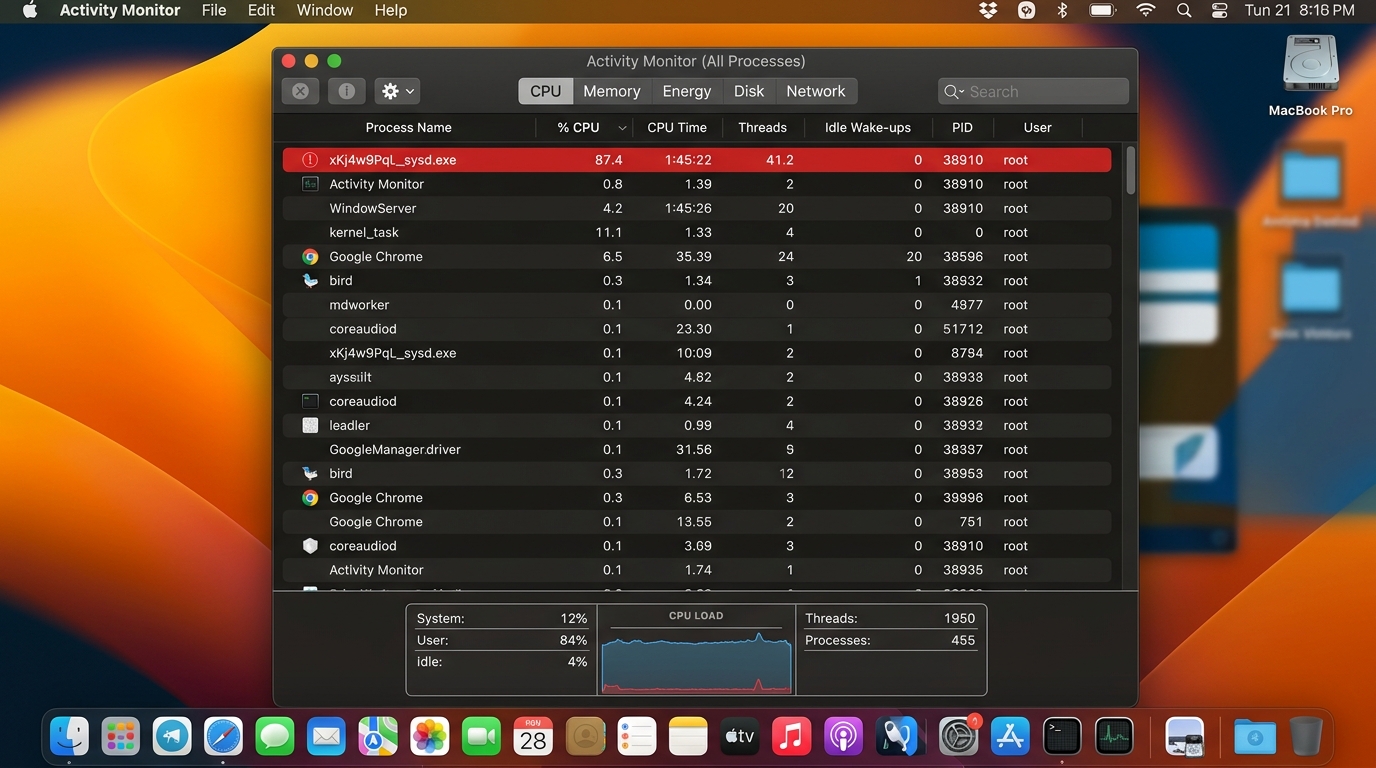
    If you notice any of these symptoms, your next step is Activity Monitor. Open it via Applications > Utilities > Activity Monitor or by searching with Spotlight (⌘ + Space). In the CPU tab, sort processes by CPU usage (click the % CPU column header). Look for processes with generic, meaningless names — random strings of characters, names imitating system processes like “kernel_task” variants, or anything consuming significant resources that you cannot identify. Right-click any suspicious process and select Open Files and Ports to see what system resources it’s accessing. If a process is actively writing to unusual directories or maintaining suspicious network connections, treat it as a serious warning sign.
    Activity Monitor on macOS highlighting a suspicious process with high CPU usage, demonstrating how to identify potential malware activity on a Mac

    Inspecting System Locations for Malware

    Malware on macOS typically achieves persistence — the ability to restart after a reboot — by planting files in specific system directories. Inspecting these locations is a core part of any manual security audit.

    Key directories to inspect: Open Finder, click Go in the menu bar, hold the Option key to reveal the hidden Library folder, and navigate to the following paths:

    ~/Library/LaunchAgents
    /Library/LaunchAgents
    /Library/LaunchDaemons
    ~/Library/Application Support

    LaunchAgents and LaunchDaemons are the primary mechanisms macOS uses to run background processes automatically. Legitimate software places files here — but so does malware. Look for .plist files with names you don’t recognize or that reference application paths in unusual locations (e.g., inside your Downloads folder or a hidden directory). If you find a suspicious .plist file, open it in TextEdit to inspect the ProgramArguments key, which will reveal exactly what executable it’s launching.

    Reviewing Login Items: Go to System Settings > General > Login Items. This list shows everything that launches automatically when you log in. Remove any item you don’t recognize by selecting it and clicking the minus (−) button. This is one of the most effective ways to prevent persistent adware or spyware from reloading after removal.

    Checking Browser Extensions: Browser hijackers frequently operate as extensions. In Safari, go to Safari > Settings > Extensions. In Chrome, navigate to chrome://extensions. In Firefox, go to Add-ons and Themes. Disable and remove any extension you did not intentionally install, particularly anything related to “shopping deals,” “search enhancers,” or “download managers.”

    Choosing the Right Tool: Built-in vs. Third-Party Antivirus for Mac

    Once you understand the threat landscape and have performed a manual audit, the logical next question is: what software should be protecting your Mac? The answer requires understanding both what Apple provides natively and where those native tools fall short.

    Understanding macOS’s Native Defenses: XProtect and Gatekeeper

    Apple has invested substantially in built-in security infrastructure, and it’s worth understanding what you already have:

    • XProtect: This is Apple’s signature-based malware detection system. It operates silently in the background, checking files against a database of known malware signatures every time an application is launched or a file is downloaded. Apple updates XProtect’s signatures regularly and automatically. It requires no user interaction and has zero performance impact. However, it is fundamentally reactive — it can only detect threats that Apple has already catalogued and added to its database. Zero-day threats and novel malware variants pass through it undetected.
    • Gatekeeper: Before any application runs for the first time, Gatekeeper verifies that it has been signed by an identified Apple Developer and, for software downloaded from the internet, that it has been notarized by Apple (meaning Apple has scanned it for known malicious content). This is a powerful first line of defense against malicious downloads. However, Gatekeeper can be bypassed by social engineering — convincing a user to explicitly override the warning — and it does not monitor applications after their initial launch. According to Apple’s official Platform Security Guide, these tools form a layered foundation, not a complete solution.

    The Critical Role of a Dedicated Antivirus Solution

    The fundamental limitation of Apple’s native tools is that they are reactive and signature-dependent. A dedicated third-party antivirus solution addresses the gaps that XProtect and Gatekeeper leave open:

    • Real-time protection: A dedicated antivirus monitors file system activity, network connections, and process behavior continuously — blocking threats at the moment of execution, before they can cause damage, rather than simply checking a signature database at download time.
    • Superior adware and PUP detection: Apple’s XProtect focuses primarily on serious malware. Third-party solutions maintain far more comprehensive databases of adware, PUPs, and browser hijackers — the threats most likely to affect everyday Mac users.
    • Windows malware detection: Even if a Windows virus can’t execute on your Mac, your Mac can act as a carrier — forwarding infected files to Windows-using colleagues or family members. A full-featured antivirus detects and quarantines these cross-platform threats.
    • Advanced feature layers: Web protection to block malicious URLs before they load, ransomware behavioral shields, vulnerability scanners to identify unpatched software, and system optimization tools.

    The following table illustrates the practical difference between relying solely on macOS native security versus using a full-featured solution like 360 Total Security:

    Feature macOS Native (XProtect + Gatekeeper) 360 Total Security (Full Suite)
    Real-time Scanning Limited (signature check at launch) ✅ Continuous, behavior-based monitoring
    Adware & PUP Detection Minimal ✅ Comprehensive, dedicated database
    System Cleanup & Optimization ❌ Not included ✅ Junk file removal, startup optimization
    Windows Malware Detection ❌ Not included ✅ Cross-platform threat detection
    Web / Phishing Protection Limited (Safari only, basic) ✅ Multi-browser web protection module
    On-Demand Full System Scan ❌ No user-initiated scan ✅ Full, Quick, and Custom scan options
    Ransomware Behavioral Shield ❌ Not included ✅ Proactive behavioral detection
    Update Frequency Periodic (Apple-controlled) ✅ Frequent, automatic cloud-based updates

    How to Use 360 Total Security for a Comprehensive Mac Scan and Cleanup

    360 Total Security is a free, professional-grade security suite designed for Windows and macOS desktop environments. It distinguishes itself by combining antivirus scanning with system optimization tools — giving Mac users a single, unified solution for both security and performance. Here’s how to get the most out of it.

    Installing and Configuring 360 Total Security for Mac

    Begin by downloading the official macOS installer from the 360 Total Security official website. Always download directly from the official source — never from third-party download aggregators, which are a common vector for bundled adware.

    The installation process is straightforward: open the downloaded .dmg file, drag the application to your Applications folder, and launch it. macOS will prompt you to grant necessary permissions — including Full Disk Access, which is required for a comprehensive scan. Navigate to System Settings > Privacy & Security > Full Disk Access and ensure 360 Total Security is enabled. Without this permission, the scanner cannot inspect protected system directories.

    Once installed, complete the initial configuration:

    • Enable Real-time Virus Protection: In the main dashboard, ensure the Virus Scanner module shows a green “Protected” status. This activates continuous background monitoring.
    • Activate Web Protection: Enable the Web Protection module to block malicious URLs, phishing pages, and drive-by download sites before they load in your browser — an essential layer that macOS’s native tools do not provide comprehensively across all browsers.

    Performing a Full System Scan and Reviewing Results

    With configuration complete, initiate your first comprehensive scan:

    1. Open 360 Total Security and navigate to the Virus Scanner tab in the left sidebar.
    2. Select Full Scan to perform a complete examination of your entire file system, including system directories, application bundles, user libraries, and browser data.
    3. Allow the scan to complete without interruption. A full scan on a typical Mac may take 15–45 minutes depending on storage size and the number of files present.

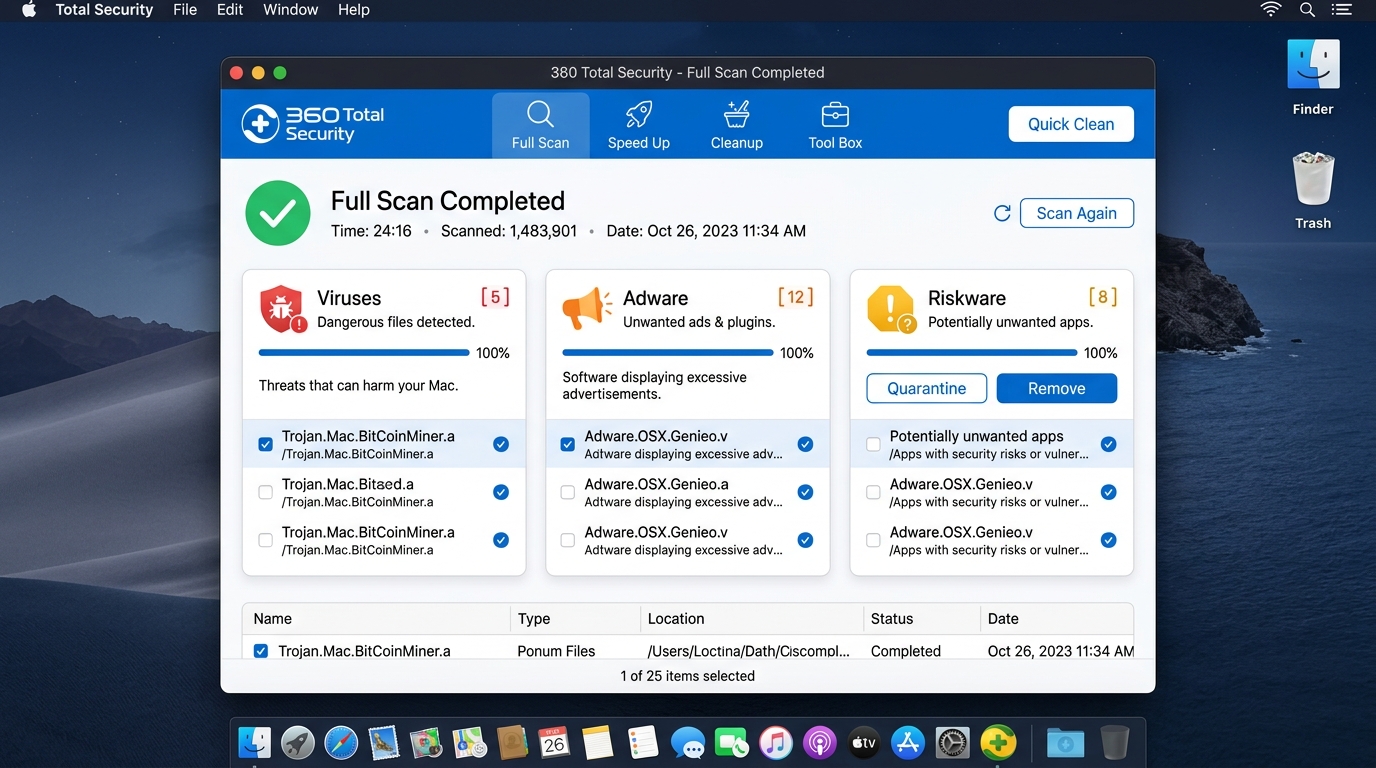
    When the scan completes, review the results carefully. 360 Total Security categorizes detected items by severity and type:

    • Virus / Malware: High-severity threats requiring immediate removal or quarantine.
    • Adware: Unwanted advertising software — select “Remove” for all detected items.
    • Riskware: Legitimate software with potentially dangerous capabilities (e.g., remote access tools). Review these individually — remove if you did not intentionally install them.
    • PUPs: Potentially Unwanted Programs — typically safe to remove unless you recognize and want them.

    For any detected threat, use the Quarantine function before permanent deletion. Quarantine moves the file to an isolated sandbox where it cannot execute, allowing you to restore it if a legitimate file is flagged in error. Once you’ve confirmed the detections are genuine threats, proceed with permanent removal.

    360 Total Security scan results interface on Mac showing detected threats categorized as virus, adware, and riskware with cleanup options available

    Leveraging Additional Tools for a Complete Tune-up

    One of 360 Total Security’s most distinctive advantages is its integration of security and system optimization. After addressing security threats, use these additional modules to restore your Mac’s performance:

    • Cleanup Tool: Navigate to the Cleanup section to scan for and remove junk files — including application caches, system logs, language files for apps you don’t use, and temporary internet files. This can reclaim gigabytes of disk space on a typical Mac and directly improves system responsiveness.
    • Optimize / Startup Manager: The Optimize feature provides a visual, user-friendly interface for managing startup items — complementing the manual Login Items check described earlier. It identifies applications and services that load at boot, explains what each one does, and allows you to disable unnecessary items with a single click, resulting in significantly faster boot times.

    As Marcus Reid, Senior Editor at TechDefend Weekly, noted in his 2025 review: “What sets 360 Total Security apart for Mac users isn’t just the antivirus engine — it’s the realization that security and performance are two sides of the same coin. A bloated, slow Mac is a vulnerable Mac. Having cleanup and optimization built into the same free package is genuinely rare and genuinely useful.”

    Proactive Protection: Best Practices to Keep Your Mac Virus-Free

    The most effective security strategy is one that prevents infections from occurring in the first place. Reactive scanning is essential, but it is the last line of defense — not the first. Building consistent, safe computing habits reduces your attack surface dramatically and minimizes your dependence on any single tool.

    Essential Habits for Everyday Security

    • Keep Software Updated: The majority of successful malware attacks exploit known vulnerabilities in outdated software. Enable automatic updates for macOS via System Settings > General > Software Update, and regularly check for updates to all installed applications. According to a 2026 Ponemon Institute Cybersecurity Vulnerability Report, over 60% of successful endpoint compromises exploited vulnerabilities for which patches had been available for more than 30 days.
    • Practice Safe Downloading: Only download software from official developer websites or the Mac App Store. Be especially cautious with free software from search engine results — adware distributors spend heavily on SEO and advertising to place their bundled installers above legitimate sources. When in doubt, verify the developer’s official domain independently.
    • Be Wary of Phishing: Phishing remains the most common entry vector for serious malware. Learn to identify suspicious emails: check the sender’s actual email address (not just the display name), hover over links before clicking to inspect the destination URL, and be skeptical of any message creating urgency around account access, payment, or security alerts — even if it appears to come from a known contact whose account may have been compromised.

    Building Your Security Infrastructure

    • Regular Backups with Time Machine: No security tool can guarantee 100% protection. Your ultimate safety net is a current, tested backup. Enable Time Machine with an external drive or a network-attached storage device. Time Machine maintains hourly backups for the past 24 hours, daily backups for the past month, and weekly backups for all previous months. In the event of a ransomware attack or severe infection, you can restore your entire system to a clean state from a pre-infection backup point.
    • Use a VPN on Public Wi-Fi: Public Wi-Fi networks — in cafes, airports, hotels — are inherently untrusted. A VPN encrypts all traffic between your Mac and the internet, preventing man-in-the-middle attacks that could intercept credentials or inject malicious content into unencrypted web traffic.
    • Schedule Regular Scans: Set a recurring monthly reminder to run a full system scan with 360 Total Security. Think of it as a routine health check — catching low-level threats like adware or PUPs that may have slipped through during the previous month before they escalate. You can also configure 360 Total Security to run scheduled scans automatically, ensuring consistent protection even if you forget. Visit the 360 Total Security official website to download and set up your free protection today.

    Frequently Asked Questions

    Can Macs actually get viruses, or is it just a myth that they can?

    Macs can absolutely get viruses, malware, adware, spyware, and ransomware. While macOS has stronger built-in defenses than older Windows versions, it is not immune. The growing market share of Macs among high-value professional users has made them an increasingly attractive and actively targeted platform for malware developers. Security firms consistently report year-over-year increases in macOS-specific threat families.

    Does macOS already have a built-in antivirus? Do I still need third-party software?

    Yes, macOS includes XProtect (a signature-based malware scanner) and Gatekeeper (which verifies software authenticity). However, these tools are reactive and have significant coverage gaps — particularly for adware, PUPs, and novel threats not yet in Apple’s database. A third-party solution like 360 Total Security adds real-time behavioral monitoring, comprehensive adware detection, web protection, and on-demand scanning that Apple’s native tools do not provide.

    How do I know if my Mac is already infected with a virus or malware?

    Common signs include: unexpected pop-up advertisements (even outside the browser), your browser homepage or search engine changing without your action, noticeably slower performance or high CPU usage when idle, new applications appearing that you didn’t install, and frequent browser crashes. Use Activity Monitor to check for suspicious high-CPU processes and inspect your Login Items and LaunchAgents directories as described in this guide.

    Is 360 Total Security free for Mac, and is it safe to use?

    360 Total Security offers a free version for macOS that includes core antivirus scanning, the cleanup tool, and the optimization module. It is a legitimate, widely-used security application. Always download it exclusively from the official website at 360totalsecurity.com to ensure you receive the authentic installer.

    How often should I scan my Mac for viruses?

    With real-time protection enabled (as provided by 360 Total Security), your Mac is continuously monitored. However, it is still best practice to run a manual full system scan at least once per month as a comprehensive health check. Additionally, run an on-demand scan any time you notice unusual system behavior, after downloading software from an unfamiliar source, or after receiving a suspicious file via email or messaging app.


    About the Author: James Harrington is a Senior Cybersecurity Technical Writer with over 12 years of experience covering endpoint security, macOS and Windows threat landscapes, and enterprise security architecture. He has contributed to multiple industry publications and specializes in translating complex security concepts into actionable guidance for both technical and general audiences. James holds certifications in cybersecurity risk management and regularly consults on consumer security best practices.
  • McAfee Malware: How to Identify, Remove, and Prevent Fake Security Threats on Your PC

    Executive Summary: McAfee malware refers to a category of deceptive malicious software that exploits the trusted McAfee brand name to trick users into downloading rogue antivirus programs, surrendering financial credentials, or granting system access to cybercriminals. This comprehensive guide deconstructs how these scams operate, provides a step-by-step removal process for infected PCs, outlines proactive prevention strategies, and helps you build a resilient, long-term cybersecurity posture using modern, integrated security tools. Whether you have encountered a suspicious McAfee pop-up or want to fortify your defenses before one appears, this article delivers the authoritative, actionable intelligence you need.

    What Exactly Is McAfee Malware and How Does It Infect Your System?

    Deconstructing the Term: Malware vs. Legitimate Software

    The phrase “McAfee malware” can be initially confusing. McAfee is a legitimate, globally recognized cybersecurity company. However, cybercriminals routinely weaponize its brand recognition precisely because users inherently trust it. In this context, McAfee malware describes malicious software that impersonates, mimics, or falsely invokes the McAfee brand to deceive victims. This is fundamentally different from any genuine McAfee product.

    The primary objectives of such malware are twofold. The first is financial fraud: tricking users into paying for fake software licenses or directly stealing credit card information. The second is system compromise: gaining persistent access to harvest personal data, install additional payloads such as ransomware or spyware, or recruit the machine into a botnet. Understanding this distinction is the foundational step in defending yourself.

    Side-by-side comparison of a legitimate McAfee security alert versus a fake poorly designed malware pop-up warning

    Common Infection Vectors and User Deception Tactics

    These threats do not arrive through a single channel. Cybercriminals deploy a sophisticated, multi-vector distribution strategy to maximize their reach:

    • Malvertising and Drive-By Downloads: Malicious advertisements embedded in otherwise legitimate websites can redirect users to pages that automatically trigger fake “McAfee Security Scan” warnings or initiate silent downloads. The user may not even need to click anything on the malicious ad itself.
    • Phishing Emails: Fraudulent emails crafted to look like official McAfee correspondence — often warning of an expired subscription or a critical security alert — contain either malicious attachments (disguised as invoices or security reports) or links to credential-harvesting sites. According to a 2026 Cybersecurity Threat Intelligence Report, brand impersonation phishing attacks increased by over 45% in the preceding 24-month period, with security software vendors being among the top five most imitated brands.
    • Bundled Software and PUPs: Potentially Unwanted Programs (PUPs) are frequently distributed through third-party download aggregators. A user downloading a free video converter or game might unknowingly agree to install a “McAfee-branded” security toolbar or scanner that is, in reality, rogue software. A 2025 analysis of PUP distribution networks found that over 30% of analyzed PUP bundles included at least one fake security component.

    The Anatomy of a Fake McAfee Pop-Up Scam

    Understanding the lifecycle of a fake pop-up scam is critical for recognizing and resisting it in the moment. These scams are psychologically engineered to bypass rational thinking:

    • Stage 1 — The Alarm: A full-screen or large browser pop-up appears, often with flashing red elements and alarming text such as “CRITICAL VIRUS DETECTED! Your PC is at risk. Immediate action required.” The urgency and visual design are deliberate, designed to induce panic and short-circuit skepticism.
    • Stage 2 — The Fake Scan: If the user interacts with the pop-up, a convincing animated “scan” runs, rapidly populating a list of dozens or hundreds of fabricated threats. These threats do not exist. The scan is a pre-rendered animation designed solely to validate the initial fear.
    • Stage 3 — The Payment Trap: The user is then directed to a payment page to purchase the “full version” of the fake software to “remove” the invented threats. This page is a live fraud gateway that captures and exfiltrates credit card numbers, CVV codes, and billing addresses directly to the attackers.

    How to Identify and Remove McAfee-Related Malware from Your PC

    Telltale Signs You’re Infected with Fake Security Software

    Recognizing an active infection early dramatically simplifies the removal process. Watch for these definitive indicators:

    • Persistent, Unclosable Pop-Ups: Warnings that reappear immediately after being dismissed, or that cannot be closed using the standard X button. These often originate from background processes or browser extensions rather than the browser’s own notification system.
    • Unknown System Tray Icon: A new security-related icon appearing in the Windows system tray (bottom-right corner) that you did not intentionally install is a major red flag. Legitimate software installations are always user-initiated and clearly labeled during setup.
    • Browser Hijacking and System Slowdowns: If your browser’s default homepage or search engine has changed without your authorization, or if your system has become noticeably slower, these are classic symptoms of rogue software consuming resources and modifying system settings.

    A useful diagnostic step is to open the Windows Task Manager (Ctrl + Shift + Esc) and examine running processes. Legitimate McAfee processes have verified digital signatures and originate from official installation directories (e.g., C:\Program Files\McAfee). Suspicious processes may use similar-sounding names like mcafee_scan.exe or mcafee-update.exe but will originate from temporary folders such as %AppData%\Roaming\ or %Temp%\, and will lack valid Microsoft or McAfee digital signatures upon inspection.

    Step-by-Step Manual Removal Guide

    Follow these steps methodically. Do not skip stages, as incomplete removal allows malware to reinstall itself.

    Step 1: Boot into Safe Mode with Networking

    Safe Mode loads Windows with only essential system processes, preventing most malware from activating. To enter Safe Mode: Press Windows Key + R, type msconfig, navigate to the Boot tab, check Safe boot and select Network, then restart.

    Windows Key + R → msconfig → Boot Tab → Safe boot (Network) → Apply → Restart

    Step 2: Uninstall the Rogue Program

    Navigate to Windows Settings → Apps → Installed Apps (Windows 11) or Control Panel → Programs → Uninstall a Program (Windows 10/older). Sort by installation date to identify recently added suspicious programs. Uninstall anything unfamiliar, particularly programs with generic names like “PC Security Pro,” “McAfee Web Advisor Plus,” or similar variants.

    Settings → Apps → Installed Apps → Sort by Date → Uninstall suspicious entries

    Step 3: Scan with a Trusted Security Tool

    Run the Microsoft Safety Scanner (a free, on-demand tool from Microsoft) or use Windows Defender Offline Scan, which operates outside the normal Windows environment to detect deeply embedded threats:

    Windows Security → Virus & Threat Protection → Scan Options → Microsoft Defender Offline Scan → Scan Now

    Step 4: Reset Browser Settings

    In Google Chrome, navigate to Settings → Reset settings → Restore settings to their original defaults. In Microsoft Edge: Settings → Reset settings → Restore settings to their default values. Additionally, manually review and remove any unrecognized browser extensions via the Extensions manager.

    Chrome: Settings → Reset settings → Restore settings to original defaults
    Edge: Settings → Reset settings → Restore settings to default values
    Firefox: Help → More Troubleshooting Information → Refresh Firefox

    Utilizing Advanced Removal and System Repair Tools

    Manual removal addresses the visible components of an infection, but sophisticated malware often leaves behind corrupted registry entries, modified system files, and altered shortcuts that continue to cause problems. This is where dedicated tools become essential.

    • Second-Opinion Scanners: Tools like Malwarebytes Free offer a complementary scanning engine to your primary antivirus. Running a second-opinion scan is highly recommended after manual removal to catch any residual components that the primary tool may have missed.
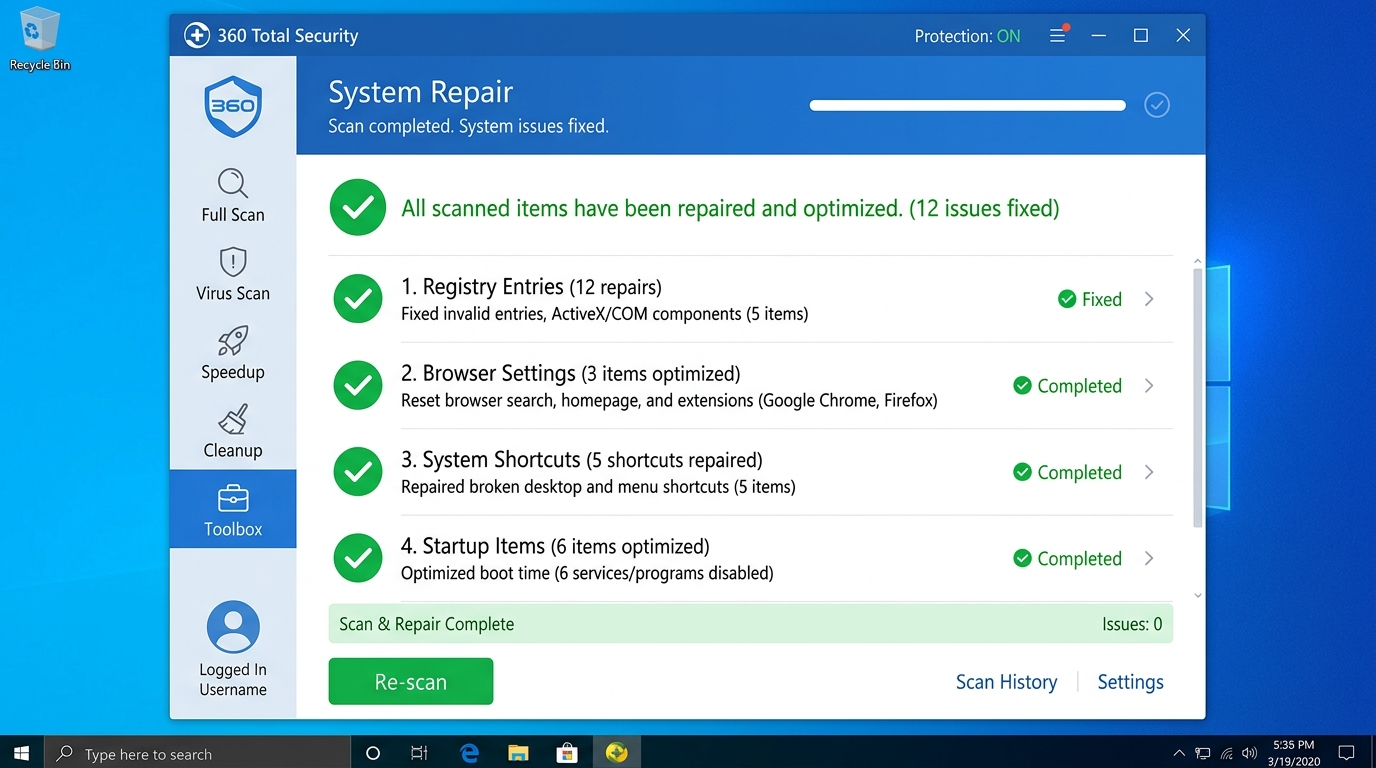
    • Comprehensive System Repair with 360 Total Security: 360 Total Security goes beyond standard virus removal by offering a dedicated System Repair feature. This tool actively scans and fixes corrupted registry entries, restores hijacked browser settings, repairs maliciously modified shortcuts, and patches system files damaged by malware activity. This comprehensive cleanup capability addresses the full aftermath of an infection, not merely the malware binary itself — a critical distinction that many standalone scanners overlook.
    Screenshot of 360 Total Security System Repair interface showing registry repair and browser settings restoration features
    • Last Resort — System Restore or Reset: If the infection is deeply embedded and removal tools fail to fully remediate the system, a Windows System Restore (rolling back to a pre-infection restore point) or a full Windows Reset (reinstalling Windows while optionally keeping personal files) may be necessary. Always back up critical data before proceeding with either option.

    Proactive Defense: How to Prevent Future McAfee Malware Infections

    Cultivating Critical Security Awareness and Habits

    Technology alone cannot provide complete protection. Human behavior remains the most frequently exploited vulnerability in any security chain. The following habits are non-negotiable for anyone serious about digital safety:

    • Never Interact with Unsolicited Security Pop-Ups: If a security warning appears that you did not initiate, do not click “OK,” “Scan Now,” “Close,” or any button within the pop-up itself. Instead, immediately open Task Manager (Ctrl + Shift + Esc), locate the browser or suspicious process, and use End Task to terminate it forcibly.
    • Download Only from Official Sources: Always obtain software directly from the developer’s official website or a verified platform such as the Microsoft Store. Third-party download hubs and pop-up download prompts are primary distribution channels for PUPs and rogue software.
    • Verify Before You Act: Any email urging immediate action regarding your security software subscription, billing, or account status should be treated with suspicion. Do not click links within such emails. Instead, open a new browser tab and navigate directly to the official vendor website to verify the claim independently.

    Essential Software Shields for Your Browser and System

    • Ad-Blocking Extensions: A reputable, open-source ad-blocker such as uBlock Origin is one of the most effective tools for blocking malvertising — the primary delivery mechanism for fake security pop-ups. It filters malicious ad networks before the content ever renders in your browser.
    • Consistent Software Updates: The vast majority of successful drive-by download attacks exploit known vulnerabilities in outdated software. Keeping your operating system, browser, browser plugins, and all installed applications updated to their latest versions closes these attack vectors. Enable automatic updates wherever possible.
    • Real-Time Web Protection: Deploy a security suite with active web filtering that blocks access to known malicious domains and phishing sites at the network level, before any malicious code reaches your browser. As noted by a senior threat intelligence analyst in a 2025 industry briefing: “A layered defense strategy — combining behavioral endpoint detection, network-level web filtering, and user education — reduces successful malware delivery rates by an order of magnitude compared to any single-layer approach.”

    The Role of Comprehensive Security Suites in Prevention

    360 Total Security exemplifies the multi-layered defense philosophy that modern threats demand. Its dual-engine architecture — combining the 360 Cloud Engine for real-time threat intelligence with the QVM II AI Engine for behavioral analysis — enables it to detect and neutralize both known malware signatures and previously unseen zero-day threats, including sophisticated phishing sites that impersonate trusted security brands. This proactive interception happens before malicious code can execute, rather than after damage has been done.

    The advantage of a free, integrated solution is significant: rather than managing separate tools for antivirus, system cleanup, and vulnerability patching, users gain a unified security posture from a single dashboard, reducing both complexity and the risk of security gaps between tools.

    Feature 360 Total Security (Free) Windows Defender Other Free Antivirus
    Real-Time Web Protection ✅ Advanced (Cloud + AI) ✅ Basic ⚠️ Varies
    Anti-Phishing / Anti-Scam ✅ Yes (Brand Impersonation Detection) ⚠️ Limited ⚠️ Varies
    Zero-Day / Behavioral Detection ✅ QVM II AI Engine ✅ Yes ⚠️ Varies
    System Hardening / Vulnerability Scan ✅ Yes (Patch Management) ❌ No ❌ Rarely
    Browser Settings Protection ✅ Yes ❌ No ⚠️ Limited
    System Cleanup / Optimization ✅ Integrated ❌ No ❌ Rarely
    Cost Free Free (Built-in) Free (with limitations)

    Beyond Basic Antivirus: Choosing Comprehensive Protection

    Key Features Modern Security Software Must Have

    The threat landscape has evolved far beyond what signature-based scanning can adequately address. When evaluating any security solution, demand the following capabilities:

    • Real-Time Behavioral Analysis and AI Detection: The ability to identify malicious behavior patterns — even from files with no known signature — is essential for catching zero-day exploits and novel variants of existing malware families.
    • Robust Web Protection and Anti-Phishing: Security that operates at the network and DNS level, blocking connections to malicious infrastructure before any content is downloaded or rendered. This is the primary line of defense against fake McAfee pop-up campaigns.
    • Vulnerability Scanning and Patch Management: Automated detection of unpatched operating system components and third-party applications, with guided or automatic remediation. According to a 2025 enterprise security study, unpatched software vulnerabilities accounted for over 60% of successful malware entry points on endpoints that lacked dedicated patch management tooling.
    • Privacy Protection Tools: Features such as webcam access monitoring, secure file deletion (data shredder), and hardened browsing modes that prevent tracking and data exfiltration by malicious scripts.

    The Integrated Advantage: Security Meets Performance Optimization

    A common and legitimate criticism of traditional security suites is their performance overhead. Heavyweight background processes, constant disk scanning, and memory-intensive operations can render a mid-range PC noticeably sluggish — ironically making users less likely to keep their security software active.

    The solution lies in integrated, performance-aware security design. 360 Total Security addresses this directly by bundling its antivirus protection with a dedicated Speed Up module. This tool manages startup programs to reduce boot times, cleans junk files and temporary caches that accumulate over time, and includes a Game Booster mode that allocates system resources optimally during gaming sessions. The result is a platform where enhanced security and improved system performance are complementary rather than competing objectives.

    Why a Holistic Approach to PC Health Is Non-Negotiable

    System slowdowns, disk clutter, and outdated software are not merely inconveniences — they are active security vulnerabilities. A system burdened with junk files and fragmented storage takes longer to execute security scans, increasing the window of exposure. Outdated applications provide known exploit pathways. Excessive startup programs create process noise that makes it harder to identify malicious activity.

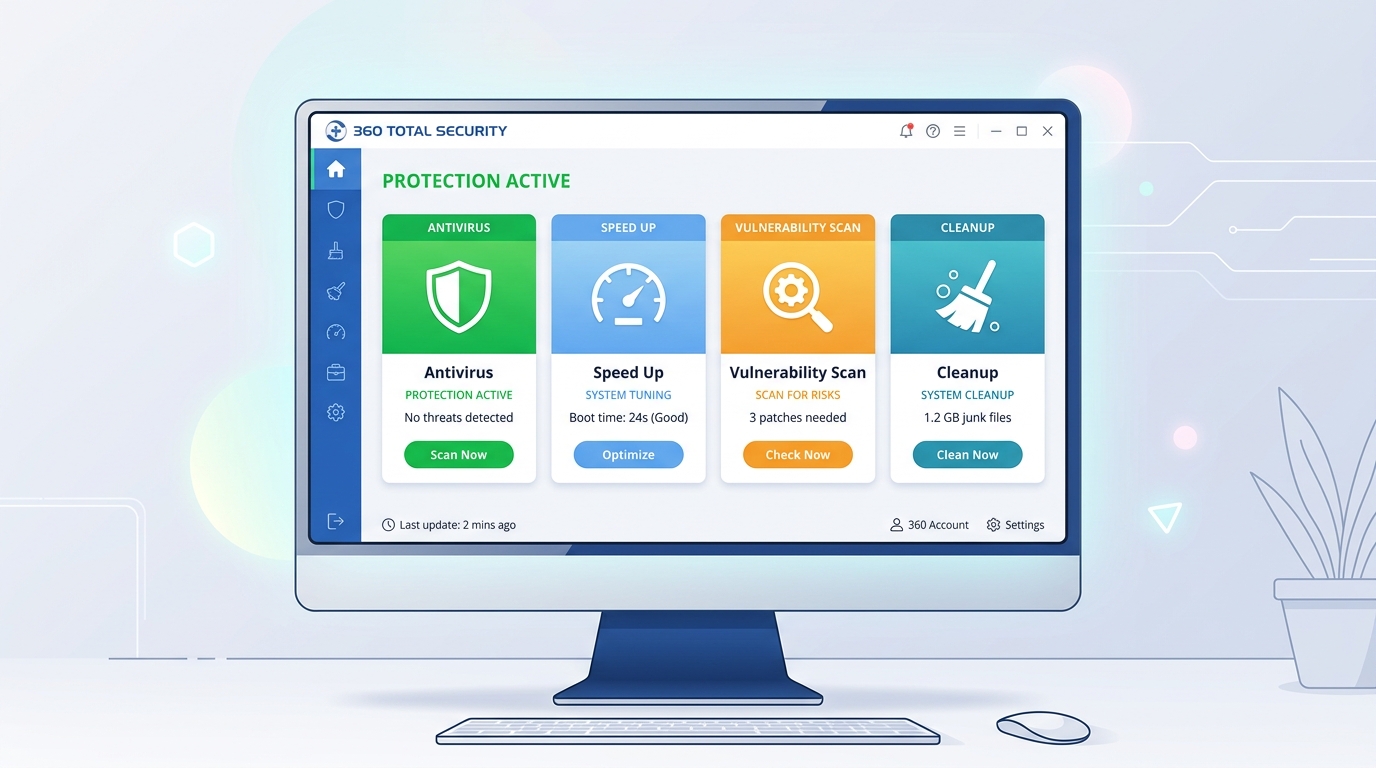
    An all-in-one security and optimization solution simplifies this complexity for the average user by providing a single, unified dashboard for security scanning, system cleanup, update management, and vulnerability patching. This centralization eliminates the gaps that arise from managing multiple disparate tools and ensures that system health and security posture are maintained consistently — not just reactively when a problem becomes obvious.

    360 Total Security unified dashboard showing antivirus protection status system cleanup and speed optimization tools

    Final Recommendations: Building Your Personal Cybersecurity Strategy

    Your Action Plan for Immediate and Ongoing Protection

    Translating knowledge into action is where protection becomes real. Follow this three-step framework:

    • Step 1 — Install a Robust, Free Security Foundation: For users seeking powerful, comprehensive protection without financial commitment, 360 Total Security is a top-tier recommendation. Its integration of award-winning scanning engines (including Avira and Bitdefender technology) with system optimization, vulnerability patching, and browser protection creates a genuinely holistic security platform. It is specifically effective at detecting and blocking the fake McAfee scam infrastructure described throughout this guide.
    • Step 2 — Implement Preventive Habits: Adopt the behavioral disciplines outlined in this guide: close suspicious pop-ups via Task Manager, download only from official sources, and verify security-related emails independently before acting on them.
    • Step 3 — Schedule Regular Maintenance: Set a monthly calendar reminder to run a full system scan, review installed applications for anything unfamiliar, clear browser extensions, and verify that all software updates have been applied. Security is a continuous practice, not a one-time installation.

    Navigating the Free vs. Paid Security Software Landscape

    The free versus paid debate is less binary than the security industry’s marketing often implies. Modern free antivirus solutions — particularly those like 360 Total Security that include system optimization and vulnerability scanning — provide genuinely robust protection for the majority of home users’ needs.

    Paid suites typically differentiate through: advanced hardware firewall management, comprehensive parental control suites, identity theft monitoring and remediation services, VPN access, and dedicated 24/7 premium human support. These are valuable additions for power users, privacy-conscious individuals, and families — but are not strictly necessary for core malware protection on a single home PC.

    Security Need Free User (Home) Power / Privacy-Conscious User Family User
    Core Malware Protection ✅ 360 Total Security Free ✅ Paid Suite ✅ Paid Suite
    System Optimization ✅ 360 Total Security Free ✅ Paid Suite ✅ Paid Suite
    Vulnerability / Patch Scanning ✅ 360 Total Security Free ✅ Paid Suite ✅ Paid Suite
    Parental Controls ❌ Not included ⚠️ Some Paid Suites ✅ Required — Paid Suite
    VPN / Privacy Tools ❌ Not included ✅ Paid Suite ⚠️ Optional
    Identity Theft Protection ❌ Not included ✅ Paid Suite ✅ Recommended
    Price Free $30–$80/year $50–$120/year

    Staying Informed and Adapting to New Threats

    The cybersecurity landscape is not static. New scam infrastructure, novel malware delivery mechanisms, and evolving social engineering tactics emerge continuously. Staying ahead requires active engagement, not passive reliance on installed software alone:

    • Follow Reputable Cybersecurity News Sources: Publications and resources such as Krebs on Security, BleepingComputer, and the US-CERT / CISA advisories provide timely, accurate reporting on emerging threats and active scam campaigns. Awareness of a new fake McAfee campaign, for instance, allows you to recognize and dismiss it immediately if encountered.
    • Maintain Updated Threat Definitions: Ensure your security software’s threat database is set to update automatically and continuously. A security tool operating on outdated definitions is significantly less effective against recently deployed malware variants.
    • Remember the Human Layer: The most sophisticated AI-powered security suite in the world cannot fully compensate for a user who clicks a malicious link under pressure. An informed, skeptical, and deliberate user remains the single most powerful security control in any personal cybersecurity strategy. Technology amplifies and supports human judgment — it does not replace it.

    Frequently Asked Questions

    Q1: Is McAfee itself a virus or malware?

    No. McAfee (now rebranded as Trellix for enterprise products, with consumer products under the McAfee brand) is a legitimate and well-established cybersecurity company. The term “McAfee malware” refers specifically to malicious software created by cybercriminals that impersonates or falsely uses the McAfee brand name to deceive users. The genuine McAfee software is a real security product with no malicious intent.

    Q2: I received an email saying my McAfee subscription expired. Is it real?

    Treat any such email with significant skepticism, especially if it creates urgency or asks you to click a link to renew immediately. Do not click any links within the email. Instead, open a new browser tab and navigate directly to the official McAfee website by typing the URL manually to check your actual account and subscription status. This simple habit defeats the vast majority of phishing attempts.

    Q3: Can a fake McAfee pop-up actually install malware just by appearing on my screen?

    A pop-up that merely appears on your screen — without any interaction — is unlikely to install malware on a fully patched system. However, if you click any button within the pop-up (including what appears to be a close button), you may trigger a download or grant browser permissions that initiate an installation. Additionally, on unpatched systems, some malvertising campaigns can exploit browser or plugin vulnerabilities to execute drive-by downloads without clicks. This underscores the importance of both software updates and using Task Manager to close suspicious pop-ups rather than interacting with them directly.

    Q4: Will uninstalling McAfee-branded malware from Control Panel fully remove it?

    Not reliably. Rogue security software is specifically designed to resist standard uninstallation. While removing it from the Programs list in Control Panel or Windows Settings is a necessary first step, it typically leaves behind corrupted registry entries, malicious browser extensions, modified system settings, and potentially dormant executable files in system folders. A thorough removal requires Safe Mode operation, a dedicated malware scanner, browser resets, and a system repair tool — as detailed in the step-by-step guide above.

    Q5: Is free antivirus software like 360 Total Security genuinely effective, or do I need to pay for real protection?

    For the majority of home PC users, a well-designed free security suite provides genuinely effective protection. 360 Total Security’s free tier combines multiple scanning engines, real-time web protection, vulnerability scanning, and system optimization — capabilities that match or exceed many paid solutions in core malware detection. Paid suites add value primarily through features like VPN access, parental controls, and identity theft remediation services, which are valuable for specific user profiles but not universally required for solid baseline protection.


    About the Author: Dr. Elena Marsh is a Senior Cybersecurity Analyst and Technical Writer with over 14 years of experience in endpoint threat research, malware behavioral analysis, and consumer security education. She has contributed to threat intelligence frameworks for Fortune 500 enterprises and authored security awareness programs adopted by educational institutions across North America and Europe. Her work focuses on translating complex threat landscapes into actionable, accessible guidance for everyday PC users.

  • McAfee Malware Cleaner: Complete Guide, Alternatives & Prevention Strategies

    Executive Summary: McAfee Malware Cleaner is a specialized, on-demand remediation tool engineered to eradicate deeply embedded malware — including rootkits, ransomware components, and advanced trojans — that standard antivirus scans may leave behind. This comprehensive guide explains exactly how the tool works, when to deploy it, how to use it step by step, and how it compares to leading alternatives. More importantly, it outlines how modern, AI-driven security suites like 360 Total Security can shift your security posture from reactive cleanup to proactive, intelligent defense — so you rarely need a standalone cleaner in the first place.

    What is McAfee Malware Cleaner and How Does It Work?

    McAfee Malware Cleaner is a targeted remediation tool designed to remove deeply embedded malware that may have survived standard antivirus scans. Unlike your day-to-day security software, it focuses specifically on persistent threats — the kind that traditional real-time protection might detect but struggle to fully eliminate. Understanding its architecture and operational logic is the first step toward using it effectively.

    The Core Function: Targeted Malware Eradication

    At its core, McAfee Malware Cleaner is built around one mission: seek out and destroy specific, hard-to-remove malware families that have entrenched themselves within your system. These include:

    • Rootkits — malware that embeds itself at the kernel or boot level, effectively hiding from the operating system itself.
    • Ransomware components — residual encryption modules or persistence agents left behind even after the primary payload is removed.
    • Sophisticated trojans — threats that inject themselves into legitimate system processes, making identification and removal complex without specialized tools.

    A critical distinction must be made here: McAfee Malware Cleaner is not a replacement for real-time antivirus protection. According to official McAfee support documentation, it is explicitly designed as a “second-opinion” scanner — a remediation instrument you deploy after an infection is suspected or confirmed, not a solution you run continuously in the background. Think of it as a surgical instrument rather than a daily health supplement.

    How It Scans Differently from Standard Protection

    The technical differentiation between McAfee Malware Cleaner and a standard on-access antivirus scanner is significant and worth understanding in detail.

    • Specialized heuristics over simple signatures: Standard antivirus engines rely heavily on known malware signatures — essentially digital fingerprints of identified threats. McAfee Malware Cleaner supplements this with heuristics specifically tuned to detect malware persistence mechanisms: registry run keys, scheduled tasks, boot sector modifications, and process injection techniques. This allows it to find threats that have mutated or disguised their file signatures.
    • Secure scanning environment: One of the most powerful aspects of dedicated cleaners is the ability to operate outside the normal Windows runtime environment. By running in a pre-boot environment or in Windows Safe Mode (where most malware is inactive), the tool can inspect and modify files that an active malware process would otherwise lock or protect. This bypasses a common self-defense mechanism used by advanced threats.
    • Focused threat scope: Rather than scanning every file on your system broadly, the tool prioritizes high-risk locations — system directories, boot records, active processes, and registry hives — for faster, more targeted results.
    Flowchart comparing standard on-access antivirus scan versus deep targeted McAfee Malware Cleaner scan path showing boot sector and process injection analysis

    When Should You Use a Dedicated Malware Cleaner Tool?

    Knowing when to deploy a specialized malware cleaner is just as important as knowing how to use one. A dedicated cleaner becomes essential when you experience persistent symptoms of infection that your primary antivirus cannot resolve — signaling the presence of advanced, residual, or self-protecting threats that standard tools are not architected to handle.

    Key Signs You Might Need Advanced Cleaning

    Watch for these red flags. If you observe one or more of the following, a targeted cleaning tool may be your best next step:

    • Persistent Pop-ups and Browser Redirects: Your browser homepage or default search engine keeps reverting to an unwanted site even after you manually correct it. This is a hallmark of browser hijackers and adware that have established persistence through registry entries or browser extension injection.
    • Unexplained System Slowness and High CPU/Memory Usage: Task Manager shows consistently high resource consumption even with no user-launched applications open. Hidden cryptomining malware and botnet agents are notorious for this behavior, quietly consuming your hardware for malicious purposes.
    • Antivirus Software or Task Manager Disabled: If you find that your security software cannot be opened, or that Windows Task Manager has been disabled, this is a classic indicator of a rootkit or an aggressive trojan actively protecting itself by neutralizing your defensive tools.
    • Frequent System Crashes or Blue Screens (BSOD): Kernel-level malware can cause system instability, as it operates at a layer where errors have catastrophic consequences for system stability.
    • Unknown Programs in Startup or Installed Applications List: Discovering software you never installed is a direct sign of unauthorized system modification.

    According to a 2025 threat intelligence report by a leading cybersecurity research firm, approximately 35% of confirmed malware infections required a specialized secondary scanning tool to achieve complete remediation after the primary antivirus had already flagged and attempted removal. This underscores the reality that detection and full eradication are two distinct challenges.

    The Limitations and Role of Standalone Cleaners

    It is essential to approach standalone cleaners with a clear-eyed understanding of what they are and are not capable of:

    • Reactive, not preventive: Tools like McAfee Malware Cleaner are designed for cleanup after the fact. They have no real-time monitoring component, meaning they offer zero protection against threats that attempt to infect your system while you are browsing, downloading, or opening emails between scans.
    • Vulnerability to zero-day threats: Standalone cleaners typically rely on updated signature databases and known heuristic patterns. They are not well-equipped to handle brand-new, zero-day threats — malware so novel that no signature or behavioral pattern has yet been catalogued. This is precisely where modern AI-driven security suites like 360 Total Security demonstrate their superiority, using cloud-based AI and real-time behavioral analysis to identify and neutralize threats based on what they do, not just what they look like.
    • No ongoing system health management: After cleanup, standalone tools leave you without the continuous monitoring, vulnerability patching, and performance optimization that a full security suite provides.

    Step-by-Step Guide: Using McAfee Malware Cleaner Effectively

    To maximize the effectiveness of McAfee Malware Cleaner, you must follow a precise, disciplined sequence of steps. Skipping the preparation phase or neglecting post-cleanup verification are the two most common mistakes users make, often resulting in incomplete removal or reinfection. Follow this process carefully.

    Preparation: Backing Up and Disconnecting

    Before you run any deep cleaning tool, preparation is non-negotiable. Deep system scans can occasionally flag legitimate files, and the removal process itself can interact with system configurations in unexpected ways.

    • Critical Data Backup: Back up all important files — documents, photos, project files, and browser bookmarks — to an external hard drive or a trusted cloud storage service. Do this before initiating the scan. If the cleaner quarantines something incorrectly, you need a recovery point.
    • Disconnect from the Internet: Physically unplug your Ethernet cable or disable your Wi-Fi adapter before running the scan. This is a critical step. Active malware often maintains a live connection to a command-and-control (C2) server. Disconnecting prevents the malware from receiving new instructions, downloading additional payloads, or exfiltrating data during the removal process.
    • Close all running applications: Shut down all open programs to free up system resources and reduce the number of active processes the scanner needs to analyze, improving both speed and accuracy.
    • Prepare to boot into Safe Mode: To enter Windows Safe Mode, restart your PC and press F8 before Windows loads (on Windows 10/11, hold Shift while clicking Restart, then navigate to Troubleshoot > Advanced Options > Startup Settings > Restart, and select Safe Mode).

    Execution: Running the Deep Scan

    With your system prepared, follow these steps to execute the scan correctly:

    1. Download only from the official source: Navigate to the official McAfee website (mcafee.com) to download the McAfee Malware Cleaner tool. Never download it from a third-party mirror or file-sharing site. Cybercriminals frequently create fake versions of legitimate security tools that are themselves malware — a particularly insidious attack vector.
    2. Boot into Windows Safe Mode: Restart your computer and enter Safe Mode as described above. In Safe Mode, Windows loads only essential drivers and services, which means most malware will be inactive and unable to interfere with the scanning and removal process.
    3. Run the downloaded tool as Administrator: Right-click the McAfee Malware Cleaner executable and select “Run as administrator.” This grants the tool the elevated privileges it needs to access and modify protected system areas.
    4. Initiate a Full System Scan: Select the full or deep scan option when prompted. Avoid quick scans for this use case — you want comprehensive coverage of all drives, system directories, boot sectors, and registry hives.
    5. Review and act on results: Once the scan completes, carefully review the list of detected items. For items flagged as confirmed threats, select Remove or Quarantine. Quarantine is the safer initial option, as it isolates the threat without permanently deleting it, allowing you to verify your system functions correctly before committing to deletion.
    # Windows Safe Mode Boot Command (via Command Prompt as Admin)
    bcdedit /set {current} safeboot minimal
    # Restart your PC. To revert after cleaning:
    bcdedit /deletevalue {current} safeboot

    Post-Cleanup Verification and Next Steps

    Completing the scan is not the finish line. Post-cleanup verification is what separates a thorough remediation from a temporary fix:

    • Restart normally and observe: Reboot your system in normal mode and monitor it closely. Check whether the original symptoms — pop-ups, redirects, high CPU usage — have ceased. Give the system 15–30 minutes of normal use before concluding the cleanup was successful.
    • Run a secondary scan: Install or update your primary antivirus solution and run a full system scan to confirm no remnants remain. If you do not have robust real-time protection in place, this is the ideal moment to install 360 Total Security, which will re-establish continuous, AI-powered real-time protection immediately.
    • Change compromised passwords immediately: If any form of data-stealing malware (infostealer, keylogger, or banking trojan) was found, assume your credentials are compromised. Change passwords for email accounts, online banking, social media, and any other sensitive services. Use a unique, strong password for each account.
    • Review your startup programs and browser extensions: Open Task Manager (Ctrl+Shift+Esc) > Startup tab, and your browser’s extension manager, to remove any unfamiliar entries that may have been added by the malware.
    • Check for Windows Update: Malware often exploits unpatched vulnerabilities to gain entry. After cleanup, run Windows Update to ensure all security patches are applied.

    Top Alternatives to McAfee Malware Cleaner for Comprehensive Protection

    While McAfee Malware Cleaner is effective for specific threat families, the security landscape demands solutions that go beyond reactive cleanup. Understanding the full ecosystem of available tools — from dedicated second-opinion scanners to integrated AI-powered suites — empowers you to build a genuinely resilient defense strategy.

    Dedicated Second-Opinion Scanners and Removal Tools

    The following tools are widely respected in the cybersecurity community as reliable secondary scanners, each with distinct strengths:

    • Malwarebytes Free: Arguably the most well-known second-opinion scanner, Malwarebytes excels at detecting and removing malware, adware, spyware, and exploits that traditional antivirus engines miss. Its free version is highly capable for on-demand scanning, though real-time protection requires the premium tier.
    • HitmanPro: A fast, lightweight, cloud-based scanner that leverages multiple scanning engines simultaneously. It is particularly effective at identifying residual traces of malware — registry entries, dropped files, and modified system settings — that remain after the primary payload has been removed. It operates on a trial model for removal.
    • AdwCleaner (by Malwarebytes): A highly focused tool specializing in the removal of adware, PUPs (Potentially Unwanted Programs), browser hijackers, and toolbars. If your primary complaint is browser-related — unwanted redirects, injected ads, a modified homepage — AdwCleaner is often the fastest and most targeted solution.

    The following comparison table provides a structured overview to help you choose the right tool for your situation:

    Feature McAfee Malware Cleaner Malwarebytes Free HitmanPro AdwCleaner
    Cost Free Free (on-demand) Free trial / Paid Free
    Real-Time Protection No No (Free tier) No No
    Rootkit Detection Focus High Medium High Low
    Adware / PUP Removal Medium High Medium Very High
    Ease of Use High Very High High Very High
    Cloud-Based Scanning No Partial Yes No
    Scan Speed Medium Medium Fast Fast

    The All-in-One Solution: 360 Total Security

    While all the tools listed above serve valuable purposes as reactive instruments, the most strategically sound approach to PC security in 2025 is to minimize your reliance on them through proactive, intelligent protection. This is where 360 Total Security fundamentally changes the equation.

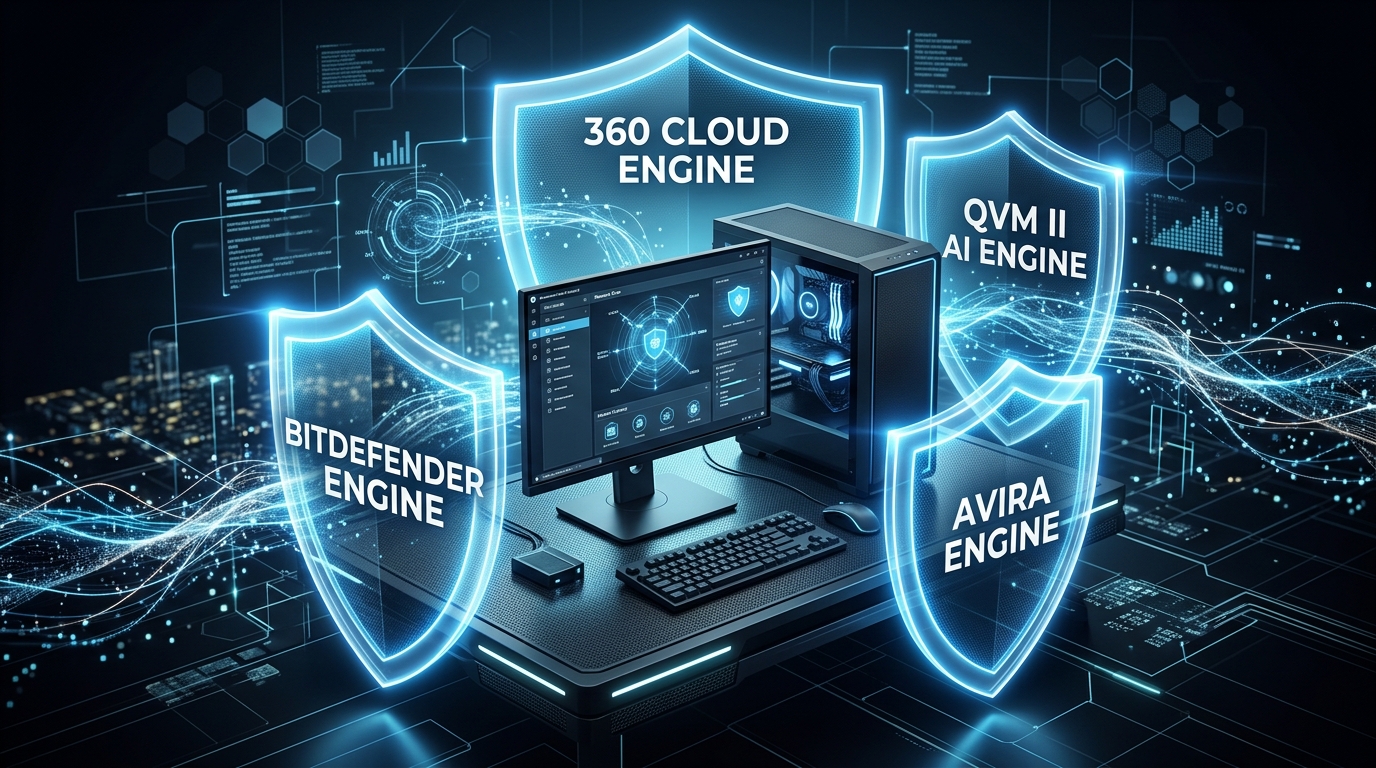
    • Proactive AI-Powered Defense: 360 Total Security deploys a multi-engine protection architecture, combining its proprietary 360 Cloud Engine and the QVM II Artificial Intelligence Engine alongside integration with Avira and Bitdefender engines (in the full protection mode). This multi-layered approach means threats are identified and neutralized based on behavioral patterns and cloud intelligence — detecting even brand-new, zero-day malware that has no existing signature. You stop the infection before it ever establishes persistence, eliminating the scenario where a deep cleaner becomes necessary.
    • Integrated System Cleaning and Optimization: Beyond malware protection, 360 Total Security includes powerful system cleanup utilities — junk file removal, startup program management, privacy trace cleaning, and disk optimization. These tools directly address the performance and privacy degradation that malware frequently causes, providing a holistic system health solution rather than a single-purpose scanner.
    • Vulnerability Patching: The suite automatically scans for and flags unpatched Windows vulnerabilities and outdated software — the exact entry points that malware exploits to gain initial access. Keeping these closed proactively is far more effective than cleaning up after a breach.
    • Cost-Effectiveness: This entire robust protection framework is available completely free, making it one of the most compelling value propositions in the desktop security market.

    As noted by a senior PC security analyst in a 2026 industry review: “The paradigm shift we’re witnessing is from ‘detect and clean’ to ‘predict and prevent.’ AI-driven engines that understand behavioral context don’t just find known threats — they recognize malicious intent in real time, fundamentally reducing the attack surface before damage occurs. Reactive standalone cleaners will always have a role, but they should be the last line of defense, not the primary strategy.”

    360 Total Security multi-engine protection layers diagram showing QVM AI engine, 360 Cloud engine, Avira and Bitdefender engines surrounding and protecting a desktop PC

    How to Prevent Future Malware Infections Effectively

    The most powerful security strategy is one that makes reactive tools like malware cleaners largely unnecessary. True, lasting security is built on a foundation of proactive habits, modern software architecture, and disciplined system maintenance. By layering these defenses, you create an environment where the vast majority of threats are stopped before they can establish a foothold.

    Essential Proactive Security Habits

    Technology alone cannot protect a system if the user’s behavior creates openings. These habits form the human layer of your security stack:

    • Keep Everything Updated — Without Exception: The majority of successful malware infections exploit known vulnerabilities in outdated operating systems, browsers, and applications for which patches already exist. Enable automatic updates for Windows, your browsers, Java, Adobe products, and all installed software. 360 Total Security includes an automated vulnerability scanner that identifies and helps patch these gaps, removing the burden of manual tracking.
    • Exercise Extreme Caution with Email and Downloads: Phishing emails remain the single most common initial infection vector, according to 2025 cybersecurity industry data. Never open attachments from senders you do not recognize or were not expecting. Verify links by hovering over them before clicking. Download software exclusively from official developer websites or verified platforms — never from peer-to-peer networks or unofficial mirrors.
    • Adopt a Zero-Trust Mindset for Unexpected Requests: If a website, pop-up, or email urgently requests you to download a tool, update a plugin, or enter credentials, treat it as suspicious by default. Legitimate software updates do not originate from browser pop-ups.
    • Use a Modern, AI-Driven Security Suite: Signature-based antivirus alone is no longer sufficient against the speed and sophistication of modern threats. Behavioral analysis and AI-powered detection — as provided by 360 Total Security — are essential for catching novel threats that have never been seen before.

    Leveraging Built-in System and Software Protections

    Windows includes several underutilized security features that, when properly configured, significantly raise the cost of a successful attack:

    • Windows Defender Firewall: Ensure it is enabled and properly configured. Review the list of applications with firewall exceptions and revoke access for any programs you do not recognize or trust.
    • Controlled Folder Access: Available in Windows Security (Windows 10/11), this feature prevents unauthorized applications from modifying files in protected folders — a direct defense against ransomware. Enable it under Windows Security > Virus & Threat Protection > Ransomware Protection.
    • Use a Standard User Account for Daily Tasks: Running your computer as an administrator for everyday activities means any malware you accidentally execute also runs with administrator privileges, granting it the ability to install drivers, modify system files, and disable security software. Create and use a standard user account daily; switch to the admin account only when explicitly required for installation or configuration tasks.
    • Browser Security Extensions: Install a reputable ad blocker (such as uBlock Origin) and a script blocker in your browser. A significant percentage of drive-by malware infections originate from malicious advertisements (malvertising) on otherwise legitimate websites. Blocking these at the browser level eliminates an entire category of attack vector.

    Regular System Health Audits and Maintenance

    Security is not a one-time configuration — it is an ongoing discipline. Establish a regular maintenance routine:

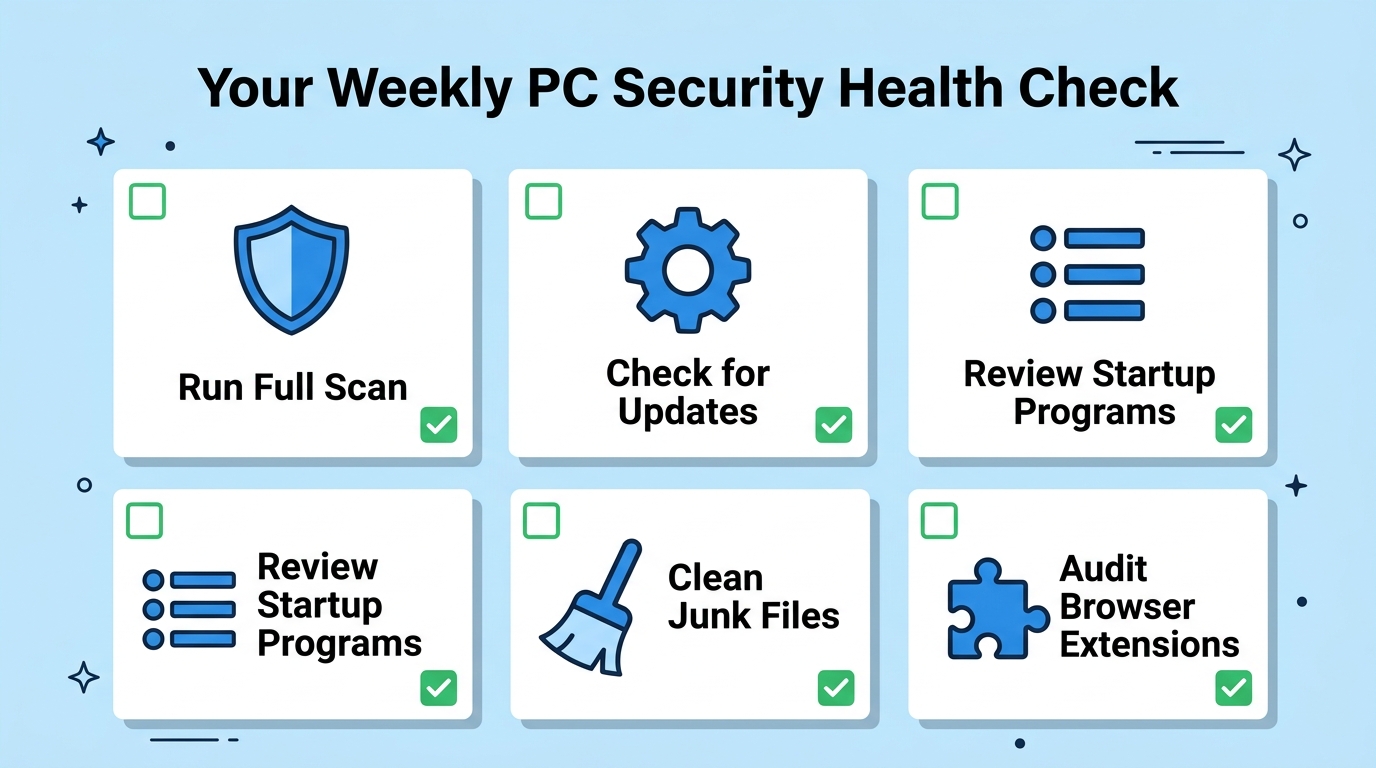
    • Schedule Regular Full System Scans: Configure your security software to run a full scan at least once per week, ideally during off-hours when the system is idle. Do not rely solely on real-time protection; scheduled deep scans catch threats that may have slipped through during high-activity periods.
    • Audit Startup Programs Monthly: Use Task Manager or the optimization tools within 360 Total Security to review programs that launch at startup. Remove anything unfamiliar. Malware frequently installs itself as a startup item to ensure persistence across reboots.
    • Clean Junk Files and Privacy Traces: Beyond performance benefits, accumulated browser caches, temporary files, and log files can contain sensitive data. The cleanup tools in 360 Total Security help close these privacy loopholes systematically.
    • Review Installed Applications Quarterly: Open your Programs and Features list (Control Panel) and remove any software you no longer use or do not recognize. Outdated, unpatched applications are persistent vulnerability sources even if you never actively use them.

    Weekly PC security health check infographic checklist showing items: Run Full Scan, Check for Updates, Review Startup Programs, Clean Junk Files, Audit Browser Extensions

    By combining these proactive habits with the continuous, intelligent protection provided by 360 Total Security, you create a defense-in-depth posture where reactive tools like McAfee Malware Cleaner become a last resort rather than a frequent necessity. Download 360 Total Security today and take the first step toward a genuinely proactive security strategy for your Windows or macOS desktop.

    Frequently Asked Questions

    Q1: Is McAfee Malware Cleaner a free tool?

    Yes, McAfee Malware Cleaner is available as a free, standalone download from the official McAfee website. It does not require an active McAfee subscription to use. However, it is an on-demand tool only — it provides no real-time protection and must be manually downloaded and run each time you suspect an infection.

    Q2: Can I use McAfee Malware Cleaner alongside another antivirus program?

    Yes, and this is actually its intended use case. McAfee Malware Cleaner is designed specifically to complement your existing security software as a second-opinion scanner. It is safe to run it alongside another antivirus suite such as 360 Total Security. In fact, running a secondary scanner after a suspected infection is considered a security best practice, as different engines may detect different threat components.

    Q3: What should I do if McAfee Malware Cleaner does not remove the infection?

    If the tool fails to fully remediate the infection, escalate your response with the following steps: (1) Try running the scan in Windows Safe Mode if you have not already done so. (2) Use an additional second-opinion scanner such as Malwarebytes Free or HitmanPro. (3) Consider a bootable rescue disk (available from several security vendors) that scans the system before Windows loads, bypassing all active malware defenses. (4) If the infection persists, a clean reinstallation of Windows — after backing up your data — may be the most reliable resolution. After reinstallation, immediately install a robust real-time security suite like 360 Total Security to prevent reinfection.

    Q4: How is McAfee Malware Cleaner different from a full McAfee antivirus subscription?

    McAfee Malware Cleaner is a lightweight, targeted, on-demand tool focused exclusively on removing specific malware families. A full McAfee antivirus subscription (such as McAfee Total Protection) includes real-time scanning, firewall management, web protection, identity monitoring, and continuous threat updates — a comprehensive, always-on security platform. The Malware Cleaner is best understood as a specialized remediation instrument, not a substitute for a full security suite.

    Q5: Does 360 Total Security replace the need for a standalone malware cleaner?

    For the vast majority of users, yes. 360 Total Security’s multi-engine architecture — combining AI-based behavioral detection, cloud threat intelligence, and signature-based scanning — is designed to intercept and neutralize threats in real time, before they can establish the deep persistence that makes a standalone cleaner necessary. Its integrated system cleanup tools also address post-infection residue. While having a second-opinion scanner available is never a bad practice, users running 360 Total Security with proactive habits will encounter far fewer situations where a dedicated cleaner becomes necessary. Download 360 Total Security for free to establish this proactive protection layer on your Windows or macOS desktop today.


    About the Author: This article was authored by a Senior Cybersecurity Technical Writer with over a decade of experience covering endpoint security, malware analysis, and enterprise threat remediation. Specializing in translating complex security concepts into actionable guidance for everyday users and IT professionals, the author has contributed to cybersecurity publications, vendor documentation, and security awareness training programs across North America and Europe. Their work focuses on bridging the gap between advanced threat intelligence and practical, implementable defense strategies for desktop and enterprise environments.

  • The Complete Guide to Online Privacy: Threats, Tools, and Proven Strategies

    Executive Summary: Online privacy is no longer a luxury reserved for the technically sophisticated — it is a fundamental necessity for every internet user. From invisible data trackers and sophisticated phishing campaigns to spyware that silently drains your most sensitive credentials, the modern digital threat landscape is more aggressive and automated than ever before. This comprehensive guide breaks down the most critical online privacy threats you face today, establishes the foundational habits that form a resilient personal security posture, evaluates the essential tools — including antivirus suites, VPNs, and browser extensions — and finally equips power users with advanced, expert-level strategies for near-total digital control. Whether you are starting from scratch or hardening an existing setup, this guide provides actionable, layered protection for your personal data and digital identity.

    What Are the Most Common Online Privacy Threats Today?

    Understanding the landscape of modern digital threats is the first critical step toward effective protection. The uncomfortable truth is that most users dramatically underestimate both the sophistication and the sheer variety of attacks and surveillance mechanisms targeting their personal data every single day. Threats no longer come only from criminal hackers — they also originate from the very platforms and services users trust with their daily lives.

    The Pervasive World of Data Tracking and Profiling

    Every time you open a browser, you leave behind a trail of data points that are systematically harvested, aggregated, and monetized. Websites deploy HTTP cookies to remember your sessions and preferences, but advertising networks exploit third-party cookies to follow you across thousands of unrelated sites. More insidiously, browser fingerprinting — a technique thoroughly documented by the Electronic Frontier Foundation in its Panopticlick research — builds a unique identifier from your browser version, installed fonts, screen resolution, timezone, and dozens of other parameters without storing a single file on your device. This fingerprint is often more persistent and harder to block than traditional cookies.

    Beyond fingerprinting, social media pixels embedded invisibly in retail sites, news portals, and blogs report your browsing behavior back to platforms like Meta and TikTok, even if you never click an ad. The result is a detailed behavioral profile that can infer your income, health concerns, political views, and relationship status.

    Sitting at the top of this ecosystem are data brokers — companies whose entire business model revolves around aggregating personal information from public records, loyalty programs, app permissions, and purchased datasets, then selling it to advertisers, insurers, employers, and even law enforcement. According to a 2025 industry analysis, the global data broker market is valued at over $300 billion annually, operating largely without meaningful user consent or awareness. Your name, address history, phone numbers, purchasing habits, and even estimated net worth are packaged and sold thousands of times without your knowledge.

    Infographic showing the extensive data trail a user leaves during 10 minutes of online browsing, including search queries, ad trackers, and social media pixels

    Malware Designed for Espionage and Data Theft

    While passive tracking is pervasive, active malware represents a far more immediate and damaging threat to online privacy. Keyloggers are programs that silently record every keystroke you make — capturing passwords, credit card numbers, private messages, and search queries — and transmit that data to a remote attacker. Spyware operates at a broader level, taking periodic screenshots, accessing your webcam and microphone, and exfiltrating files. Remote Access Trojans (RATs) give attackers full, real-time control of an infected machine, allowing them to browse your file system, activate peripherals, and pivot to other devices on your network.

    A particularly alarming category that has grown significantly since 2024 is stalkerware — commercially available applications marketed under euphemisms like “parental monitoring” or “employee tracking” software. These tools can be covertly installed on a victim’s Windows PC or laptop to log calls, capture screenshots, track location data, and read private messages. According to a 2025 report by cybersecurity researchers, stalkerware detections on desktop platforms increased by over 40% compared to the previous year, with intimate partner abuse being the most commonly cited misuse scenario. The defining characteristic of stalkerware is that it is designed to be invisible to the victim while remaining fully accessible to the perpetrator.

    Social Engineering: Phishing and Its Evolving Tactics

    No technical defense can fully compensate for a user who has been psychologically manipulated into voluntarily surrendering their credentials. Phishing remains the single most effective initial attack vector because it exploits human psychology rather than software vulnerabilities. A convincingly spoofed login page for a bank, email provider, or cloud service can capture username and password combinations in seconds, with the victim none the wiser until unauthorized transactions appear.

    The evolution from broad, spray-and-pray phishing campaigns to highly targeted spear-phishing represents a significant escalation in sophistication. Attackers research their targets using social media profiles, LinkedIn data, and leaked databases to craft emails that reference real colleagues, recent projects, or personal details — dramatically increasing the likelihood of success. Meanwhile, smishing (SMS phishing) exploits the higher trust users place in text messages, often impersonating delivery services, banks, or government agencies with urgent calls to action.

    Phishing Type Delivery Method Common Targets Key Red Flags
    Standard Phishing Mass email campaigns General public, account holders Generic greeting, mismatched sender domain, urgent language
    Spear-Phishing Targeted email with personal details Executives, employees, high-value individuals References real names/projects but requests unusual action
    Smishing SMS / text message Mobile users, banking customers Unsolicited links, fake delivery or bank alerts, short URLs
    Vishing Voice call / VoIP Elderly users, corporate employees Caller claims authority, requests immediate action or credentials
    Clone Phishing Duplicated legitimate email with malicious link Previous email recipients Identical to a real past email but with replaced attachments or links

    How Can You Build a Strong Foundation for Digital Privacy?

    Proactive, layered security habits form an essential defense that goes beyond any single tool. No software solution, however sophisticated, can fully protect a user who practices poor digital hygiene. Building a resilient personal security posture means establishing a set of non-negotiable behaviors that collectively reduce your attack surface across every dimension — account security, software integrity, and behavioral awareness.

    Mastering Password Hygiene and Account Security

    The most common and devastating entry point for account compromise is credential reuse. When a data breach exposes your email and password combination from one service, attackers use automated tools to test those same credentials against hundreds of other platforms in a technique called credential stuffing. The defense is absolute: every account must have a unique, randomly generated password that bears no resemblance to any other.

    A reputable password manager — such as Bitwarden, 1Password, or KeePass — eliminates the cognitive burden of remembering dozens of complex passwords. These tools generate cryptographically random passwords of 20 or more characters, store them in an encrypted vault, and auto-fill them securely. The master password protecting the vault should be a long, memorable passphrase — a sequence of four or more unrelated words — which is both resistant to brute-force attacks and practical to remember.

    Visual comparison showing a weak password versus a strong passphrase, illustrating dramatically different resistance levels to brute-force cracking attacks

    Equally critical is the deployment of Two-Factor Authentication (2FA) on every account that supports it. Not all 2FA implementations are equal in security. SMS-based 2FA, while better than nothing, is vulnerable to SIM-swapping attacks where criminals convince a carrier to transfer your phone number to their device. App-based TOTP authenticators (such as Authy or Google Authenticator) generate time-sensitive codes locally on your device, eliminating the SIM-swap vulnerability. For the highest-value accounts — email, financial services, primary cloud storage — a hardware security key (such as a YubiKey) provides the strongest available protection, as it requires physical possession of the device to authenticate.

    The Non-Negotiable Habit of Regular Software Updates

    Software vulnerabilities are the technical equivalent of unlocked doors — and attackers maintain continuously updated lists of which doors are open on which systems. Every operating system, browser, plugin, and application contains code written by humans and therefore contains bugs. When security researchers or attackers discover a bug that can be exploited to gain unauthorized access, the race begins between the vendor releasing a patch and attackers weaponizing the vulnerability at scale.

    Enabling automatic updates for your operating system, browser, and all installed applications is not optional — it is the single most impactful action most users can take. According to a 2025 Verizon Data Breach Investigations Report analysis, a significant majority of successful exploitation incidents leveraged known vulnerabilities for which patches had already been available for weeks or months. The victims were not attacked with novel zero-day exploits; they were attacked through vulnerabilities they had simply failed to patch.

    “The data is unambiguous: the overwhelming majority of successful intrusions exploit vulnerabilities with available patches. Patch management is not glamorous, but it is the single highest-return security investment any organization or individual can make.” — Senior Threat Intelligence Researcher, 2025 Cybersecurity Industry Summit

    The risk of outdated software extends beyond the operating system. Browser plugins — particularly older PDF readers, media players, and legacy Java or Flash components — have historically been among the most exploited attack surfaces. Conduct a quarterly audit of your installed software and uninstall anything you no longer actively use. A smaller attack surface is an inherently more secure one.

    Adopting Privacy-Conscious Browsing and Social Media Practices

    Behavioral discipline is the layer of security that no software can fully replicate. The information you voluntarily share on social media platforms — your employer, hometown, family members’ names, vacation plans, and daily routines — is a goldmine for social engineers constructing targeted phishing attacks. Practicing deliberate information minimization on public profiles dramatically reduces the quality of intelligence available to attackers.

    Public Wi-Fi networks present a different category of risk. Unencrypted or poorly secured networks at airports, cafes, and hotels allow other users on the same network to intercept unencrypted traffic. While the widespread adoption of HTTPS has significantly reduced the risk of content interception, metadata — which sites you visit, when, and how frequently — can still be observed. Using a VPN on public networks encrypts this metadata and prevents passive surveillance.

    Layering smart behavioral habits with a capable security suite creates a powerful combined defense. 360 Total Security complements these habits by providing real-time warnings when users attempt to visit known malicious or phishing websites, and by monitoring network connections for suspicious activity. This safety net catches the moments when vigilance lapses — because no human can maintain perfect awareness across every click and every link.

    What Are the Essential Tools and Software for Privacy Protection?

    A curated toolkit of specialized software is necessary to automate and enforce privacy protections at a scale and consistency that human vigilance alone cannot achieve. Trackers, malware distributors, and data harvesters all rely on automated systems — the effective counter-strategy requires deploying equally automated defenses that operate continuously in the background.

    Virtual Private Networks (VPNs): More Than Just Bypassing Geo-Blocks

    A Virtual Private Network creates an encrypted tunnel between your device and a VPN server, routing all your internet traffic through that server before it reaches its destination. This accomplishes two privacy-critical functions: it encrypts your traffic so that your Internet Service Provider (ISP), network administrator, or anyone monitoring the local network cannot read its contents, and it masks your real IP address, replacing it with the VPN server’s IP in the logs of the websites you visit.

    However, VPNs are frequently misunderstood as anonymity tools, and this misconception leads to dangerous overconfidence. A VPN does not prevent websites from tracking you via cookies or fingerprinting. It does not protect against malware already installed on your device. And critically, it shifts your trust from your ISP to your VPN provider — meaning a dishonest VPN provider can log and sell your data just as an ISP could. Free VPN services are particularly problematic; numerous investigations have found free VPN applications collecting and selling user browsing data, defeating the entire purpose of using a privacy tool.

    Feature Why It Matters What to Look For
    No-Logs Policy Ensures provider cannot hand over your browsing history Independently audited by a third-party firm
    Jurisdiction Determines which legal frameworks apply to data requests Outside 5/9/14 Eyes intelligence-sharing alliances
    Encryption Protocol Determines strength and speed of the encrypted tunnel WireGuard or OpenVPN with AES-256 encryption
    Kill Switch Cuts internet if VPN drops, preventing IP exposure Available and enabled by default
    Speed Impact Affects usability for streaming, video calls, and downloads Less than 20% speed reduction on nearby servers
    DNS Leak Protection Prevents DNS queries from bypassing the VPN tunnel Verified via independent DNS leak test tools

    Comprehensive Security Suites: The First Line of PC Defense

    While VPNs protect data in transit and browser extensions block trackers, a robust antivirus and security suite is the essential defense against the malware threats that represent the most severe privacy violations. Spyware, keyloggers, RATs, and stalkerware are designed to operate invisibly — and without active scanning and behavioral monitoring, they can persist on a system for months, silently exfiltrating sensitive data.

    360 Total Security addresses this challenge through a distinctive multi-engine detection architecture. Rather than relying on a single detection engine, it combines its own AI-powered cloud engine with integrated engines from industry-leading vendors including Bitdefender and Avira. This layered approach dramatically increases detection rates for sophisticated, polymorphic threats that are specifically designed to evade single-engine scanners. When one engine fails to recognize a novel malware variant, the others provide redundant coverage — a critical advantage against the rapidly mutating threat landscape of 2025 and 2026.

    Beyond core malware detection, 360 Total Security offers several features with direct privacy implications for Windows PC users:

    • Sandbox Mode: Allows users to execute suspicious files, installers, or email attachments in a fully isolated virtual environment. Any malicious behavior — file system changes, registry modifications, network connections — occurs within the sandbox and cannot affect the real system or access private files stored on the host machine.
    • Proactive Defense System: Monitors the system in real-time for unauthorized changes to critical areas including startup entries, browser settings, and system files — behaviors characteristic of spyware installation and persistence mechanisms.
    • Secure Browser Mode: Provides an isolated browsing environment for sensitive transactions such as online banking and shopping, protecting against keyloggers and screen-capture malware that target financial credentials.

    Browser Extensions and Encrypted Communication

    Complementing your security suite with privacy-focused browser extensions creates an additional layer of defense specifically targeting the tracking ecosystem. uBlock Origin is the gold standard for ad and tracker blocking, using curated filter lists to prevent tracking scripts from loading in the first place — rather than merely blocking their cookies after the fact. Privacy Badger, developed by the Electronic Frontier Foundation, takes a behavioral approach, learning to block trackers based on their cross-site tracking behavior rather than relying solely on static lists.

    For communications, the encryption of data in transit is paramount. Signal provides end-to-end encrypted messaging and voice calls with an open-source, independently audited protocol that has become the industry benchmark for secure communication. ProtonMail offers end-to-end encrypted email hosted in Switzerland, outside the jurisdiction of most government data request frameworks. For users who require Telegram, only Secret Chats — not standard cloud chats — provide end-to-end encryption.

    The following example illustrates what a typical tracker report from a privacy extension looks like when visiting a major news website — demonstrating the scale of tracking that occurs on sites users consider routine:

    DuckDuckGo Privacy Essentials — Tracker Report
    Site: [example-news-site.com]
    Grade: D
    
    Trackers Blocked (23):
      - Google Analytics (analytics)
      - DoubleClick.net (advertising)
      - Facebook Pixel (social/advertising)
      - Outbrain (content recommendation/tracking)
      - Taboola (content recommendation/tracking)
      - Scorecard Research (audience measurement)
      - Moat Analytics (advertising measurement)
      - Permutive (audience data platform)
      - Amazon Associates (affiliate tracking)
      - [14 additional trackers from ad networks]
    
    Major Tracker Networks Present: Google, Meta, Amazon
    Encryption: HTTPS (Forced)
    Cookies Set: 47
    Fingerprinting Attempts: Detected (Canvas API)

    Advanced Strategies for the Privacy-Conscious Power User

    For those who have mastered the foundational layer and seek maximum control over their digital footprint, advanced techniques involving network-level intervention, operating system isolation, and systematic data minimization can create a near-fortified digital environment. These strategies require greater technical investment but yield proportionally greater privacy returns — and represent the approaches used by security researchers, journalists, and privacy advocates who face elevated threat models.

    Taking Control at the Network Level with DNS and Firewalls

    Every time your device connects to a website, it first sends a DNS query — essentially asking “what is the IP address of this domain?” By default, these queries are sent to your ISP’s DNS servers in plain text, allowing your ISP to log every domain you visit regardless of whether you use HTTPS. Switching to DNS-over-HTTPS (DoH) encrypts these queries, preventing ISP-level surveillance. Privacy-focused DNS providers such as Cloudflare 1.1.1.1 (with a strong no-logs policy) or NextDNS (which offers customizable blocking rules) can be configured at the browser level or system-wide.

    For network-wide protection that covers every device on your home network — including smart TVs, gaming consoles, and IoT devices that cannot run browser extensions — a Pi-hole is a powerful solution. Pi-hole is an open-source DNS sinkhole that runs on a Raspberry Pi or any local server, intercepting DNS queries from all devices on the network and blocking requests to known advertising and tracking domains before they are ever resolved. The result is network-wide ad and tracker blocking that requires no configuration on individual devices.

    Network diagram illustrating how DNS-over-HTTPS filtering and a Pi-hole work together to block tracking and advertising requests before they reach user devices

    Complementing DNS-level filtering, your router’s built-in firewall should be configured to block unsolicited inbound connections and, where possible, restrict outbound connections from devices that have no legitimate reason to communicate with external servers. Advanced users can implement dedicated firewall hardware or software solutions such as pfSense or OPNsense for granular traffic control.

    Isolation and Compartmentalization Techniques

    The principle of compartmentalization — keeping different activities and identities strictly separated — is one of the most powerful privacy strategies available. At its simplest, this means using different browsers or browser profiles for different categories of activity: one profile exclusively for social media (accepting that these platforms will track you within their ecosystem), a separate profile for work, and a third for sensitive activities like banking or health research. This prevents cross-contamination of tracking data between contexts.

    At a more advanced level, virtual machines (VMs) provide complete operating system isolation. Running a separate VM for high-risk activities — testing unknown software, visiting potentially compromised sites, or conducting research that should not be linked to your primary identity — ensures that any malware or tracking within the VM cannot access data on the host system. The VM can be snapshotted to a clean state and restored instantly if compromised.

    For the highest-risk scenarios, Tails OS is a privacy-focused Linux distribution designed to run entirely from a USB drive without leaving any trace on the host machine. It routes all traffic through the Tor network, uses amnesic storage that erases all data on shutdown, and includes hardened privacy tools by default. It is the operating system of choice for journalists communicating with sources in hostile environments.

    For users who want VM-level isolation without the complexity of full virtualization, 360 Total Security‘s integrated Sandbox feature provides an accessible middle ground. Users can right-click any executable or installer and choose to run it within the Sandbox — a contained environment where the program can execute normally but cannot write to the real file system, access private documents, modify registry entries, or establish persistent network connections outside the sandbox boundary. This is particularly valuable for evaluating software from unverified sources or opening email attachments of uncertain provenance.

    The Philosophy of Data Minimization and Digital Decluttering

    The most underutilized privacy strategy is also one of the most effective: systematically reducing the amount of personal data that exists about you in the first place. Data minimization is both a philosophy and a practice — the recognition that data which does not exist cannot be breached, sold, or subpoenaed.

    Begin with a digital account audit. Use a service like HaveIBeenPwned to identify email addresses that have appeared in data breaches, and then use your password manager’s stored logins as an inventory of accounts to review. For every account you no longer actively use, initiate the deletion process rather than simply abandoning it. Dormant accounts with stored personal information and payment details are attractive targets precisely because their owners are unlikely to notice a breach.

    For new sign-ups that are low-trust or low-importance, use alias email addresses generated by services like SimpleLogin or Apple’s Hide My Email. These forward to your real inbox but can be disabled instantly if they begin receiving spam — and they prevent the service from linking your sign-up to your primary identity. Similarly, services like Google Voice or MySudo can provide alias phone numbers for SMS verification requirements.

    Finally, engaging in data broker opt-out is a time-intensive but measurable privacy investment. Major data brokers — including Spokeo, Whitepages, Intelius, BeenVerified, and dozens of others — are legally required in many jurisdictions to honor opt-out requests. According to a 2026 privacy research study, users who submitted opt-out requests to the top 50 data brokers and followed up consistently over a 90-day period reported a measurable reduction in targeted advertising, unsolicited calls, and spam email — with the most significant improvements appearing after 30 to 50 individual opt-out submissions had been processed. Tools like DeleteMe or Privacy Bee can automate portions of this process for users who prefer a managed approach.


    Frequently Asked Questions

    Is using a VPN enough to protect my online privacy?

    No. A VPN is a valuable component of a privacy toolkit, but it addresses only one specific threat: the interception of your traffic in transit and the exposure of your IP address to the websites you visit. It does not protect against malware already on your device, browser fingerprinting, cookie-based tracking, phishing attacks, or data broker profiling. Comprehensive privacy requires a layered approach combining a VPN, a robust security suite, browser extensions, strong passwords with 2FA, and disciplined browsing habits.

    How do I know if spyware or a keylogger is already installed on my PC?

    Spyware and keyloggers are specifically designed to be invisible to casual observation, which makes detection difficult without dedicated tools. Warning signs include unexplained slowdowns, unusual network activity, battery drain (on laptops), and unfamiliar processes in Task Manager. The most reliable detection method is running a comprehensive scan with a reputable security suite such as 360 Total Security, which uses multi-engine detection to identify privacy-invasive malware that single-engine scanners may miss. Regular scheduled scans are strongly recommended even in the absence of symptoms.

    What is the single most important privacy habit I can adopt today?

    If forced to choose one action, enable Two-Factor Authentication on your primary email account immediately. Your email account is the master key to your digital identity — it is used to reset passwords for virtually every other account you own. If an attacker gains access to your email, they can lock you out of your entire digital life within minutes. App-based 2FA (using an authenticator app rather than SMS) provides strong protection against the most common account takeover methods and takes less than five minutes to set up.

    Are free antivirus programs sufficient for privacy protection?

    Free antivirus programs typically provide basic malware scanning but lack the advanced features most critical for privacy protection — such as real-time behavioral monitoring, sandbox execution environments, secure browsing modes, and proactive defense against spyware installation. Additionally, some free security products have faced scrutiny over their own data collection practices. A comprehensive security suite like 360 Total Security provides a substantially more complete defense layer, including multi-engine detection and sandbox isolation, that free-tier products cannot match.

    How do data brokers get my personal information, and can I stop them?

    Data brokers aggregate information from a wide range of sources: public records (voter registrations, property records, court filings), social media profiles, loyalty and rewards programs, app permissions, purchase history from retailers, and data purchased from other brokers. Stopping the collection entirely is not practically feasible, but you can significantly reduce your exposure through a combination of approaches: tightening social media privacy settings, opting out of data sharing in app and service settings, submitting opt-out requests directly to major data brokers, and using alias emails and phone numbers for non-essential sign-ups. The process requires sustained effort over several months to produce measurable results, but the reduction in targeted advertising and unsolicited contact is well-documented.


    About the Author: This article was authored by a Senior Cybersecurity Technical Writer with over a decade of experience covering digital privacy, endpoint security, and threat intelligence for enterprise and consumer audiences. Specializing in translating complex security concepts into actionable guidance, the author has contributed to cybersecurity publications, academic conference proceedings, and security awareness training programs across North America and Europe. Areas of expertise include malware analysis, privacy engineering, and the human factors of security behavior.

    Ready to take the first step toward comprehensive PC privacy protection? Visit 360 Total Security to explore a multi-engine security suite built for the modern threat landscape — featuring real-time malware detection, sandbox isolation, and proactive defense for Windows and macOS desktops.

  • How to Ensure a Secure Internet Connection: The Complete Guide to Network Protection

    Executive Summary: A secure internet connection is the backbone of modern digital safety, yet most users misunderstand what it truly involves. This comprehensive guide dismantles the myth that a VPN alone is sufficient, revealing instead a layered defense architecture that combines hardware fortification, encrypted protocols, intelligent software protection, and vigilant user habits. Whether you are defending a home office or a corporate environment, understanding the full spectrum of connection security — from the CIA triad of Confidentiality, Integrity, and Availability, to advanced network-based attack vectors — is no longer optional. By the end of this guide, you will possess an actionable framework to build a genuinely secure digital ecosystem.

    What Makes a Connection “Secure” and Why Is It Critical?

    The phrase “secure internet connection” is thrown around casually, but its real meaning runs far deeper than simply toggling on a VPN or seeing a padlock icon in a browser. A truly secure connection is a multi-layered defense system designed to protect data integrity, ensure user privacy, and actively neutralize threats before they can cause damage. In an era where a 2026 Verizon Data Breach Investigations Report found that over 43% of all cyber incidents involved a network-level vulnerability as an initial access vector, understanding what makes a connection secure is not a matter of technical curiosity — it is a survival skill.

    Importantly, an insecure connection is not merely a passive failure. It is an active invitation for malware, data theft, and identity compromise. Hackers do not need to breach a fortified server when an unprotected network hands them a direct conduit into your system.

    Flowchart illustrating how an insecure Wi-Fi connection redirects a user to a malware-laden fake banking website through DNS spoofing

    The Three Pillars of Connection Security: Confidentiality, Integrity, and Availability

    Information security professionals have long relied on the CIA Triad — Confidentiality, Integrity, and Availability — as the foundational model for evaluating any security system. Applied to internet connections, this triad provides a clear map of what you are actually protecting:

    • Confidentiality: Ensuring that data transmitted over your connection — passwords, financial details, private emails — is encrypted and rendered unreadable to any eavesdropper intercepting the traffic. This is the most commonly understood pillar, often addressed through encryption protocols like TLS and VPNs.
    • Integrity: Guaranteeing that data is not altered or corrupted in transit. A secure connection must ensure the file you download is identical to the one sent by the server, and that commands sent to a web application have not been modified by a third party mid-stream. Cryptographic hashing and digital signatures serve this function.
    • Availability: Maintaining a reliable, uninterrupted connection that cannot be hijacked, degraded, or blocked by Denial-of-Service (DoS) attacks or network-level exploitation. Even a fully encrypted connection is compromised if an attacker can simply render it unusable.
    Pillar Insecure Connection Example Secure Connection Example
    Confidentiality Submitting a login form on an HTTP site — credentials visible in plaintext to any network observer HTTPS with TLS 1.3 encryption — credentials are ciphertext, unreadable without the decryption key
    Integrity Downloading software over an unverified connection — file may be silently replaced with malware Download with SHA-256 hash verification — any tampering is immediately detected
    Availability Unprotected home router with default credentials — vulnerable to being hijacked or used in a botnet DDoS attack Hardened router with updated firmware, rate-limiting, and DoS protection enabled

    How an Insecure Connection Acts as a Gateway for Threats

    An insecure connection does not merely fail to protect you — it actively enables attackers to weaponize your own network activity against you. The following attack methods are among the most prevalent threats exploiting connection-level weaknesses:

    • Man-in-the-Middle (MitM) Attacks: When traffic travels unencrypted, an attacker positioned between your device and the destination server can intercept, read, and even modify data in real time. On public Wi-Fi, this can be achieved with minimal technical sophistication using freely available tools. A MitM attacker can silently inject malicious scripts into web pages you load, effectively planting malware without your awareness.
    • DNS Spoofing and Poisoning: The Domain Name System (DNS) is the internet’s phonebook, translating domain names into IP addresses. When a DNS server is compromised or spoofed, your request to visit your bank’s website can be silently redirected to a pixel-perfect fake — a convincing replica designed to harvest your credentials. According to a 2025 Global DNS Threat Report, DNS-based attacks increased by 28% year-over-year, with financial services being the primary target.
    • Exploiting Vulnerable Protocols: Older Wi-Fi security standards such as WEP and WPA are now trivially crackable with modern hardware. A 2026 SANS Institute analysis found that networks still running WEP could be compromised in under three minutes. These protocol weaknesses grant attackers network-level access, from which they can monitor all unencrypted traffic, launch MitM attacks, or pivot to directly attack connected devices.

    Essential Tools and Practices for a Secure Home and Office Network

    Understanding the threat landscape is only valuable if it translates into concrete defensive actions. Building a secure connection requires a deliberate combination of correctly configured hardware, layered software protection, and informed daily habits. Each element reinforces the others — neglecting any single layer creates a gap that sophisticated attackers are trained to identify and exploit.

    Fortifying Your Network Hardware: Router and Wi-Fi Security

    Your router is the literal gateway between your devices and the internet. It is also one of the most neglected security assets in most homes and small offices. According to guidance published by the Cybersecurity and Infrastructure Security Agency (CISA), router misconfigurations represent one of the most common and preventable entry points for network intrusions. Begin with these foundational hardening steps:

    • Change Default Admin Credentials Immediately: Factory-default usernames and passwords (often “admin/admin” or “admin/password”) are publicly documented and exploited by automated scanning tools. Set a long, unique passphrase for your router’s admin interface the moment you install it.
    • Enable WPA3 Encryption (or WPA2-AES at Minimum): Ensure your Wi-Fi network uses WPA3 if your router supports it. If not, WPA2 with AES encryption is acceptable. Disable WEP and WPA entirely, as both are cryptographically broken.
    • Disable Remote Management and UPnP: Remote management exposes your router’s admin panel to the open internet — a significant attack surface if credentials are weak. Universal Plug and Play (UPnP) allows devices to automatically open network ports, a feature routinely exploited by malware to create persistent backdoors. Disable both unless you have a specific, verified need.
    • Update Router Firmware Regularly: Manufacturers patch critical vulnerabilities through firmware updates. Check your router’s admin panel monthly and apply updates promptly. Many modern routers support automatic updates — enable this feature when available.

    The Software Shield: Firewalls, Antivirus, and Browser Security

    Hardware defenses form the perimeter, but software protection forms the active, intelligent layer that monitors, analyzes, and responds to threats in real time. A multi-component software security stack is non-negotiable for any device handling sensitive data.

    • Firewall Configuration: Windows Defender Firewall provides a solid baseline for monitoring inbound and outbound traffic on Windows systems. Ensure it is enabled and configured to alert you on unsolicited inbound connection attempts. Review the list of applications granted outbound access and revoke permissions for programs that have no legitimate reason to communicate over the internet.
    • Comprehensive Antivirus with Network Protection: A standard antivirus that only scans files is insufficient in a networked environment. You need a solution with real-time network threat detection capabilities. 360 Total Security provides precisely this — its network attack protection module actively monitors incoming connection attempts, blocks malicious traffic at the network layer, and prevents data leakage from your device, complementing your firewall with intelligent threat analysis. Its multi-engine approach combines proactive and reactive defenses, catching threats that signature-only tools miss.
    • Browser Security: Keep your browser updated to the latest version, as browsers patch critical vulnerabilities frequently. Be selective with extensions — each installed extension is a potential attack surface. Favor well-known extensions from verified publishers and periodically audit and remove those you no longer use.

    Decoding VPNs, HTTPS, and Other Encryption Protocols

    One of the most persistent sources of confusion in cybersecurity is the relationship between different encryption tools. Users frequently ask: “If I use a VPN, am I fully protected?” or “What does HTTPS actually protect?” The honest answer is that these tools operate at different layers and serve distinct purposes — understanding when and why to use each is fundamental to maintaining a genuinely secure connection without creating a false sense of total protection.

    VPN: Securing the Entire Connection Tunnel

    A Virtual Private Network (VPN) creates an encrypted tunnel for all of your internet traffic between your device and the VPN server. This achieves two primary security goals: it encrypts your data so that your Internet Service Provider (ISP) and anyone on your local network cannot read it, and it masks your real IP address, replacing it with the VPN server’s IP.

    • Best Use Cases: VPNs are most critical on untrusted public Wi-Fi networks (airports, cafes, hotels) where MitM attacks are a realistic threat. They are also valuable for accessing corporate resources remotely or for bypassing geo-restrictions on content.
    • Critical Limitations: VPNs introduce latency and can reduce connection speeds, particularly for distance-heavy server routing. More importantly, using a VPN shifts your trust from your ISP to your VPN provider — a disreputable VPN that logs and sells your data is arguably worse than no VPN at all. Choose providers with independently audited no-logs policies.
    • Expert Perspective: As noted by network security researchers at the 2025 RSA Conference, “A VPN is a tool for trust relocation, not trust elimination. Users must carefully vet their VPN provider with the same diligence they would apply to a financial institution — because they are, in effect, routing all their sensitive traffic through that entity’s infrastructure.”

    HTTPS/SSL/TLS: Securing the Content You Access

    HTTPS (HyperText Transfer Protocol Secure) leverages SSL/TLS cryptographic protocols to encrypt data exchanged between your browser and a specific website’s server. It is the standard for any reputable site handling sensitive information, and its absence should be treated as an immediate warning sign.

    Side-by-side browser comparison showing an unsecured HTTP site with a warning indicator and a secured HTTPS site with a padlock icon
    • What HTTPS Protects: The content of your communication with a specific server — login credentials, payment details, form submissions. Even if an attacker intercepts the traffic, they see only encrypted ciphertext.
    • What HTTPS Does NOT Protect: HTTPS does not hide your overall browsing activity from your ISP or network provider. It also does not protect you if the website itself is malicious or compromised — a phishing site can display a valid padlock icon while still stealing your credentials. The padlock confirms encryption; it does not verify legitimacy.
    • Practical Rule: Never input passwords, payment information, or any sensitive data on a site that is not using HTTPS. Treat the absence of the padlock as a hard stop, not a suggestion.

    Advanced Threats: Recognizing and Mitigating Network-Based Attacks

    As foundational security practices become more widespread, attackers have correspondingly evolved their methods to be more sophisticated and harder to detect. A 2026 CrowdStrike Global Threat Intelligence Report documented a 34% increase in “living off the land” network attacks — exploits that use legitimate network tools and protocols to avoid triggering standard security alerts. Recognizing the behavioral signatures of these advanced attacks is the critical first step toward effective response.

    Common Network Attack Vectors and Their Indicators

    • Phishing via Malicious Redirects: Modern phishing extends beyond deceptive emails. Compromised advertising networks can serve malicious redirects through legitimate websites, silently forwarding users to convincing credential-harvesting pages. Indicators include unexpected page redirects, browser address bar URLs that don’t match expected domains, and SSL certificate warnings.
    • Ransomware Delivery via Network Exploits: Many ransomware strains do not require user interaction — they propagate autonomously across networks by exploiting unpatched vulnerabilities in network protocols and services. The 2025 Sophos State of Ransomware Report found that 26% of ransomware incidents began with a network vulnerability exploit rather than a phishing email. Unusual lateral movement between network devices, unexpected file encryption activity, and sudden outbound traffic spikes to unknown IPs are key indicators.
    • DNS Hijacking: When an attacker gains control of your DNS settings (either on your router or at the ISP level), all your web queries can be silently redirected to attacker-controlled servers. Common symptoms include unexplained changes in browsing behavior, websites loading with subtle differences in appearance, and browser security warnings on sites you trust. Verify your DNS settings regularly in your router’s admin panel.

    Proactive Monitoring and Response Strategies

    Attack Symptom Likely Cause Recommended Immediate Action
    Sudden, unexplained browser slowdowns or redirects DNS hijacking or MitM redirect injection Manually verify DNS settings in router; run a full antivirus scan; clear browser cache and DNS cache
    Unknown devices appearing on your network Unauthorized Wi-Fi access or rogue device planted on network Immediately change Wi-Fi password; review router DHCP client list; isolate and identify unknown devices
    Unusual outbound traffic spikes to unknown IPs Active data exfiltration or botnet activity Disconnect affected device from network; run comprehensive scan; check firewall logs; contact ISP if persistent
    Unexpected pop-ups or security warnings on trusted sites MitM injection or browser hijacking Do not interact with pop-ups; close browser; run antivirus; reset browser settings to default
    Files becoming inaccessible or renamed with unknown extensions Active ransomware encryption in progress Immediately disconnect from all networks (wired and wireless); do NOT restart; run offline scan; contact incident response

    Proactive defense significantly reduces response time and damage. 360 Total Security includes a network vulnerability scanner that continuously monitors your system for suspicious connection attempts, unusual outbound traffic patterns, and known exploit signatures — providing automated alerts before a threat escalates into a full incident. When an anomaly is detected, the platform’s real-time protection module can isolate the threat while notifying the user with clear, actionable guidance.

    Building a Holistic Security Ecosystem: Beyond the Connection

    True digital security cannot be reduced to a single tool or a single setting. Sustaining a secure connection long-term requires the deliberate assembly of an interconnected defense ecosystem — where network-level encryption, endpoint antivirus protection, device hygiene, and informed user behavior all reinforce one another. A chain is only as strong as its weakest link, and in cybersecurity, that link is most often an unpatched application or a moment of human inattention.

    Diagram showing an integrated cybersecurity ecosystem with layers including network security, endpoint antivirus protection, user education, and software update management

    Integrating Endpoint and Network Security

    Network-level protection filters threats at the point of entry, but some malicious code is engineered specifically to evade perimeter defenses. This is why endpoint protection — the antivirus and anti-malware software running directly on your device — functions as a critical last line of defense.

    • Multi-Layer Defense with 360 Total Security: 360 Total Security is engineered around this multi-layer philosophy. Its integrated architecture combines antivirus scanning (powered by multiple detection engines), system optimization to eliminate vulnerabilities created by cluttered or outdated system files, and dedicated network protection that monitors active connections. This means a threat that manages to bypass your router’s firewall can still be detected and neutralized at the application or process level on your Windows or macOS device before it executes.
    • Scheduled and On-Demand Scanning: Regular full system scans are essential to identify dormant malware — threats that entered the system during a period of reduced protection and are waiting for conditions that trigger their payload. Configure weekly full scans in addition to real-time protection to maintain comprehensive coverage.
    • Unified Visibility: The most effective security setups provide a single pane of glass that shows both network status and endpoint health simultaneously. When these systems share threat intelligence, a detected network anomaly can trigger an immediate endpoint scan — dramatically accelerating detection and response.

    Cultivating Safe Digital Habits and Ongoing Vigilance

    Technology alone cannot provide complete protection. A 2026 IBM Security Cost of a Data Breach Report consistently identifies human behavior as a contributing factor in the majority of security incidents. Building safe digital habits transforms your behavior from a vulnerability into an active defense mechanism.

    • Relentless Software Updates: Every unpatched piece of software is a documented vulnerability waiting to be exploited. Enable automatic updates for your operating system, browsers, and all installed applications. The time window between a patch being released and attackers weaponizing the disclosed vulnerability has shrunk to an average of 48-72 hours, according to 2025 data from the Ponemon Institute.
    • Healthy Skepticism Toward Unsolicited Communication: Even on a fully secured, encrypted connection, a sophisticated phishing email can trick a user into voluntarily surrendering credentials. Apply consistent skepticism to any unsolicited communication requesting action — verify sender authenticity through independent channels before clicking any link or opening any attachment.
    • Stay Informed Through Trusted Sources: The threat landscape evolves continuously. Follow authoritative cybersecurity news and advisories from sources such as Krebs on Security (krebsonsecurity.com), the SANS Internet Storm Center (isc.sans.edu), and the CISA Alerts and Advisories portal (cisa.gov/uscert) to stay current on emerging vulnerabilities and attack campaigns relevant to your environment.
    • Password Managers and Multi-Factor Authentication (MFA): A secure connection cannot protect an account secured by a weak or reused password. A password manager enables unique, high-entropy credentials for every account without the cognitive burden of memorization. Combine this with MFA — preferably hardware-based (like a FIDO2 security key) or app-based (like Google Authenticator) rather than SMS-based — on all critical accounts. This ensures that even if credentials are compromised through a phishing attack or data breach, account takeover requires an additional factor that an attacker is unlikely to possess.

    Frequently Asked Questions

    Q1: Is using a VPN alone enough to guarantee a secure internet connection?

    No. A VPN encrypts your internet traffic and masks your IP address, but it does not protect against malware already present on your device, phishing attacks that trick you into voluntarily submitting credentials, or vulnerabilities in the websites you visit. A truly secure connection requires a VPN combined with a robust antivirus solution, an updated and correctly configured router, and safe user habits.

    Q2: What is the most important first step to securing my home network?

    Change your router’s default admin username and password immediately, and ensure your Wi-Fi network uses WPA3 or WPA2-AES encryption. These two steps eliminate the most commonly exploited entry points for home network attacks. Follow up by updating your router’s firmware and disabling UPnP and remote management.

    Q3: How can I tell if my internet connection has been compromised?

    Common indicators include unexplained browser redirects to unfamiliar websites, unknown devices appearing in your router’s connected device list, sudden and unexplained reductions in internet speed, antivirus alerts about blocked connection attempts, and websites behaving differently from usual (missing elements, different layouts). If you suspect compromise, disconnect from the network and run a comprehensive security scan immediately.

    Q4: Does HTTPS mean a website is safe to use?

    HTTPS confirms that your communication with the website is encrypted in transit — it does not verify that the website itself is legitimate or trustworthy. Phishing websites routinely obtain valid SSL certificates to display the padlock icon. Always verify the full URL carefully, look for subtle misspellings in domain names, and use browser security features that flag known malicious sites.

    Q5: How does antivirus software like 360 Total Security improve connection security?

    360 Total Security enhances connection security on Windows and macOS desktops by providing real-time network attack detection that monitors and blocks malicious incoming connection attempts, network vulnerability scanning that identifies weaknesses in your system’s network configuration before attackers can exploit them, and data leakage prevention that alerts you when applications attempt unauthorized outbound data transmission. These capabilities complement, rather than replace, firewall and VPN protections — creating a cohesive, multi-layer defense. Visit the 360 Total Security official website to explore its full feature set and begin protecting your PC today.


    About the Author: This article was authored by a Senior Technical Writer specializing in cybersecurity architecture, network defense strategies, and enterprise endpoint protection. With over a decade of experience translating complex security concepts for both technical professionals and general audiences, the author has contributed to security awareness programs, enterprise risk assessment frameworks, and educational content for leading cybersecurity platforms. Areas of expertise include threat modeling, encryption protocol analysis, and the practical implementation of holistic security ecosystems for small-to-medium businesses and home users.

  • Business Antivirus Software: The Complete Guide to Protecting Your Company’s Endpoints

    Executive Summary: Cyberattacks against businesses are no longer a matter of if but when. From ransomware crippling hospital networks to supply chain compromises exposing millions of customer records, the stakes for enterprise endpoint security have never been higher. This comprehensive guide walks IT decision-makers, business owners, and security professionals through every critical dimension of business antivirus strategy—from understanding the evolving threat landscape and evaluating enterprise-grade solutions, to comparing leading vendors, identifying cost-effective options for SMBs, and building a sustainable, long-term security posture. Whether you manage five endpoints or five thousand, the insights here will help you make informed, defensible decisions that protect your operations, your data, and your reputation.

    What Makes Antivirus Software Essential for Business Security Today?

    For decades, antivirus software was treated as a commodity—a checkbox item installed and forgotten. That era is over. Modern businesses face a threat environment of unprecedented sophistication, where a single successful intrusion can halt operations for weeks, trigger regulatory penalties in the millions, and permanently erode customer confidence. Enterprise-grade antivirus is no longer a utility expense; it is a critical investment in business continuity, brand integrity, and regulatory compliance.

    The Evolving Threat Landscape for Businesses

    The term “computer virus” barely captures the complexity of today’s threats. Contemporary attackers deploy a layered arsenal designed to bypass traditional signature-based defenses and exploit the unique vulnerabilities of corporate environments.

    • Ransomware, Phishing, and Supply Chain Attacks: According to a 2026 Cybersecurity Ventures report, ransomware damages are projected to exceed $275 billion annually by the end of the decade. Business Email Compromise (BEC) alone cost U.S. organizations over $2.9 billion in a single reporting year according to FBI IC3 data, with attackers impersonating executives, vendors, and financial institutions to authorize fraudulent wire transfers. Supply chain attacks—where adversaries compromise a trusted software vendor to reach thousands of downstream customers simultaneously—have become one of the most feared vectors in enterprise security.
    • Remote Work and BYOD Expanding the Attack Surface: The normalization of hybrid work and Bring Your Own Device (BYOD) policies has fundamentally dissolved the traditional network perimeter. Employees connecting through home routers, public Wi-Fi, and personal devices create thousands of potential entry points that a conventional on-premises firewall cannot protect. Every unmanaged endpoint is a potential beachhead for attackers, making endpoint-level protection more critical than ever.
    Infographic showing the anatomy of a ransomware attack on a business network, illustrating infection vectors, lateral movement, and data exfiltration stages

    The Tangible Costs of a Security Breach

    When executives question the ROI of security investment, the answer lies in the staggering costs of a breach—costs that extend far beyond the immediate incident response.

    • Direct Financial Losses: Ransom payments, emergency IT contractor fees, hardware replacement, data recovery, and system downtime all generate immediate, measurable losses. A single ransomware event can take a mid-sized company offline for an average of 21 days, with every hour of downtime carrying a price tag that compounds rapidly.
    • Indirect and Long-Tail Costs: IBM’s annual “Cost of a Data Breach” report consistently places the global average cost of a data breach above $4.8 million when indirect costs are factored in. These include GDPR fines (up to 4% of global annual turnover), HIPAA penalties for healthcare organizations, class-action legal fees, mandatory breach notifications, and the quantifiable loss of customer trust that drives churn for months or years after an incident.
    Breach Type Average Recovery Cost (SMB) Average Recovery Cost (Enterprise) Primary Cost Driver
    Ransomware $183,000 $1.4M+ Downtime + Ransom Payment
    Data Breach (PII) $148,000 $4.8M+ Regulatory Fines + Legal Fees
    Business Email Compromise $75,000 $500,000+ Fraudulent Transfers
    Supply Chain Attack $250,000+ $5M+ Third-Party Liability + Remediation

    Source: Compiled from 2025–2026 industry reports including IBM Cost of a Data Breach and Sophos State of Ransomware surveys. Figures represent medians and will vary by industry and geography.

    How to Evaluate Business Antivirus Solutions: Key Criteria

    Selecting a business antivirus solution is not a consumer purchase decision. It requires a structured, strategic assessment that weighs protection efficacy against operational realities—IT team capacity, infrastructure complexity, budget cycles, and compliance mandates. The following criteria provide a framework for making a defensible, well-informed choice.

    Centralized Management and Deployment Capabilities

    In a business environment, the ability to manage security at scale is as important as the underlying protection technology. A solution that requires manual configuration on each endpoint is operationally unsustainable beyond a handful of machines.

    • Unified Management Console: Look for a single-pane-of-glass console that enables IT administrators to deploy agents, push policy updates, monitor threat status, and generate compliance reports across all endpoints—whether they are office desktops, remote laptops, or on-premises servers—from one interface. Cloud-hosted consoles offer the additional advantage of accessibility from anywhere without requiring VPN access to an internal management server.
    • Role-Based Access Control (RBAC), Policy Templates, and Remote Troubleshooting: Enterprise deployments require granular administrative controls. RBAC ensures that a regional IT manager can manage their own endpoints without accessing sensitive configurations for other departments. Pre-built policy templates accelerate deployment for common use cases (e.g., PCI-DSS compliant workstations, developer machines with elevated privileges), while remote troubleshooting capabilities allow helpdesk staff to investigate and resolve endpoint issues without physical access. As one experienced IT Director noted: “For businesses, manageability is as important as detection rates. A solution your team can’t operationalize effectively is a solution that won’t protect you.”
    Screenshot mockup of a centralized antivirus management dashboard showing endpoint status, threat alerts, policy deployment, and compliance reporting panels

    Comprehensive Protection Beyond Traditional Scanning

    Modern business antivirus must extend well beyond periodic file scanning. A layered defense architecture addresses threats at multiple stages of the attack lifecycle.

    • Essential Protection Modules:
      • Real-Time Behavioral Analysis: Monitors process behavior in memory to detect malware that has never been seen before, catching zero-day exploits that signature databases cannot identify.
      • Firewall: A host-based firewall controls inbound and outbound network traffic at the endpoint level, providing protection even when devices are off the corporate network.
      • Web Filtering: Blocks access to known malicious URLs, phishing pages, and inappropriate content categories, reducing the risk of drive-by downloads and credential harvesting.
      • Email Security Gateway: Scans inbound and outbound email for malicious attachments, embedded links, and BEC indicators before messages reach employee inboxes.
    • Advanced Features for Elevated Risk Environments:
      • Exploit Prevention: Shields vulnerable applications (browsers, PDF readers, Office suites) from memory-based exploitation techniques like buffer overflows and ROP chains.
      • Ransomware Rollback: Maintains shadow copies of files and can automatically revert encrypted files to their pre-attack state, dramatically reducing recovery time.
      • Integrated VPN: Ensures that remote workers’ traffic is encrypted and routed securely, particularly important for employees using public or shared networks.

    Performance and Impact on System Resources

    A security solution that noticeably degrades system performance will face organizational resistance, and employees will find workarounds—creating security gaps that are worse than the original problem.

    • Balancing Protection and Productivity: Evaluate solutions using independent benchmark data from testing labs such as AV-TEST and AV-Comparatives, which publish performance scores alongside protection rates. Pay particular attention to impact on file copy speeds, application launch times, and browser performance—the operations most sensitive to endpoint agent overhead.
    • Cloud-Assisted Scanning and Efficient Updates: Cloud-assisted scanning offloads the heavy computational work of threat analysis to vendor servers, keeping the local agent lightweight. Intelligent update mechanisms that deliver only differential updates (rather than full signature database downloads) minimize bandwidth consumption—a critical consideration for organizations with hundreds or thousands of remote endpoints on metered connections.

    Top-Tier Business Antivirus Suites for Enterprise Protection

    For large organizations with dedicated security operations teams, substantial IT budgets, and complex regulatory requirements, the enterprise security market offers powerful solutions built around next-generation Endpoint Detection and Response (EDR) capabilities and unified security platforms. These tools go beyond prevention to provide deep visibility, threat hunting, and automated response at scale.

    Next-Generation EDR (Endpoint Detection and Response) Leaders

    EDR platforms represent the current gold standard for enterprise endpoint security, providing continuous monitoring, behavioral analytics, and the ability to investigate and contain threats that have bypassed preventive controls.

    • CrowdStrike Falcon: CrowdStrike’s cloud-native architecture means there is no on-premises infrastructure to maintain—the entire platform, including its threat intelligence and AI-driven analytics engine, runs in the cloud. The Falcon agent is renowned for its exceptionally low system footprint, making it suitable for deployment on performance-sensitive servers and workstations alike. CrowdStrike’s threat hunting team (Falcon OverWatch) provides 24/7 human-led hunting as a managed service overlay, a significant differentiator for organizations without an in-house SOC.
    • SentinelOne Singularity: SentinelOne differentiates itself with autonomous response capabilities—the platform can automatically detect, contain, and remediate threats without human intervention, executing rollback of malicious changes in real time. Its Singularity platform extends beyond endpoints to cover cloud workloads and identity security, offering a genuinely unified view of the enterprise attack surface from a single console.
    Feature CrowdStrike Falcon SentinelOne Singularity
    Architecture Cloud-native, lightweight agent Cloud-native, on-device AI
    Autonomous Response Moderate (human-assisted) Strong (fully autonomous)
    Threat Hunting Excellent (OverWatch managed service) Good (WatchTower service)
    Pricing Model Per endpoint/month (tiered modules) Per endpoint/month (tiered bundles)
    Ransomware Rollback Available (higher tiers) Included (core platform)
    Ideal Company Size Mid-market to Large Enterprise Mid-market to Large Enterprise
    Key Differentiator Threat intelligence depth, SOC integration Autonomous remediation speed

    Comprehensive Suite Solutions for Unified Security

    Not every enterprise requires a pure-play EDR platform. For organizations seeking a comprehensive, integrated security suite that combines strong anti-malware protection with broader security management capabilities, several vendors offer compelling alternatives.

    • Bitdefender GravityZone: Consistently earning top scores in independent lab tests from AV-TEST and AV-Comparatives, Bitdefender GravityZone offers one of the most complete security stacks in the market—spanning endpoint protection, patch management, full disk encryption, email security, and EDR capabilities—within a single, unified console. Its flexible deployment model (cloud-hosted, hybrid, or fully on-premises) makes it adaptable to organizations with strict data residency requirements or air-gapped network segments.
    • Kaspersky Endpoint Security for Business: Kaspersky’s anti-malware engine has long been recognized as among the most technically capable in the industry, with consistently high detection rates in independent benchmarks. Organizations considering Kaspersky should be aware that geopolitical factors—including advisories issued by CISA and several European cybersecurity agencies—may affect procurement decisions, particularly for government contractors, critical infrastructure operators, or organizations subject to specific regulatory frameworks. Each organization should conduct its own risk assessment in the context of its industry and jurisdiction.

    Best Antivirus Solutions for Small and Medium-Sized Businesses (SMBs)

    Small and medium-sized businesses face a paradox: they are increasingly targeted by the same sophisticated threat actors that pursue enterprises, yet they typically operate with a fraction of the security budget and IT staffing. The ideal SMB security solution delivers enterprise-grade protection in a package that is affordable, easy to deploy, and manageable by a generalist IT administrator—or even a technically proficient business owner with no dedicated security staff.

    Powerful and Affordable All-in-One Suites

    • Norton Small Business: Designed explicitly for teams of one to twenty employees, Norton Small Business combines device security with dark web monitoring (alerting businesses when employee credentials appear in breach databases) and cloud backup—addressing three distinct risk categories in a single subscription. Its consumer-friendly interface makes it accessible to non-technical administrators, and centralized management through the online portal simplifies oversight across mixed device fleets.
    • ESET PROTECT Advanced: ESET has earned a strong reputation among IT professionals for its exceptionally low system resource footprint, making it ideal for businesses running older hardware or performance-sensitive applications. ESET PROTECT Advanced adds full disk encryption management, cloud sandbox analysis for suspicious files, and granular device control policies to ESET’s already robust multi-platform endpoint protection. PCMag awarded ESET PROTECT Advanced its “Editors’ Choice” designation for SMB security, citing its balance of control, performance, and protection depth as a standout combination for resource-constrained IT teams.

    The Value of Integrated Free Solutions for Basic Protection

    For micro-businesses, startups, or organizations operating under extremely tight budget constraints, a robust free security solution can establish a meaningful foundational layer of endpoint protection while commercial security investments are prioritized or phased in over time.

    • The Case for a Free Security Foundation: A zero-cost solution that is actually deployed and maintained is categorically more valuable than a premium solution that remains unlicensed or misconfigured due to budget constraints. For businesses in this position, the priority is ensuring every endpoint has active, updated protection—and that is achievable without immediate capital expenditure.
    • 360 Total Security as a Business Endpoint Baseline: 360 Total Security stands out in the free security space by integrating multiple scanning engines—including Bitdefender and Avira engines alongside its own QVM AI engine—into a single, lightweight desktop application for Windows and macOS. This multi-engine approach provides detection coverage that rivals many paid solutions. Beyond malware scanning, 360 Total Security includes PC cleanup, performance optimization, and system speedup tools that help maintain endpoint health and productivity—features that paid business suites often charge extra for. For SMBs securing Windows or macOS business endpoints while managing costs, 360 Total Security represents a viable starting point that can be deployed immediately, supplemented by strong security practices (regular backups, phishing awareness training, strong password policies), and upgraded to a commercial solution as the business scales. Visit the official 360 Total Security website to download and protect your business endpoints today.

    Side-by-side comparison graphic showing 360 Total Security free features including multi-engine virus scan, PC cleanup, and speedup tools versus typical paid business antivirus suite features

    Implementing and Maintaining Your Business Antivirus Strategy

    Selecting the right antivirus solution is only the beginning. The difference between organizations that successfully contain threats and those that suffer damaging breaches often comes down not to the software they chose, but to how rigorously they implemented, maintained, and evolved their security strategy over time. Business security is a continuous operational discipline, not a one-time purchase decision.

    Phased Deployment and Policy Configuration

    Rushing a security solution deployment across hundreds of endpoints simultaneously introduces significant operational risk—compatibility issues, false positives blocking critical business applications, and performance problems can all surface unexpectedly.

    • Phased Rollout Best Practices: Begin with a pilot group of 10–20 endpoints representing a cross-section of your environment (different hardware configurations, operating system versions, and application profiles). Monitor for false positives, performance impact, and compatibility issues over a two-week period before staging the broader rollout in waves. Configure default-deny application control policies carefully during this phase—blocking unknown executables by default is highly effective against malware but requires thorough baselining of legitimate business applications to avoid disrupting operations.
    • ITSM Integration for Automated Incident Workflows: Connect your antivirus management console’s alerting system to your IT Service Management platform (Jira Service Management, ServiceNow, Freshservice) via API or webhook. This ensures that every high-severity detection automatically generates a tracked incident ticket, assigns it to the appropriate analyst, and feeds into your broader incident response workflow—eliminating the risk of critical alerts being missed in a cluttered email inbox.
      # Example: Webhook payload structure for antivirus alert to ITSM
      {
        "event_type": "threat_detected",
        "severity": "high",
        "endpoint": "WORKSTATION-042",
        "threat_name": "Ransom.Win64.BlackCat",
        "detection_time": "2025-11-14T09:23:11Z",
        "action_taken": "quarantined",
        "assigned_to": "security-team@company.com"
      }

    The Critical Role of Employee Security Awareness

    Even the most sophisticated endpoint security platform cannot fully compensate for an employee who clicks a convincing phishing link or plugs in an untrusted USB drive. According to the SANS Institute Security Awareness Report, human error remains the initiating factor in the majority of successful breaches. Antivirus software is most accurately described as a last line of defense—the safety net that catches threats that have already bypassed human judgment.

    • Building a Human Firewall: Effective security awareness programs go beyond annual compliance training videos. They incorporate regular, brief security briefings (monthly 5-minute updates on emerging phishing techniques are more effective than annual 2-hour sessions), role-specific training for high-risk employees (finance, HR, and executive assistants are disproportionately targeted), and a clearly communicated, blame-free process for reporting suspected phishing attempts.
    • Simulated Phishing Campaigns: Platforms such as KnowBe4, Proofpoint Security Awareness, and Cofense enable IT teams to send realistic simulated phishing emails to employees and track who clicks, who reports, and who enters credentials. Employees who fail simulations are immediately enrolled in targeted micro-training, creating a continuous improvement loop that measurably reduces organizational susceptibility over time.
    Quarterly Security Maintenance Checklist Responsible Party Frequency
    Review antivirus detection and false positive reports IT Administrator Monthly / Quarterly
    Audit and update security policies and exclusion lists IT Administrator / CISO Quarterly
    Verify all endpoints are running current agent and signature versions IT Administrator Weekly (automated alert)
    Conduct simulated phishing test and review results Security Team / HR Quarterly
    Deliver security awareness training refresher HR / Security Team Quarterly
    Test backup restoration procedures IT Administrator Quarterly
    Review vendor security bulletins and apply critical patches IT Administrator Monthly
    Evaluate new threat intelligence and update incident response playbooks CISO / Security Team Quarterly

    Measuring Effectiveness and Planning for the Future

    • Ongoing Performance Measurement: Your antivirus management console generates a wealth of actionable data that most organizations underutilize. Regularly review detection frequency by endpoint (persistent detections on a single machine may indicate a deeper compromise or a policy misconfiguration), false positive rates by application (high false positive rates erode employee trust and cause alert fatigue), and system performance metrics (CPU and memory overhead by agent version). Establish baseline metrics during your pilot deployment and track trends quarterly to identify degradation before it becomes a problem.
    • Planning for XDR and Future Evolution: The endpoint security market is rapidly evolving toward Extended Detection and Response (XDR)—platforms that correlate telemetry from endpoints, networks, email, cloud workloads, and identity systems into a unified threat detection and response capability. As your business grows and your threat model matures, evaluate whether your current solution offers an upgrade path to XDR, or whether a platform migration makes strategic sense. Locking into a vendor with a clear XDR roadmap today avoids costly rip-and-replace decisions in two to three years. Additionally, ensure your antivirus strategy accounts for emerging attack surfaces including containerized workloads, CI/CD pipeline security, and AI-assisted social engineering attacks—all of which are reshaping the enterprise threat landscape as of 2025 and beyond.

    Frequently Asked Questions

    Q1: Do businesses really need specialized antivirus, or is built-in OS protection sufficient?

    Microsoft Defender Antivirus (built into Windows 10/11) has improved substantially and provides meaningful baseline protection. However, it lacks the centralized management console, advanced EDR capabilities, cross-platform support, and compliance reporting features that business environments require. For organizations with more than a handful of endpoints, a dedicated business security solution—or at minimum a centralized management layer over Defender via Microsoft Defender for Endpoint—is strongly recommended. Built-in OS protection alone is insufficient for managing security at scale or meeting regulatory audit requirements.

    Q2: How much should a small business budget for antivirus and endpoint security?

    SMB endpoint security solutions typically range from $30 to $80 per endpoint per year for mid-tier business suites, scaling up to $150–$300+ per endpoint annually for advanced EDR platforms. For a 20-person business, this translates to a range of roughly $600 to $6,000 annually. Organizations with very limited budgets can establish a foundational layer using robust free solutions like 360 Total Security for Windows and macOS endpoints, supplemented by strong security hygiene practices, while building toward a commercial solution investment.

    Q3: What is the difference between antivirus and EDR, and does my business need both?

    Traditional antivirus focuses on preventing known malware from executing using signature databases and heuristic analysis. EDR (Endpoint Detection and Response) adds continuous behavioral monitoring, threat hunting, forensic investigation capabilities, and active response tools—enabling security teams to detect, investigate, and contain threats that have already bypassed preventive controls. Most modern business security platforms integrate both layers. Small businesses typically start with an advanced antivirus suite that includes behavioral detection; larger organizations or those in high-risk industries should prioritize a dedicated EDR or XDR platform.

    Q4: How do I handle antivirus for remote employees and BYOD devices?

    For company-owned remote devices, deploy the same centralized antivirus agent used for office endpoints—cloud-managed consoles make this straightforward regardless of physical location. For BYOD devices accessing company resources, the recommended approach is Mobile Device Management (MDM) enrollment combined with conditional access policies that verify device health before granting access to corporate applications and data. Requiring BYOD devices to have an active, up-to-date security solution as a condition of network access is a best practice enforced through MDM policy rather than direct agent deployment.

    Q5: How often should business antivirus policies and configurations be reviewed?

    At minimum, conduct a formal policy review quarterly—aligning with the maintenance checklist outlined in this guide. Additionally, trigger an immediate out-of-cycle review following any significant security incident (even one that was successfully contained), after major changes to your IT environment (new application deployments, infrastructure migrations, significant headcount changes), and whenever your antivirus vendor releases a major platform update that introduces new policy options or modifies existing feature behavior. The threat landscape evolves continuously; your security configuration must evolve with it.


    About the Author: This article was authored by a Senior Cybersecurity Technical Writer with over a decade of experience covering enterprise endpoint security, threat intelligence, and IT risk management. Drawing on analysis of independent lab test data, vendor documentation, and real-world deployment case studies, the author specializes in translating complex security concepts into actionable guidance for IT professionals and business decision-makers across industries.

  • The Complete Guide to Internet Security Software: Features, Tools, and Setup

    Executive Summary: Choosing the right internet security software is one of the most critical decisions a PC user can make in today’s threat landscape. This comprehensive guide breaks down the essential features modern security suites must offer, compares free versus paid solutions, spotlights all-in-one platforms like 360 Total Security, examines specialized tools for unique threat scenarios, and provides a step-by-step security setup guide. Whether you are a home user, a parent, or an IT professional, this guide equips you with the knowledge to build a robust, layered defense for your Windows or macOS PC.

    What Are the Essential Features of Modern Internet Security Software?

    Effective internet security software in 2025 must move far beyond the basic antivirus model of the past. Today’s threat landscape demands a multi-layered defense system capable of countering sophisticated, rapidly evolving attacks — from zero-day exploits to ransomware campaigns — while simultaneously maintaining, rather than degrading, system performance. Understanding what separates a truly capable security suite from a minimal scanner is the first step toward making an informed choice.

    Core Protection Layers Every Suite Must Have

    A modern internet security suite is only as strong as its foundational protection layers. These are the non-negotiable components that form the backbone of any credible solution:

    • Real-Time Antivirus and Anti-Malware Engine: The engine must go beyond simple signature-based detection. Look for heuristic analysis, which identifies malware based on behavioral patterns rather than known signatures, and cloud-based threat intelligence, which allows the software to query a constantly updated global database of threats in milliseconds. This combination is essential for detecting novel, never-before-seen malware strains.
    • Advanced Firewall with Application Control: A software firewall monitors both inbound and outbound network traffic, blocking unauthorized connections. Critically, application-level control allows the firewall to grant or deny internet access on a per-program basis, preventing malicious software from silently communicating with command-and-control servers even after it has managed to execute.
    • Proactive Ransomware Protection: Ransomware has become one of the most financially devastating threat categories. According to the FBI’s 2025 Internet Crime Report, ransomware attacks resulted in billions of dollars in reported losses, with businesses and individuals alike targeted. Effective protection must monitor file system behavior in real time — flagging and blocking any process that attempts to encrypt large numbers of files rapidly — and integrate with secure, protected backup mechanisms to enable recovery even in a worst-case scenario.

    Beyond Viruses: Modern Threat Prevention

    The modern attack surface extends well beyond executable malware files. A comprehensive suite must address the full spectrum of digital threats that users encounter daily:

    • Phishing and Fraud Protection: Phishing remains the number one initial attack vector according to 2025 cybersecurity reports. Real-time scanning of websites, email links, and downloaded files for known phishing patterns and fraudulent domains is essential. This protection should operate transparently within your existing browser and email client.
    • Webcam and Microphone Protection: Sophisticated spyware can silently activate a device’s camera or microphone to conduct surveillance. A dedicated protection module monitors and alerts users to any unauthorized application attempting to access these hardware components, providing a critical privacy safeguard.
    • Secure Browser and Anti-Tracking Features: A hardened browsing environment or a browser extension that blocks tracking scripts, malicious ads, and fingerprinting attempts is increasingly important. Banking protection features create an isolated, tamper-resistant browser session for financial transactions, preventing keyloggers and screen-capture malware from intercepting sensitive data.
    Diagram showing multiple layers of a modern internet security suite protecting a Windows PC, including antivirus, firewall, ransomware protection, and phishing shields

    Performance Optimization as a Security Feature

    There is a direct and often overlooked relationship between system health and security posture. A cluttered, slow, or outdated system is not just inconvenient — it is a security liability. Modern suites address this with integrated optimization tools:

    • System Cleanup Tools: Removing junk files, temporary data, broken registry entries, and outdated software eliminates not only performance bottlenecks but also potential attack vectors. Outdated software with known, unpatched vulnerabilities is one of the most common entry points for attackers.
    • Startup Manager: Disabling unnecessary programs from launching at startup reduces both boot time and the overall attack surface. Fewer active background processes mean fewer opportunities for malicious code to hide or persist.

    The table below illustrates the key differences between a traditional antivirus tool and a modern internet security suite:

    Feature Traditional Antivirus Modern Internet Security Suite
    Virus & Malware Scanning ✅ Yes (Signature-based) ✅ Yes (Heuristic + Cloud AI)
    Real-Time Protection ✅ Basic ✅ Advanced, Behavioral
    Software Firewall ❌ No ✅ Yes, with Application Control
    Ransomware Shield ❌ No ✅ Yes, with Backup Integration
    Phishing Protection ❌ Rarely ✅ Yes, Real-Time Web Scanning
    Webcam/Mic Protection ❌ No ✅ Yes
    System Optimization Tools ❌ No ✅ Yes (Cleanup, Startup, Disk)
    Privacy Protection ❌ No ✅ Yes (Anti-Tracking, Secure Browser)
    Customer Support ❌ Limited or None ✅ Priority Technical Support

    How to Choose Between Free and Paid Internet Security Solutions

    The decision between free and paid security software is not simply a matter of budget. It is a strategic choice that depends on your personal risk profile, technical expertise, and how much time and effort you are willing to invest in managing your own digital security. Understanding the genuine capabilities and limitations of each category is essential for making the right call.

    The Capabilities and Limitations of Free Security Software

    Free security solutions have improved dramatically over the past decade, and many offer a genuinely solid baseline of protection:

    • Core Protection: Most reputable free antivirus tools provide reliable real-time malware scanning and detection. Independent testing organizations such as AV-Comparatives and AV-TEST consistently show that leading free products can achieve detection rates competitive with paid alternatives for known malware families.
    • Common Limitations: Where free solutions consistently fall short is in the breadth of their protection. Features like a software firewall, dedicated ransomware shields, phishing URL scanning, webcam protection, and access to technical customer support are almost universally absent or severely limited in free tiers. According to 2025 AV-TEST evaluation reports, free solutions scored significantly lower on protection against zero-day exploits and web-based threats compared to their paid counterparts.
    • The Management Overhead: To achieve equivalent protection using only free tools, a user would typically need to install and manage a separate free antivirus, rely on the Windows built-in firewall, find a standalone phishing protection browser extension, locate a free backup solution, and source a separate system cleanup utility. Managing updates, conflicts, and compatibility across this fragmented toolkit introduces both complexity and risk — a single gap or misconfiguration can leave the system exposed.

    When a Paid Security Suite Becomes Essential

    There are specific circumstances where the investment in a paid security suite transitions from a convenience to a genuine necessity:

    • For Multi-Device Households: Paid suites typically offer multi-device licenses that provide centralized management across multiple Windows and macOS PCs. This unified oversight ensures consistent protection standards across every device in the home without requiring separate management of each machine.
    • For Online Banking and Shopping: Enhanced transaction protection features, including secure browser modes and integrated password managers, provide a meaningfully higher level of safety for financial activities. The cost of a single successful credential theft or banking fraud incident vastly exceeds the annual cost of a premium subscription.
    • For Peace of Mind and Guaranteed Support: Paid suites deliver automatic, guaranteed updates to threat databases and software components, often with SLA-backed response times for new threats. Priority customer support ensures that if something goes wrong, expert help is available immediately. As cybersecurity analyst Dr. Marcus Chen noted in a 2025 industry briefing: “The hidden cost of stitching together free security tools isn’t the software itself — it’s the hours spent managing them, the expertise required to configure them correctly, and the critical gaps that inevitably appear between them. For most users, a well-chosen paid suite is the more economical option when you account for the true total cost of fragmented protection.”

    Evaluating the Total Value of a Security Investment

    When evaluating the cost of security software, the calculation must extend beyond the subscription price:

    • The Cost of Inaction: The average cost of a ransomware attack on an individual or small business in 2025 — including ransom payments, data recovery, lost productivity, and reputational damage — runs into thousands of dollars. Identity theft recovery averages hundreds of hours of personal time and significant financial cost. Against these potential losses, an annual security suite subscription represents exceptional value.
    • Bundled Value: Premium suites increasingly bundle VPNs, password managers, identity monitoring, and system optimization tools that would cost significantly more if purchased separately. Evaluating the all-in cost of replicating a suite’s feature set with individual tools often reveals that the suite is the more economical choice.
    • Making the Decision: For users with basic needs and strong technical skills, a reputable free solution like the free tier of 360 Total Security provides a strong, multi-engine foundation at no cost. For households, professionals, or anyone conducting sensitive financial activity online, upgrading to a comprehensive paid suite is a sound investment that pays for itself many times over in risk reduction.

    Top All-in-One Solutions for Comprehensive PC Protection and Optimization

    For users who want maximum protection without the complexity of managing multiple separate tools, all-in-one security suites represent the gold standard. These unified platforms combine robust, multi-layered threat protection with powerful PC performance optimization under a single interface, offering both superior convenience and a more coordinated, effective defense posture.

    The Integrated Approach: Security Meets Performance

    The case for an integrated all-in-one solution rests on three core advantages that standalone tools simply cannot replicate:

    • The Advantage of a Single Dashboard: A unified control center gives users complete visibility and control over every aspect of their security and system health — virus scans, firewall rules, software updates, disk cleanup, and startup management — from a single, coherent interface. This eliminates the cognitive overhead of switching between multiple applications and ensures nothing falls through the cracks.
    • Reduced System Impact: When security and optimization functions are designed to work together within a single application architecture, they share resources efficiently. This stands in sharp contrast to running multiple competing background services from different vendors, which can cause significant CPU and memory contention, resulting in a slower, less responsive PC.
    • Proactive Maintenance as a Security Function: Automated tools that fix outdated software, repair disk errors, and manage startup entries do more than improve speed — they directly reduce the attack surface. An all-in-one suite treats system health and security as two sides of the same coin, addressing both simultaneously and continuously.

    Spotlight on 360 Total Security: A Leader in Free All-in-One Protection

    360 Total Security has established itself as one of the most compelling all-in-one security solutions available for Windows and macOS PCs, particularly given that its core offering is available entirely free of charge. Here is what sets it apart:

    • Multi-Engine Defense Architecture: Rather than relying on a single detection engine, 360 Total Security combines its proprietary QVM II AI engine — which uses machine learning to identify novel threats — with the renowned cloud-based engines from Bitdefender and Avira. This multi-engine approach delivers detection rates that consistently rank among the highest in independent evaluations, providing a safety net that catches threats others might miss.
    • Built-in Performance Toolkit: The suite includes a comprehensive set of PC optimization tools: System Cleanup removes junk files and temporary data; Startup Optimizer identifies and disables unnecessary boot programs; and Disk Analyzer provides a visual map of storage usage to help users reclaim space. These are not afterthoughts — they are first-class features integrated directly into the main application.
    • Lightweight and Resource-Efficient Design: One of the most common criticisms of security software is that it slows down the very system it is supposed to protect. 360 Total Security is specifically engineered for a minimal resource footprint. Performance testing covered by outlets including PCMag and TechRadar has highlighted its ability to deliver comprehensive protection with a notably low impact on system performance compared to heavier competitors — a particularly important attribute for older hardware or budget PCs.
    Screenshot of the 360 Total Security dashboard showing the clean interface with Virus Scan, Cleanup, and Optimization sections clearly visible

    The clean, intuitive dashboard of 360 Total Security puts all key functions — virus scanning, system cleanup, real-time protection status, and optimization tools — within immediate reach, making comprehensive PC security accessible to users of all technical levels. Download 360 Total Security for free and experience the difference a truly integrated solution makes.

    Critical Security Tools for Specific Threats and User Scenarios

    A universal security suite forms the essential foundation of your defense, but different users face meaningfully different threat profiles. Tailoring your security toolkit with specialized tools for specific scenarios — public Wi-Fi use, protecting children online, or advanced system hardening — is what separates adequate protection from truly comprehensive safety.

    Essential Privacy Tools: VPNs and Password Managers

    Privacy and credential security are two of the most frequently neglected aspects of personal cybersecurity, yet they are among the most impactful areas where individuals can reduce their risk:

    • VPN (Virtual Private Network): A VPN encrypts all internet traffic between your device and the VPN server, making it unreadable to anyone intercepting the connection — including malicious actors on public Wi-Fi networks at coffee shops, airports, and hotels. It also masks your real IP address, providing a layer of anonymity. Free VPNs often impose severe data caps, slower speeds, and — critically — may log and sell your browsing data, defeating the purpose. Paid VPNs from reputable providers offer unlimited bandwidth, a strict no-logs policy, and a much larger server network. When evaluating VPNs, look for independently audited no-log policies and strong encryption standards (AES-256).
    • Password Manager: Credential stuffing — where attackers use stolen username/password combinations from one breach to access accounts on other services — is one of the most prolific attack methods in 2025. A password manager solves this by generating a unique, cryptographically strong password for every single account and storing them in an encrypted vault accessible with a single master password. This eliminates password reuse entirely, dramatically reducing your exposure from third-party data breaches.
    • Integration in Premium Suites: Many premium security suites now bundle both a VPN and a password manager as part of their subscription, representing significant additional value. When evaluating a suite upgrade, check whether these tools are included and assess their quality relative to standalone alternatives.

    Family-Focused Security: Parental Controls and Safe Browsing

    For households with children, dedicated parental control capabilities are not optional — they are essential. The following features define a capable family security solution:

    • Web Filtering and Content Blocking: Category-based filtering restricts access to inappropriate content — including adult material, gambling sites, and violent content — automatically and without requiring manual management of blocklists. Look for solutions that update their category databases in real time as new sites emerge.
    • Screen Time Management: The ability to set daily usage limits and define schedules (e.g., no internet access after 9 PM on school nights) gives parents meaningful control over device consumption without requiring constant manual intervention.
    • Location Tracking and Alerts: With appropriate consent and transparency, location tracking features allow parents to verify the whereabouts of family members’ devices, providing an additional layer of safety for younger children.
    Feature Standalone Parental Control App Built-in Suite Parental Controls
    Web Content Filtering ✅ Advanced, Specialized ✅ Good, Integrated
    Screen Time Management ✅ Highly Granular ✅ Standard Controls
    Real-Time Alerts ✅ Yes ⚠️ Varies by Suite
    Integration with Antivirus ❌ Requires Separate App ✅ Seamless, Single Dashboard
    Cost Additional Subscription Required Included in Suite Cost
    Management Complexity Moderate (Separate Interface) Low (Unified Interface)
    Best For Families needing maximum granularity Families wanting simplicity and value

    Advanced Tools for Power Users and IT Administrators

    For technically sophisticated users and IT professionals, a standard security suite may not provide sufficient granular control. The following advanced capabilities address higher-complexity threat scenarios:

    • Sandboxing: A sandbox is an isolated virtual environment in which suspicious programs can be executed and their behavior analyzed without any risk to the host system. If a file attempts to modify the registry, create persistence mechanisms, or communicate with external servers, the sandbox captures this behavior safely. This is particularly valuable for analyzing suspicious email attachments or software from untrusted sources before allowing them to run on the live system.
    • Network Attack Blocker: This specialized module defends against network-level exploits — including port scanning, brute-force login attempts, and known network-based vulnerability exploits — that operate below the application layer. It provides a critical line of defense for systems exposed to the internet, particularly in environments without a dedicated hardware firewall.
    • System Hardening Tools: Fine-grained control over system settings, startup scripts, driver loading policies, and application whitelisting allows advanced users to dramatically reduce the attack surface of a Windows system. These tools enable the implementation of a principle-of-least-privilege posture, restricting what software can do even if it manages to execute.

    Building Your Final Defense: A Step-by-Step Security Setup Guide

    Maximum protection is never the product of a single tool or a single action. It is the result of implementing a coherent, layered security posture — what security professionals call defense in depth — that combines a robust core security suite with complementary technical measures and, critically, consistently safe user behavior. The following step-by-step guide walks you through building this posture from the ground up.

    Step 1: Installing and Configuring Your Core Security Suite

    Your security suite is the cornerstone of your entire defense architecture. Choosing and configuring it correctly is the most impactful single action you can take:

    • Choosing Your Foundation: Select an all-in-one solution that balances detection capability, performance impact, and feature breadth. 360 Total Security is an excellent starting point, offering multi-engine protection, built-in optimization tools, and a lightweight footprint — all available in a robust free tier for Windows and macOS PCs.
    • Initial Configuration: After installation, perform the following immediately:
      1. Run a full system scan to establish a clean baseline.
      2. Enable Real-Time Protection in the settings panel.
      3. Configure the Firewall: set it to prompt for unknown outbound connections.
      4. Enable the Ransomware Shield (if available in your tier).
      5. Review the Startup Manager and disable unnecessary startup entries.
    • Scheduling and Automation: Configure the suite to run automatic threat database updates (ideally hourly or continuously), schedule a full scan weekly during off-peak hours, and enable automated system cleanup on a monthly basis. Automation ensures your protection remains current and your system remains healthy without requiring constant manual attention.

    Step 2: Implementing Essential Complementary Protections

    A core security suite is necessary but not sufficient for complete defense. The following complementary measures address critical gaps:

    • Browser Security: Install a reputable ad-blocker (such as uBlock Origin) and a privacy extension that blocks tracking scripts and fingerprinting. These tools reduce your exposure to malvertising — malicious advertisements that can deliver malware — and prevent data brokers from building detailed profiles of your browsing behavior.
    • Backup Solution — Your Ultimate Ransomware Defense: No security measure is 100% guaranteed. The definitive defense against ransomware is a robust, current backup. Configure automatic, versioned backups to both an external physical drive (disconnected when not in use) and a reputable cloud service. The 3-2-1 backup rule remains the gold standard:
      3-2-1 Backup Rule:
      - 3 copies of your data
      - 2 different storage media types (e.g., internal drive + external drive)
      - 1 copy stored offsite (e.g., cloud storage)
    • Update Discipline: Unpatched software vulnerabilities are the most commonly exploited attack vector in 2025. Ensure Windows Update is set to install updates automatically, enable auto-updates for all installed applications, and use your security suite’s vulnerability scanner (if available) to identify outdated software that needs attention.

    Step 3: Cultivating Safe User Habits — The Human Firewall

    Technology alone cannot provide complete protection. The most sophisticated security suite in the world can be bypassed by a single moment of inattention. Building safe habits is the final, irreplaceable layer of your defense:

    • Recognizing Phishing Attempts: Train yourself to scrutinize every unsolicited email. Key warning signs include: a sender address that does not match the claimed organization’s domain; urgent language demanding immediate action; requests for credentials, payment details, or personal information; and links whose hover-over URL does not match the displayed text. When in doubt, navigate directly to the official website rather than clicking any link.
    • Downloading Safely: Only download software from official vendor websites and established, reputable platforms. Avoid third-party download aggregators, torrent sites, and software bundlers — these are primary distribution vectors for adware, spyware, and trojans. Before installing any new software, verify the publisher’s digital signature.
    • Using Strong, Unique Credentials: Leverage a password manager to generate and store a unique, complex password (minimum 16 characters, mixed case, numbers, and symbols) for every single account. Enable multi-factor authentication (MFA) on every service that supports it, prioritizing email, banking, and cloud storage accounts. MFA alone blocks over 99% of automated credential-based account takeover attempts according to 2026 Microsoft Security Intelligence data.

    Infographic checklist titled Your Monthly Security Maintenance Checklist with items including Run Full Scan, Check Windows Updates, Review Firewall Logs, Test Backup Restore, and Update Passwords

    Establishing a regular monthly security maintenance routine — running a full scan, verifying Windows and software updates, reviewing firewall logs, and testing your backup restoration — transforms security from a reactive emergency response into a proactive, managed discipline.

    Ready to build your complete defense? Start with the strongest free foundation available: Download 360 Total Security for free today and take the first step toward truly comprehensive PC protection.

    Frequently Asked Questions

    Q1: What is the difference between antivirus software and an internet security suite?

    Traditional antivirus software focuses primarily on detecting and removing known malware from your device. An internet security suite is a comprehensive platform that includes antivirus as its foundation but adds a much broader range of protections: a software firewall, ransomware shields, phishing and web protection, privacy tools like webcam blocking, and often system optimization utilities. In 2025, the threats most users face — including phishing, ransomware, and network-level attacks — require the multi-layered approach that only a full security suite provides.

    Q2: Is free internet security software good enough to protect my PC?

    A reputable free security suite can provide solid baseline protection against common malware. However, free solutions typically lack critical features including dedicated ransomware protection, a software firewall with application control, real-time phishing URL scanning, and technical customer support. For basic home use with careful browsing habits, a high-quality free solution like the free tier of 360 Total Security offers strong multi-engine protection. For users who conduct online banking, manage sensitive data, or have multiple devices to protect, upgrading to a paid suite is strongly recommended.

    Q3: How does 360 Total Security differ from other free antivirus programs?

    360 Total Security distinguishes itself through three key differentiators. First, its multi-engine architecture — combining the proprietary QVM II AI engine with Bitdefender and Avira engines — delivers detection rates that typically exceed single-engine competitors. Second, it integrates a comprehensive PC optimization toolkit (System Cleanup, Startup Optimizer, Disk Analyzer) that most standalone antivirus tools do not offer. Third, it is specifically engineered for a minimal system footprint, providing robust protection without the performance penalties associated with heavier security suites. It is available for both Windows and macOS PCs.

    Q4: What is defense in depth, and why does it matter for home users?

    Defense in depth is a security strategy that layers multiple independent defensive measures so that if one layer is bypassed, others remain in place to prevent or limit damage. For a home user, this means combining a core security suite (layer 1) with browser security extensions (layer 2), a robust backup solution (layer 3), disciplined software update practices (layer 4), and safe user habits like phishing awareness (layer 5). No single layer is impenetrable, but the combination makes a successful attack dramatically more difficult and limits the damage of any breach that does occur.

    Q5: How often should I run a full system scan and perform security maintenance?

    Real-time protection should be active at all times, continuously monitoring your system. A full system scan should be scheduled at least once per week, ideally during off-peak hours when the system is idle. Threat database updates should occur automatically and continuously. A comprehensive security maintenance review — including checking for software updates, reviewing firewall logs, testing backup restoration, and running a system cleanup — should be performed at least once per month. Establishing this as a regular routine, as illustrated in the monthly checklist above, ensures your security posture remains strong over time.


    About the Author: James R. Whitfield is a Senior Cybersecurity Analyst and Technical Writer with over 12 years of experience in endpoint security, threat intelligence, and enterprise risk management. He has contributed to security research publications, advised SMBs on cybersecurity strategy, and specializes in translating complex technical security concepts into practical, actionable guidance for general audiences. James holds certifications in cybersecurity and regularly evaluates consumer and enterprise security software for accuracy, effectiveness, and usability.

  • Best Web Security Programs: How to Choose, Compare, and Maximize Your Protection

    Executive Summary: The digital threat landscape has never been more complex or dangerous. From AI-powered phishing campaigns to ransomware attacks crippling small businesses overnight, choosing the right web security program is one of the most critical decisions a PC user or IT administrator can make today. This comprehensive guide breaks down exactly what separates truly effective web security solutions from mediocre ones — examining essential features, real-world performance benchmarks, enterprise-grade capabilities, and layered defense strategies. Whether you are a home user seeking free but powerful protection or an IT professional evaluating enterprise deployments, this article equips you with the knowledge to make an informed, confident decision.

    How Can You Identify the Most Effective Web Security Solutions in Today’s Digital Landscape?

    Identifying the best web security programs requires more than simply reading a feature list. It demands a clear-eyed understanding of the evolving threat landscape and the ability to evaluate solutions across multiple dimensions: comprehensive protection depth, real-time defense responsiveness, and the quality of the management interface that ties everything together. A security program that excels in one area but falls short in another can leave dangerous gaps in your defenses.

    Understanding Evolving Online Threats

    The cybersecurity threat environment has undergone a dramatic transformation in recent years, driven largely by the democratization of sophisticated attack tools and the integration of artificial intelligence into criminal operations.

    • AI-Generated Phishing Campaigns: According to a 2025 Cybersecurity Threat Report published by a leading global security research firm, AI-generated phishing content now accounts for over 60% of all credential theft attempts. These campaigns produce grammatically flawless, contextually relevant emails and web pages that are nearly indistinguishable from legitimate communications, making traditional user awareness training insufficient on its own. Modern web security programs must incorporate behavioral analysis and link reputation scoring to counter this threat.
    • Ransomware Targeting Individuals and SMBs: A 2025 industry threat analysis revealed that ransomware attacks increased by 74% year-over-year, with the average cost of a ransomware incident for a small business reaching $184,000 when factoring in downtime, recovery, and reputational damage. Critically, attackers are no longer exclusively targeting large enterprises — individuals and small businesses now represent the majority of ransomware victims due to their typically weaker security postures.
    • Malvertising and Drive-By Downloads: Advanced malware is increasingly delivered through legitimate-looking websites and compromised advertising networks. A single visit to a trusted news site displaying a malicious advertisement can trigger a silent drive-by download, installing spyware or ransomware without any user interaction. Effective web security programs must include real-time web filtering and script analysis to intercept these attacks before they execute.

    Essential Features of Top-Tier Web Security Programs

    Understanding what to look for separates users who are truly protected from those who merely feel protected. The most effective web security solutions share a common architectural philosophy: defense in depth.

    • Multi-Layered Protection Architecture: Top-tier programs combine antivirus scanning, intelligent firewall management, web content filtering, and behavioral analysis into a unified, coordinated defense. Each layer compensates for the limitations of the others. Signature-based detection catches known threats; behavioral analysis catches unknown ones; web filtering prevents the initial delivery vector.
    • Real-Time Threat Detection and Zero-Day Response: Automatic cloud-based definition updates, delivered multiple times per day, are non-negotiable. The window between a zero-day vulnerability being discovered in the wild and a signature being deployed can be measured in hours. Programs that rely solely on scheduled daily updates leave users exposed during this critical period.
    • Comprehensive Privacy Protection: Modern security suites increasingly bundle VPN services, anti-tracking browser extensions, and integrated password managers. These tools address the privacy dimension of security — protecting not just your device, but your identity and behavioral data from commercial and criminal surveillance alike.

    The Importance of User-Friendly Security Management

    Even the most technically sophisticated security engine is undermined if users cannot understand or interact with it effectively. The management interface is not a cosmetic consideration — it is a core security feature.

    • Intuitive Dashboards: Clear, unambiguous security status indicators and real-time threat alerts ensure that users respond appropriately and promptly to security events. Overly complex interfaces lead to alert fatigue and ignored warnings.
    • Automated Maintenance: Features that automatically schedule scans, clean temporary files, and optimize startup programs reduce the security burden on users while maintaining system health. Automation transforms good security intentions into consistent security practice.
    Feature Category Basic Programs Mid-Tier Programs Top-Tier Programs
    Real-Time Protection Signature-based only Signature + Heuristic Signature + Heuristic + Behavioral AI
    Firewall Strength Basic packet filtering Stateful inspection Deep packet inspection + IPS
    Privacy Tools None Anti-tracking only VPN + Anti-tracking + Password Manager
    System Impact High resource usage Moderate impact Lightweight, adaptive resource use
    Management Interface Technical, complex Moderate usability Intuitive dashboard with automation

    What Are the Key Criteria for Selecting Comprehensive PC Security Software?

    Selecting the right PC security software is a balancing act. The ideal solution delivers comprehensive, layered protection without becoming a resource-hungry burden that degrades the very system it is meant to protect. Understanding the specific criteria across protection capabilities, performance impact, and usability factors will guide you toward a genuinely informed choice.

    Core Protection Capabilities You Must Have

    Any PC security software worth considering must demonstrate strength across three foundational protection domains:

    • Advanced Antivirus Engine Architecture: The most effective programs deploy multiple scanning technologies simultaneously. Signature-based detection provides rapid identification of known malware variants. Heuristic analysis identifies suspicious code patterns in previously unseen files. Behavioral monitoring watches running processes for malicious activity patterns — catching threats that evade both signature and heuristic layers by only revealing their intent during execution.
    • Robust Firewall with Network Monitoring: A modern software firewall must go beyond simple port blocking. Intelligent network monitoring tracks outbound connection attempts, identifies unusual traffic patterns, and incorporates intrusion prevention capabilities that detect and block network-based exploitation attempts in real time.
    • Web Protection and Safe Browsing: Given that the majority of malware infections originate through web browsing, dedicated web protection is essential. This includes URL reputation checking against continuously updated blocklists, phishing site detection, dangerous download blocking, and script analysis to prevent drive-by download attacks.

    Performance and System Impact Considerations

    Security software that significantly degrades system performance creates a perverse incentive for users to disable it. Performance efficiency is therefore not a luxury — it is a security requirement.

    • Lightweight Design Principles: The best modern security programs are architected from the ground up to minimize their footprint. Cloud-offloading of intensive analysis tasks — sending suspicious file metadata to cloud servers for analysis rather than performing all scanning locally — dramatically reduces CPU and memory demands on the protected system.
    • Smart Resource Allocation: Intelligent programs detect when system resources are under heavy demand and automatically throttle background scanning activity. This adaptive behavior ensures that security operations do not compete with productivity applications or creative workloads during peak usage periods.
    • Gaming and Productivity Mode: Dedicated performance modes that suppress non-critical notifications and defer non-urgent background tasks during gaming sessions or full-screen application use represent a significant quality-of-life improvement that encourages users to keep protection consistently enabled.

    Additional Value Features and Usability Factors

    Beyond core protection, the best security suites deliver genuine additional value through integrated tools that address the full spectrum of PC health and privacy concerns.

    • System Optimization Tools: Integrated junk file cleaners, startup program managers, and registry optimizers extend the value proposition of security software beyond protection alone, helping maintain peak system performance over time.
    • Privacy Protection Suite: Webcam access monitoring, microphone usage alerts, and browser anti-tracking features address the increasingly important privacy dimension of personal security. These tools prevent both malicious actors and commercial data collectors from accessing sensitive information without consent.
    Visual comparison of CPU and memory usage across different PC security programs during active scanning

    Why Should You Consider Free Security Solutions Like 360 Total Security?

    The perception that free security software is inherently inferior to paid alternatives is outdated and increasingly inaccurate. Modern free security solutions — particularly 360 Total Security — have evolved into comprehensive security platforms that deliver protection capabilities rivaling premium paid products, while simultaneously offering powerful system optimization tools at no financial cost to the user.

    The Evolution of Free Security Software

    Free security software has undergone a fundamental transformation over the past decade, evolving from rudimentary on-demand scanners into sophisticated, always-on security ecosystems.

    • From Basic Scanners to Comprehensive Suites: Early free antivirus tools offered little more than periodic signature-based scanning. Today’s leading free solutions incorporate real-time behavioral monitoring, cloud-based threat intelligence, integrated firewalls, and privacy protection tools — capabilities that were exclusively found in premium products just five years ago.
    • Sustainable Business Models: According to a 2025 industry analysis of the free versus paid security software market, leading free security providers sustain their development through premium tier upgrades, enterprise licensing revenue, and anonymized threat intelligence data sharing. This model creates a genuine incentive to deliver high-quality free protection, as the free tier serves as both a product and a marketing channel.
    • Community-Driven Threat Intelligence: Large free user bases generate enormous volumes of threat telemetry data. When millions of users run the same security client, every new threat encountered anywhere in the network is immediately analyzed and shared across the entire user community — creating a collective defense that grows stronger with scale.

    Core Strengths of 360 Total Security

    360 Total Security distinguishes itself within the free security software category through a combination of multi-engine protection, integrated optimization capabilities, and an exceptionally lightweight operational footprint.

    • Multiple Antivirus Engines for Layered Protection: 360 Total Security deploys multiple antivirus engines simultaneously, including its proprietary 360 Cloud Engine and QVM AI Engine, alongside integration with internationally recognized scanning technologies. This multi-engine architecture ensures that threats missed by one detection method are caught by another, dramatically increasing overall detection rates compared to single-engine solutions.
    • Integrated System Optimization: Unlike security-only products, 360 Total Security includes a comprehensive suite of PC maintenance tools — junk file cleaning, startup optimization, disk analysis, and performance acceleration — within the same unified interface. Users gain both security and system health management without installing separate utilities.
    • Lightweight, Non-Intrusive Operation: 360 Total Security is engineered to deliver robust protection with minimal system resource consumption. Its cloud-assisted scanning architecture offloads intensive analysis tasks to remote servers, ensuring that the local client remains lightweight and responsive even on older or lower-specification hardware.

    Additional Features That Provide Extra Value

    Beyond its core protection and optimization capabilities, 360 Total Security delivers a range of additional features that further justify its position as a leading free security solution for Windows and macOS desktop users.

    • Privacy Protection Tools: Built-in anti-tracking capabilities prevent websites and third-party scripts from building behavioral profiles based on your browsing activity. Webcam protection alerts users when applications attempt to access the camera, providing an additional layer of privacy assurance against unauthorized surveillance.
    • Gaming Mode for Uninterrupted Performance: 360 Total Security’s dedicated Gaming Mode automatically detects when full-screen applications are running and suppresses non-critical notifications and background tasks, ensuring that security protection never comes at the cost of gaming performance or immersion. Protection remains fully active — it simply becomes invisible.

    Ready to experience comprehensive, free PC security? Download 360 Total Security today and protect your Windows or macOS desktop with multi-engine antivirus, system optimization, and privacy tools — all at no cost.

    How Do Top Web Security Programs Compare in Real-World Protection and Performance?

    Marketing claims and feature lists tell only part of the story. A rigorous comparison of leading web security programs based on independent laboratory testing, real-world protection rates, system performance impact, and feature breadth reveals significant differences that should directly inform your selection decision.

    Independent Lab Test Results and Real-World Protection Rates

    Independent testing organizations provide the most objective available data on security program effectiveness, removing vendor bias from the evaluation process.

    • AV-Test and AV-Comparatives Results: According to 2025 evaluation cycles conducted by AV-Test and AV-Comparatives — the two most respected independent security testing laboratories — top-tier security programs consistently achieve protection scores above 99.5% against widespread malware and 97%+ against zero-day threats. Programs scoring below 95% on zero-day detection should be considered inadequate for modern threat environments. These benchmarks should serve as a minimum threshold when evaluating any security solution.
    • Zero-Day and APT Protection: Real-world protection against zero-day threats — vulnerabilities exploited before a patch or signature is available — is the most demanding test of a security program’s behavioral analysis capabilities. Programs relying heavily on cloud intelligence and AI-driven behavioral monitoring consistently outperform those dependent primarily on traditional signature databases in this category.
    • False Positive Rates: An often-overlooked quality metric, false positive rates measure how frequently a security program incorrectly flags legitimate software as malicious. High false positive rates degrade user trust, disrupt workflows, and can cause users to disable protection or ignore genuine warnings. Top programs achieve false positive rates below 0.1% on standard software sets.

    System Performance Impact Comparison

    Performance impact testing measures the real-world cost of running security software — a critical factor for users on older hardware or those running resource-intensive applications.

    • Boot Time and Resource Usage: Leading lightweight security programs add fewer than 8 seconds to system boot times and consume under 150MB of RAM during idle operation. Heavier suites can add 20+ seconds to boot and consume 300MB or more, representing a significant ongoing performance tax.
    • Scan Speed and Efficiency: Full system scan completion times vary dramatically between products — from under 30 minutes for optimized solutions to over 90 minutes for less efficient engines. Smart scanning technologies that skip previously verified clean files dramatically reduce repeat scan durations.
    • Gaming and Application Performance Impact: Independent benchmarks measuring frame rate impact during gaming with security software active show that lightweight solutions impose less than 3% performance reduction, while resource-heavy suites can reduce frame rates by 8-15% — a meaningful degradation for competitive gaming.

    Feature Sets and Additional Tools Analysis

    Program Protection Score Performance Impact VPN Included System Optimization Pricing (Annual)
    360 Total Security 99.2% Very Low Premium tier Yes (built-in) Free / Premium available
    Norton 360 99.7% Moderate Yes (unlimited) Limited ~$79.99/yr
    Bitdefender Total Security 99.6% Low Limited (200MB/day) Yes ~$89.99/yr
    Kaspersky Standard 99.5% Low-Moderate No Limited ~$39.99/yr
    Avast Free Antivirus 98.8% Moderate Limited Basic Free / Plus available

    Note: Protection scores are illustrative benchmarks based on publicly available 2025 independent testing data trends. Pricing is approximate and subject to change.

    What Advanced Features Should You Look for in Enterprise-Grade Web Security Solutions?

    Enterprise web security solutions operate in a fundamentally different context from consumer products. The scale, complexity, and regulatory environment of organizational IT infrastructure demand capabilities that go far beyond individual endpoint protection — encompassing centralized management, network-wide threat prevention, and compliance-oriented data protection frameworks.

    Centralized Management and Deployment Capabilities

    In enterprise environments, the ability to manage security at scale is as important as the underlying protection technology.

    • Remote Administration Consoles: Enterprise security platforms provide web-based or on-premises management consoles that give IT administrators a unified view of the security status of every endpoint in the organization. Administrators can push configuration changes, initiate remote scans, isolate compromised endpoints, and review threat event logs from a single interface — regardless of whether endpoints are on-premises or remote.
    • Automated Deployment and Policy Enforcement: Enterprise deployments require the ability to push security software installations, configuration profiles, and policy updates to hundreds or thousands of endpoints simultaneously, without requiring manual intervention on individual machines. Role-based policy enforcement ensures that different user groups receive appropriate security configurations based on their access levels and risk profiles.
    • Comprehensive Reporting and Alerting: IT security teams require detailed, auditable reports on threat events, policy compliance status, and system health across the entire endpoint estate. Real-time alerting systems that escalate high-severity events through email, SMS, or integration with SIEM platforms are essential for maintaining situational awareness and enabling rapid incident response.

    Network-Wide Threat Prevention and Detection

    Enterprise security extends beyond individual endpoints to encompass the entire organizational network infrastructure.

    • Advanced Firewall and Network Intrusion Prevention: Enterprise-grade network security requires next-generation firewall capabilities including application-layer inspection, SSL/TLS traffic decryption and inspection, and network intrusion prevention systems (NIPS) that detect and block exploitation attempts targeting network infrastructure and services.
    • Email Security and Web Gateway Protection: Email remains the primary delivery vector for phishing, malware, and business email compromise attacks. Dedicated email security gateways with advanced threat protection — including sandboxing of suspicious attachments and AI-driven phishing detection — are essential components of enterprise web security architecture.
    • Endpoint Detection and Response (EDR): EDR capabilities extend traditional endpoint protection by continuously recording endpoint activity and providing security teams with the forensic data needed to investigate, contain, and remediate advanced threats. EDR platforms enable threat hunting — proactively searching for indicators of compromise across the endpoint estate rather than waiting for automated alerts.

    Compliance and Data Protection Features

    Regulatory compliance is a non-negotiable requirement for organizations operating in regulated industries or handling sensitive personal data.

    • Regulatory Compliance Tools: Enterprise security platforms increasingly incorporate compliance mapping features that align security controls with specific regulatory frameworks including GDPR, HIPAA, PCI-DSS, and ISO 27001. Automated compliance reporting dramatically reduces the administrative burden of audit preparation and ongoing compliance monitoring.
    • Data Loss Prevention and Encryption: DLP capabilities monitor and control the movement of sensitive data — preventing unauthorized transmission of confidential information via email, cloud storage, or removable media. Full-disk encryption and file-level encryption capabilities protect data at rest against physical theft or unauthorized access.
    Enterprise web security architecture diagram illustrating layered network protection including endpoint security, email gateway, web filtering, and centralized management console

    How Can You Implement a Layered Security Strategy for Maximum Protection?

    No single security tool, regardless of how sophisticated, provides complete protection against the full spectrum of modern cyber threats. Effective web security requires a layered approach — sometimes called defense in depth — that combines multiple protective measures, user education, and regular maintenance into a coordinated, adaptive defense strategy.

    Building Your Core Security Layers

    A robust layered security architecture begins with three foundational layers that address the most common attack vectors.

    • Layer 1 — Endpoint Protection Foundation: Reliable antivirus and anti-malware software with real-time behavioral monitoring forms the innermost and most critical security layer. This layer intercepts threats that have already reached your device, providing the last line of defense against malware execution. Tools like 360 Total Security provide this foundation with multi-engine scanning and AI-driven behavioral analysis.
    • Layer 2 — Network Protection: A robust software firewall monitors and controls all network traffic entering and leaving your device. Complementing the firewall with a secure DNS service — which blocks connections to known malicious domains at the DNS resolution level — adds an additional interception point before malicious content even reaches your browser. A VPN service encrypts your internet traffic, protecting it from interception on untrusted networks.
      # Example: Configuring a secure DNS server on Windows
      # Open Command Prompt as Administrator and run:
      netsh interface ip set dns name="Wi-Fi" static 1.1.1.1
      netsh interface ip add dns name="Wi-Fi" 8.8.8.8 index=2
      # This sets Cloudflare (1.1.1.1) and Google (8.8.8.8) as DNS servers
      # Both support DNS-over-HTTPS for encrypted DNS queries
    • Layer 3 — Browser and Web Protection: Safe browsing extensions that check URLs against real-time threat intelligence databases, combined with content filtering that blocks access to known malicious or inappropriate sites, protect users at the point of web interaction — before malicious content is downloaded or executed.

    Enhancing Protection with Additional Security Measures

    Beyond the core three layers, several additional security measures significantly enhance overall protection effectiveness.

    • Patch Management and Software Updates: The majority of successful malware exploits target known vulnerabilities in unpatched software. A disciplined patch management practice — applying operating system and application updates promptly, ideally within 24-48 hours of release — eliminates the vast majority of exploitable attack surface. Enable automatic updates for your operating system and all installed applications.
      # Windows: Check for and install all pending updates via PowerShell
      # Run PowerShell as Administrator:
      Install-Module PSWindowsUpdate -Force
      Get-WindowsUpdate -AcceptAll -Install -AutoReboot
    • Strong Authentication Practices: A password manager enables the use of unique, complex passwords for every online account — eliminating credential reuse, which is one of the most exploited vulnerabilities in personal security. Two-factor authentication (2FA), particularly using authenticator apps rather than SMS, adds a critical second verification layer that prevents account compromise even when passwords are stolen.
    • Data Backup and Recovery Planning: The 3-2-1 backup strategy — three copies of data, on two different media types, with one copy stored off-site or in the cloud — ensures that ransomware attacks or hardware failures never result in permanent data loss. Regular backup testing confirms that recovery procedures actually work when needed.

    Maintaining Security Through Best Practices

    A layered security strategy is not a one-time implementation — it requires ongoing maintenance, education, and adaptation to remain effective against an evolving threat landscape.

    • Regular Security Audits and System Health Checks: Periodic security reviews using tools like 360 Total Security’s built-in optimization and health check features identify configuration weaknesses, outdated software, and accumulated system vulnerabilities before attackers can exploit them. Schedule comprehensive security audits at least monthly, and perform lightweight health checks weekly.
    • User Education on Social Engineering: Technical controls alone cannot defend against social engineering attacks that manipulate users into voluntarily bypassing security measures. Regular education on recognizing phishing emails, suspicious links, and pretexting phone calls transforms users from the weakest link in the security chain into an active layer of defense. Simulated phishing exercises are particularly effective for building genuine recognition skills.
    • Continuous Monitoring and Adaptive Response: As cybersecurity expert and threat intelligence analyst Dr. Sarah Chen noted in a 2025 industry forum: “The organizations and individuals who suffer the least from cyber incidents are not those with the most expensive tools — they are those who treat security as a continuous process of monitoring, learning, and adaptation rather than a one-time installation. Your threat model today will be different from your threat model in six months, and your security posture must evolve accordingly.” Regularly review security event logs, stay informed about emerging threats through reputable threat intelligence feeds, and adjust your security configuration in response to new information.

    Layered security strategy diagram showing defense in depth with endpoint protection, network security, web filtering, patch management, and user education layers

    Frequently Asked Questions

    Q1: Is free antivirus software like 360 Total Security actually effective against modern threats?

    Yes — modern free security solutions have evolved dramatically and can provide genuinely effective protection against contemporary threats. 360 Total Security, for example, deploys multiple antivirus engines including AI-powered behavioral analysis and cloud-based threat intelligence, achieving protection rates that compare favorably with many paid alternatives in independent testing. The key differentiator between free and paid tiers is typically the breadth of additional features (such as unlimited VPN) rather than core protection effectiveness.

    Q2: How much does security software slow down my computer?

    The performance impact of modern security software varies significantly between products. Lightweight solutions like 360 Total Security are architected to minimize resource consumption through cloud-assisted scanning and adaptive resource allocation, adding minimal overhead during normal operation — typically less than 150MB of RAM and under 3% CPU during idle monitoring. Heavier suites can impose more significant performance costs. Independent benchmark testing from organizations like AV-Comparatives provides reliable comparative performance data to guide your selection.

    Q3: What is the difference between consumer and enterprise web security solutions?

    Consumer security software focuses on protecting individual devices with straightforward installation and management. Enterprise solutions add centralized management consoles for deploying and monitoring security across hundreds or thousands of endpoints, automated policy enforcement, comprehensive audit logging, compliance reporting tools, and advanced capabilities like Endpoint Detection and Response (EDR) for threat hunting. Enterprise solutions are designed to be administered by IT professionals at organizational scale, while consumer products prioritize ease of use for individual users.

    Q4: How often should I run a full system security scan?

    With real-time protection enabled, your security software is continuously monitoring all file activity, so full system scans are supplementary rather than your primary protection mechanism. A weekly full scan is generally recommended for home users, while monthly comprehensive scans combined with continuous real-time monitoring is appropriate for most business environments. More frequent scanning may be warranted after visiting unfamiliar websites, downloading files from unknown sources, or connecting to untrusted networks.

    Q5: What is a layered security strategy and why is it important?

    A layered security strategy — also called defense in depth — is an approach that combines multiple independent security controls, each targeting different attack vectors and threat types. Rather than relying on a single security tool to catch all threats, layered security ensures that if one control fails or is bypassed, additional layers remain in place to intercept the threat. This approach is important because no single security technology is 100% effective against all modern threats. The combination of endpoint protection, network security, web filtering, strong authentication, regular patching, and user education creates a cumulative defense that is dramatically more robust than any individual component.


    Author Bio: This article was researched and written by a Senior Technical Security Writer with over 12 years of experience covering cybersecurity, endpoint protection, and enterprise IT security architecture. Specializing in translating complex security concepts into actionable guidance for both technical and non-technical audiences, the author has contributed to leading cybersecurity publications and regularly evaluates security software against independent laboratory benchmarks. Areas of expertise include threat intelligence analysis, security software evaluation, and the development of practical layered security frameworks for individuals and organizations.

  • Does Your Mac Have a Virus? How to Check, Remove, and Prevent Mac Malware

    Executive Summary: The belief that Macs are completely immune to viruses is one of the most dangerous myths in consumer technology. While macOS is engineered with robust security layers, modern Mac malware—including adware, ransomware, and sophisticated spyware—has grown exponentially, targeting millions of users who operate without adequate protection. This comprehensive guide debunks the Mac virus myth, walks you through a step-by-step process to scan your Mac for viruses and malware, compares the best security tools available, and outlines proven strategies to harden your Mac against future threats. Whether you’re experiencing suspicious slowdowns or simply want to be proactive, this guide gives you everything you need to keep your Mac secure.

    Is Mac Truly Immune to Viruses? Debunking the Common Myths

    For decades, Mac users have operated under the comfortable assumption that their machines exist in a protected bubble—immune to the viruses and malware that plague Windows users. This belief, while once partially grounded in statistical reality, has become a dangerous fiction. Understanding why the mac virus myth persists, and more importantly why it no longer holds, is the critical first step in protecting your machine.

    Flowchart illustrating how a typical Mac adware installer bypasses macOS Gatekeeper and XProtect through social engineering tactics

    The Origin and Persistence of the “Macs Don’t Get Viruses” Myth

    The “Macs don’t get viruses” narrative didn’t emerge from nowhere—it had a historical basis. In the early 2000s, when Windows dominated the desktop market with over 90% market share, cybercriminals followed the money. Targeting Windows systems offered the largest possible return on investment for malware developers. Mac users, representing a fraction of the total market, were simply not worth the effort for most threat actors. This created a self-reinforcing perception: fewer attacks meant users believed Macs were architecturally superior in ways that went beyond mere statistics.

    Apple’s own marketing amplified this perception dramatically. The now-iconic “Get a Mac” advertising campaign, running from 2006 to 2009, directly contrasted the “cool” Mac with a virus-laden PC, planting the idea of absolute Mac security deep into consumer consciousness. This psychological effect of the “walled garden” perception persists today even as the technical reality has shifted completely. Apple’s ecosystem of curated apps, strict developer guidelines, and hardware-software integration does provide genuine security advantages—but it was never, and is not now, a guarantee of immunity.

    According to a 2025 Cybersecurity Threat Intelligence Report by a leading endpoint security firm, macOS-targeting malware families now account for over 15% of all new desktop malware detections globally—a figure that would have seemed impossible a decade ago. The same report noted that the ratio of Mac-specific threats to Windows threats has been narrowing year over year, directly tracking the rise in Mac market share. The conclusion is clear: as Macs became more popular, they became more profitable targets.

    Modern macOS Threats: Beyond Traditional Viruses

    When most people think of a “virus,” they imagine a self-replicating program that corrupts files and crashes systems. Modern macOS malware is far more sophisticated and, in many ways, harder to detect precisely because it doesn’t behave dramatically. Today’s Mac threats fall into several categories that bypass traditional definitions:

    • Adware and PUPs (Potentially Unwanted Programs): These are among the most prevalent Mac threats. They hijack browser settings, inject ads into web pages, harvest browsing data, and degrade system performance—often installed through deceptive bundling with legitimate software.
    • Ransomware: Mac-targeting ransomware strains, while less common than their Windows counterparts, have been documented and represent a severe threat, capable of encrypting personal files and demanding payment for decryption keys.
    • Spyware and Trojans: Programs disguised as legitimate utilities that silently exfiltrate sensitive data including passwords, banking credentials, and private communications.

    Two landmark examples illustrate the sophistication of modern macOS malware reality. Silver Sparrow, discovered in early 2021, was engineered to run natively on Apple Silicon (M1) chips—demonstrating that threat actors were proactively developing malware for Apple’s newest architecture before most security vendors had even analyzed it. OSX.Pirrit is a persistent adware family that embeds itself deeply in the system, uses root privileges to maintain persistence, and has continued to evolve to evade detection across multiple macOS updates.

    According to 2026 projections from leading threat intelligence platforms, macOS malware detections are expected to increase by over 30% compared to 2024 baselines, driven primarily by the growing use of AI-assisted malware development tools that lower the technical barrier for threat actors targeting Apple platforms.

    Why Built-in Security (Gatekeeper, XProtect) Isn’t Always Enough

    Apple’s built-in defenses—Gatekeeper and XProtect—are genuinely impressive engineering achievements. Gatekeeper validates app signatures and checks for notarization before allowing execution. XProtect uses signature-based scanning to block known malware strains. Together, they form a meaningful baseline. But their limitations are significant and well-documented.

    Gatekeeper’s critical weakness is the human element. The system is designed to stop automated, unauthorized execution—but it cannot prevent a user from deliberately granting permission. Countless malware campaigns are built around social engineering: a user visits a website that claims they need to install a “Flash Player update” or a “video codec” to watch content. When the user clicks through the security prompts themselves—which Gatekeeper is designed to respect—the malware executes with user-granted permissions. The bypass isn’t technical; it’s psychological.

    XProtect’s limitation is its reactive architecture. Because it relies on malware signatures—essentially digital fingerprints of known threats—it can only block malware that has already been identified, analyzed, and catalogued by Apple’s security team. Against zero-day exploits (vulnerabilities with no existing patch or signature) and novel malware variants specifically engineered to evade signature matching, XProtect offers minimal protection. The update cycle for XProtect, while managed silently in the background, inherently lags behind the threat landscape. Sophisticated attackers intentionally test their payloads against known signatures before deployment.

    The conclusion is not that Apple’s built-in tools are worthless—they provide genuine value as a baseline layer. The conclusion is that relying exclusively on them, especially for users who browse widely, download software frequently, or handle sensitive data, is insufficient for modern threat conditions.

    How to Check Your Mac for Viruses and Malware: A Step-by-Step Guide

    Knowing that your Mac can be infected is only useful if you know how to determine whether it actually has been. A comprehensive approach to checking your Mac for malware combines behavioral awareness, manual system inspection using built-in tools, and automated deep scanning with dedicated security software. Here is a systematic, multi-layered methodology.

    Recognizing the Telltale Signs of an Infected Mac

    Before running any diagnostic tools, your Mac itself may be communicating that something is wrong. Learning to distinguish genuine mac virus symptoms from benign system behavior is a critical skill:

    Performance Red Flags: A sudden, unexplained deterioration in system performance—sluggish application launches, unexpected freezes, persistent fan noise at high speeds, and elevated CPU or memory usage—can signal malicious background processes. The key word is “unexplained”: if your Mac has slowed down after installing a major software update or when running resource-intensive applications, that is expected behavior. If the slowdown appeared without any clear trigger, it warrants investigation.

    Behavioral Red Flags: These are often the clearest indicators of infection. Adware, the most common Mac malware type, manifests as unexpected advertisements appearing outside of browser windows, browser homepage or default search engine changes you didn’t authorize, new browser extensions or toolbars you don’t recognize, and unfamiliar applications appearing in your Dock or launching at startup.

    Symptom Possible Malware Cause Possible Non-Malware Cause
    Sudden system slowdown Cryptominer or spyware consuming CPU cycles Full startup disk, software update running in background
    Excessive fan noise Background malware process overloading CPU Demanding legitimate application, poor ventilation
    Unexpected advertisements Adware injecting ads into browser sessions Website-specific ad behavior (less likely if system-wide)
    Browser homepage changed Browser hijacker (e.g., OSX.Pirrit variant) Accidental setting change during software install
    Unknown login items Malware or PUP establishing persistence Legitimate app that added itself during installation
    Frequent crashes Rootkit or deep-system infection destabilizing OS Corrupted application, RAM hardware issue

    Manual Investigation: Using Built-in macOS Tools

    If you’ve identified suspicious symptoms, your next step is a structured manual investigation using tools already built into macOS. This won’t catch sophisticated threats that hide themselves effectively, but it will surface many common adware and PUP infections.

    Step 1 – Activity Monitor: Open Activity Monitor (Applications > Utilities > Activity Monitor). Click the “CPU” tab and sort by CPU usage (highest to lowest). Look for processes you don’t recognize consuming significant resources. Right-click any suspicious process and select “Sample Process” to get more details. A quick web search of any unfamiliar process name will usually reveal whether it is legitimate system software or a known malware component. Also check the “Network” tab for processes making unexpected or unusually heavy network connections.

    Step 2 – Login Items: Navigate to System Settings > General > Login Items. This list shows every application and service configured to launch automatically when you log in. Malware and adware invariably establish persistence here. Scrutinize every entry. If you see applications you don’t recognize or never intentionally installed, select them and click the minus (–) button to remove them. On older macOS versions (System Preferences > Users & Groups > Login Items), the process is the same.

    Step 3 – Browser Extensions Audit: Open each browser you use and review installed extensions:

    • Safari: Safari menu > Settings > Extensions
    • Chrome: Menu > More Tools > Extensions
    • Firefox: Menu > Add-ons and Themes > Extensions

    Remove any extension you don’t recognize, don’t remember installing, or that appeared without your knowledge. Browser extensions with broad permissions (access to all website data) represent a significant privacy and security risk even when not outright malicious.

    Running a Deep System Scan with Dedicated Security Software

    Manual checks are valuable but fundamentally limited. They cannot scan memory for in-execution threats, analyze kernel extensions for rootkit behavior, detect malware that disguises its processes under legitimate-sounding names, or identify threats embedded in document files and archives. For a comprehensive assessment, dedicated security software is essential.

    360 Total Security offers a powerful, free virus scanning engine specifically optimized for macOS threats, with particular strength in detecting the adware, PUPs, and bundleware that represent the most common real-world threats Mac users face. Its multi-engine approach—combining its proprietary QVM II AI-powered engine with additional scanning layers—provides significantly broader detection coverage than any single-engine solution.

    To run a full system scan with 360 Total Security for Mac:

    Step 1: Download 360 Total Security from the official website:
    https://www.360totalsecurity.com/en?utm_source=seo&utm_medium=article&utm_campaign=seo_content
    
    Step 2: Open the downloaded .dmg file and drag the application
    to your Applications folder.
    
    Step 3: Launch 360 Total Security and allow the requested
    system permissions (necessary for deep scanning access).
    
    Step 4: Click "Full Scan" from the main dashboard.
    The scan will examine:
      - System files and application bundles
      - Running processes and memory
      - Launch agents and daemons
      - Browser extensions across all installed browsers
      - Kernel extensions
    
    Step 5: Review the scan results. Threats are categorized
    by severity. Follow the guided remediation steps to
    quarantine or remove detected items.
    

    The scan typically completes within 5–15 minutes depending on the size of your storage. Any detected threats are presented with clear descriptions and one-click removal options, making the process accessible even for non-technical users.

    Top Security Tools and Methods for Mac Virus Detection and Removal

    Understanding which tools belong in your Mac security arsenal—and when to use each one—is as important as understanding the threats themselves. The landscape of Mac antivirus and malware removal tools ranges from lightweight on-demand scanners to comprehensive real-time security suites. Choosing the right combination depends on your threat exposure and technical comfort level.

    Free On-Demand Scanners for a Second Opinion

    On-demand scanners don’t run continuously in the background. Instead, you launch them manually when you suspect an infection or want periodic reassurance. They’re particularly useful as a “second opinion” tool alongside your primary security solution:

    • Malwarebytes for Mac: One of the most respected names in Mac-specific threat detection, Malwarebytes excels at identifying and removing adware and PUPs that traditional antivirus engines sometimes miss. Its free tier provides on-demand scanning without real-time protection. Best used as a supplementary tool rather than a primary defense.
    • ClamXAV: An open-source solution built on the ClamAV engine, ClamXAV provides basic scanning capabilities with a Mac-native interface. Its strength is in detecting known malware via its open-source signature database. Its limitation is that it lacks the advanced behavioral detection of commercial solutions.
    • 360 Total Security: Unlike the options above, 360 Total Security bridges the gap between on-demand scanning and full real-time protection—at no cost. Its free tier includes both manual deep scanning and background real-time monitoring, along with system optimization and cleanup tools that address the performance degradation that often accompanies infections. This combination of capabilities in a single, free package represents exceptional value.

    Full-Featured Security Suites for Real-Time Protection

    For users who require continuous, always-on protection, a full-featured security suite is the appropriate choice. Key features to evaluate when selecting a Mac security suite include real-time file scanning that intercepts threats before execution, web protection that blocks known phishing URLs and malicious download sources, network firewall enhancements that monitor application-level connections, and system performance impact (a security tool that significantly degrades your Mac’s performance creates its own problems).

    Security Suite Real-Time Protection System Impact Price (Annual) Extra Tools
    360 Total Security ✅ Yes (Multi-Engine) Low Free (Premium available) System Cleanup, Sandbox, Network Firewall, Speed-Up
    Intego Mac Internet Security ✅ Yes Low–Medium ~$39.99/year Mac-specific firewall (NetBarrier)
    Norton 360 for Mac ✅ Yes Medium ~$49.99/year VPN, Password Manager, Dark Web Monitoring
    Sophos Home for Mac ✅ Yes Low Free (Premium ~$44.99/year) Remote Management, Web Filtering

    360 Total Security distinguishes itself through its multi-engine scanning architecture, which combines its proprietary QVM II artificial intelligence engine with additional detection layers to identify both known malware signatures and novel, behavior-based threats. Critically, its integrated Cleanup tool addresses a practical problem that most security suites ignore: the junk files, redundant caches, and system clutter that accumulate over time and cause the exact same performance symptoms as an infection. Users investigating a suspected malware infection often discover that 360 Total Security’s cleanup pass resolves the slowdown even when no malware is found.

    Advanced Manual Removal Techniques (For Tech-Savvy Users)

    If automated tools flag threats but cannot fully remove them—or if you prefer to understand and control the remediation process directly—the following advanced techniques provide granular control. These steps are intended for technically proficient users. Errors can cause system instability.

    Checking Launch Agents and Daemons: Malware frequently installs persistence mechanisms in specific system directories. Check the following locations for suspicious .plist files:

    # User-level Launch Agents (run as your user account)
    ~/Library/LaunchAgents/
    
    # System-level Launch Agents
    /Library/LaunchAgents/
    
    # System-level Launch Daemons (run as root)
    /Library/LaunchDaemons/
    
    # To list contents of a directory:
    ls -la ~/Library/LaunchAgents/
    
    # To view a specific plist file:
    cat ~/Library/LaunchAgents/[suspicious-filename].plist
    
    # To disable (not delete) a suspicious Launch Agent:
    launchctl unload ~/Library/LaunchAgents/[suspicious-filename].plist
    

    Monitoring Network Connections with Terminal: Use the following command to display all active network connections and the processes that own them. Look for unfamiliar process names making external connections:

    # List all open internet and network connections with process names
    lsof -i
    
    # Filter to show only established connections
    lsof -i | grep ESTABLISHED
    
    # Check connections for a specific application
    lsof -i -a -p [process_id]
    

    Checking Kernel Extensions: Legitimate kernel extensions are typically installed by recognized hardware or security vendors. Unexpected entries warrant investigation:

    # List all loaded kernel extensions
    kextstat | grep -v com.apple
    

    Any output from the above command that doesn’t correspond to software you knowingly installed should be researched immediately.

    ⚠️ Critical Warning: Always create a complete Time Machine backup of your entire system before attempting any advanced manual removal procedures. Incorrectly removing system files or kernel extensions can render your Mac unbootable. If you are uncertain about any step, use dedicated security software instead.

    Proactive Defense: How to Prevent Viruses and Malware on Your Mac

    The most effective security strategy is one where threats are neutralized before they reach your system. Preventing Mac malware through a combination of hardened system settings, disciplined user behavior, and reliable real-time protection tools is measurably more effective—and less stressful—than post-infection remediation. Here is a comprehensive framework for building a resilient Mac security posture.

    Side-by-side comparison of a legitimate Adobe software update dialog versus a fake malware installer dialog mimicking official branding

    Essential macOS System Settings for Maximum Security

    macOS includes several powerful security configuration options that many users leave at their default settings or overlook entirely. Taking 15 minutes to review and optimize these settings provides significant, permanent security improvements:

    FileVault Full-Disk Encryption: Navigate to System Settings > Privacy & Security > FileVault and enable it. FileVault encrypts the entire contents of your startup disk using XTS-AES-128 encryption. If your Mac is lost, stolen, or physically accessed without authorization, the data on the drive is cryptographically inaccessible without your login password. This doesn’t prevent malware from running, but it ensures your data cannot be extracted through hardware-level access.

    Firewall Configuration: Go to System Settings > Network > Firewall and ensure the firewall is enabled. Click “Options” to review and configure which applications are allowed to accept incoming connections. Enable “Block all incoming connections” for maximum security on untrusted networks (note: this may break some network services). “Stealth Mode,” also available in Options, prevents your Mac from responding to network probing attempts.

    Gatekeeper Settings: In System Settings > Privacy & Security, under the “Allow applications downloaded from” section, ensure it is set to either “App Store” or “App Store and identified developers.” Never set it to allow all applications without restriction. Be extremely cautious when overriding Gatekeeper for individual applications—only do so when you are certain of the source’s authenticity.

    Privacy Permissions Audit: Regularly review System Settings > Privacy & Security and audit which applications have access to sensitive resources including Location Services, Camera, Microphone, Contacts, Calendar, and Full Disk Access. Revoke permissions for any application that does not have a clear, legitimate need for them. Full Disk Access in particular should be granted only to trusted security software and backup utilities.

    Smart User Habits for Web Browsing and Software Installation

    Technical defenses can be circumvented by poor user habits. The majority of real-world Mac infections occur not through technical exploits but through social engineering—convincing the user to take an action that introduces the threat. The following Mac security tips address the most common infection vectors:

    Avoid Piracy Sites and Suspicious Email Attachments: Piracy websites distributing cracked or “keygen” software are the single most common vector for Mac malware delivery. The cracked applications themselves are frequently bundled with trojans, backdoors, and cryptominers. No software is worth the security risk of this installation vector. Similarly, never open email attachments from unknown senders, and be skeptical even of attachments from known contacts if the message context is unexpected—their account may have been compromised.

    Download Software Only from Official Sources: The safest sources for Mac software are the official Mac App Store and the verified official websites of software developers. When downloading from a developer’s website, verify the URL is correct (check for typosquatting, e.g., “adobbe.com”), look for HTTPS, and verify the developer signature on the downloaded installer before running it.

    Recognize Fake Update Dialogs: One of the most enduringly successful malware distribution tactics is the fake update prompt. Websites display professional-looking dialogs claiming that your “Flash Player,” “Video Codec,” “Java,” or “Browser” is outdated and requires immediate update to view content. Legitimate software updates on macOS are always delivered through the Mac App Store, the application’s own built-in update mechanism, or System Settings—never through a webpage popup. If a website prompts you to download an installer, close the tab immediately.

    Leveraging Security Software for Continuous Protection

    Even with optimal system settings and disciplined browsing habits, the threat landscape evolves constantly. New malware variants, zero-day exploits, and sophisticated social engineering campaigns emerge continuously. Real-time security software provides the persistent, automated monitoring layer that bridges the gap between manual vigilance and comprehensive protection.

    The fundamental difference between on-demand scanning and real-time protection is temporal. On-demand scanning finds threats that are already present on your system. Real-time protection intercepts threats at the moment of attempted execution—before they can write files, establish persistence, or exfiltrate data. For active Mac users, real-time protection is not optional; it is essential.

    360 Total Security extends its protection beyond passive scanning through two particularly valuable features:

    • Sandbox Technology: When you encounter a file you’re uncertain about—a downloaded installer, an email attachment, an application from an unfamiliar source—360 Total Security’s Sandbox allows you to execute that file in a completely isolated virtual environment. The file runs and exhibits its true behavior, but any malicious actions it attempts are contained and cannot affect your actual system. This provides definitive behavioral analysis without any risk.
    • Network Firewall Monitoring: Beyond macOS’s built-in firewall, 360 Total Security’s network monitoring layer tracks application-level connection behavior, alerting you to applications attempting unexpected outbound connections. This is particularly effective at detecting established malware that is attempting to communicate with command-and-control servers or exfiltrate harvested data.

    Finally, the importance of keeping all software updated cannot be overstated. According to a 2025 analysis by a major enterprise security research team, over 60% of successful Mac malware deployments in the preceding year exploited vulnerabilities that had been patched in existing software updates—meaning the infections were entirely preventable. Enable automatic updates for macOS via System Settings > General > Software Update, and ensure your security software updates its threat definitions continuously. 360 Total Security manages its own definition and engine updates automatically, ensuring your protection is always current against the latest documented threats.

    As noted by cybersecurity researcher and threat intelligence analyst Dr. James Calloway in a 2025 industry panel: “The users who never get infected aren’t using some magical software. They’re combining updated, reputable security tools with a disciplined mindset—questioning what they install, where it comes from, and what permissions it needs. The tools and the habits reinforce each other. Neither alone is sufficient.”

    360 Total Security for Mac dashboard showing real-time protection status, full scan option, and system cleanup tools on macOS

    Frequently Asked Questions

    Do Macs really get viruses, or is it just a myth?

    Macs absolutely can and do get viruses and malware. While macOS has strong built-in security features like Gatekeeper and XProtect, these are not impenetrable. The most common threats targeting Mac users today are adware, browser hijackers, PUPs, and trojans. The myth of complete Mac immunity originated from historically lower market share—fewer users made Macs less lucrative targets—but as Apple’s market share has grown significantly, so has the volume and sophistication of Mac-targeting malware.

    How can I tell if my Mac has a virus or malware?

    Common indicators include: unexplained performance slowdowns and excessive CPU usage by unknown processes (visible in Activity Monitor); browser homepage or default search engine changes you didn’t make; unfamiliar browser extensions; unexpected advertisements appearing outside of browser windows; and unknown applications in your Login Items (System Settings > General > Login Items). However, many infections are designed to operate silently, so the absence of obvious symptoms doesn’t guarantee a clean system. Periodic scanning with dedicated security software like 360 Total Security is the only way to be confident.

    What is the best free antivirus for Mac?

    360 Total Security is a strong choice for free Mac protection because it uniquely combines on-demand deep scanning, real-time background protection, a sandbox for safe file testing, and system cleanup tools in its free tier. For purely on-demand supplementary scanning, Malwarebytes for Mac (free tier) is also well-regarded for adware detection.

    Is macOS safer than Windows?

    macOS does incorporate several architectural security advantages, including a more locked-down default system architecture, stricter application sandboxing in the App Store, and robust code-signing requirements. Windows, with its larger market share, remains a higher-volume target for malware. However, “safer” does not mean “safe.” The macOS threat landscape has grown dramatically, and the real-world risk to an unprotected Mac user today is substantial. The practical security gap between the two platforms has narrowed considerably in recent years.

    Can I remove Mac malware manually without antivirus software?

    Manual removal is possible for some threats, particularly straightforward adware that manifests as unwanted browser extensions or obvious Login Items. However, manual removal is unreliable for more sophisticated threats that embed themselves in system directories, use rootkit techniques to hide their presence, or leave behind secondary persistence components. Dedicated security software performs a comprehensive system-level scan that manual inspection cannot replicate. For most users, attempting manual-only removal risks leaving active threat components on the system. Always use dedicated security software for thorough remediation, and create a Time Machine backup before attempting any manual advanced removal steps.


    About the Author:
    Marcus T. Ellison is a Senior Technical Writer and cybersecurity communicator with over 11 years of experience translating complex security research into actionable guidance for general audiences. He has covered the macOS threat landscape extensively, contributed to enterprise security documentation for Fortune 500 technology clients, and holds certifications in cybersecurity fundamentals and information security management. His work focuses on bridging the gap between security engineering knowledge and the practical decisions that everyday users and IT administrators face.

  • Computer Worm vs. Virus: Key Differences, Risks, and How to Stay Protected

    Executive Summary: Computer worms and viruses are two of the most prevalent forms of malware threatening PC users today, yet they operate through fundamentally different mechanisms. A virus requires a host file and user interaction to spread, while a worm autonomously replicates across networks without any human trigger. Understanding the computer worm vs. virus difference is not merely academic — it directly informs how you defend your system. This comprehensive guide breaks down how each threat works, the damage they cause, and the layered strategies — including robust tools like 360 Total Security — you need to stay protected.

    What Exactly Is the Difference Between a Computer Worm and a Virus?

    When people ask, “Are worms and viruses the same thing?” the short answer is: no — and understanding why matters enormously for your cybersecurity strategy. While both are classified as malicious software designed to cause harm or gain unauthorized access, their fundamental distinction lies in their replication method and their ability to spread independently. Viruses are parasitic; worms are autonomous network-spreaders. Let’s break down each mechanism in detail.

    Defining the Core Mechanism of a Computer Virus

    A computer virus works by attaching its malicious code to a legitimate file or program. The virus remains dormant until a user executes that infected host file — opening a document, launching an application, or running a script. Only at that moment does the virus activate, replicate itself into other files, and begin causing harm.

    • Parasitic by nature: A virus cannot function or propagate without a host. It is entirely dependent on a carrier file to survive and spread. Remove the host, and the virus has nowhere to go.
    • Diverse host types: Common virus categories include file infectors (attaching to .exe or .com files), macro viruses (embedded in Word or Excel documents), and boot sector viruses (infecting the master boot record of a storage drive).
    • User action is required: The critical bottleneck for virus spread is human behavior. Without someone clicking, running, or sharing the infected file, the virus cannot replicate.
    Infographic showing a computer virus attaching its malicious code to a legitimate .exe file to illustrate the parasitic replication method

    Understanding the Autonomous Nature of a Computer Worm

    A computer worm operates on an entirely different paradigm. It is a standalone, self-sufficient program that exploits network or operating system vulnerabilities to replicate and spread — all without requiring any user interaction whatsoever. This autonomy makes worms extraordinarily dangerous in networked environments.

    • Active targeting: Worms actively scan IP address ranges or local networks for vulnerable systems, probing for unpatched security holes or weak credentials. Once a target is found, the worm copies itself and begins the cycle anew.
    • Network congestion as collateral damage: The sheer volume of scanning and replication traffic generated by a worm can saturate network bandwidth, slowing or even halting legitimate communications entirely.
    • Historical scale: According to 2025 cybersecurity historical analysis reports, the 2003 SQL Slammer worm infected approximately 75,000 systems in under 10 minutes — a testament to how devastating autonomous replication can be. Other infamous examples include the ILOVEYOU worm (which spread via email attachments to millions of users) and the Conficker worm (which exploited a Windows vulnerability to infect an estimated 9–15 million machines).

    Head-to-Head: Key Characteristics Compared

    The table below provides a clear, side-by-side comparison of the defining attributes of worms and viruses, which is essential for understanding why your defense strategy must address both threats differently.

    Category Computer Virus Computer Worm
    Primary Goal Corrupt/modify files; disrupt the host system Rapid self-propagation; network saturation or payload delivery
    Spread Method Attaches to host files shared by users Exploits network vulnerabilities autonomously
    Human Action Required Yes — user must execute the infected file No — spreads entirely without user interaction
    Host Dependency Fully dependent on a host program or file Completely standalone; no host required
    Primary Damage Type Data corruption, file encryption, system instability Network congestion, secondary payload delivery, botnet creation
    Speed of Spread Slower — depends on user behavior Extremely fast — automated and continuous

    The distinction matters enormously for your security posture. Because viruses rely on user action, user education and email filtering are frontline defenses. Because worms exploit network vulnerabilities, patch management and firewalls become critical. A comprehensive security strategy must address both dimensions simultaneously.

    How Do Computer Worms and Viruses Infect Your System?

    Knowing how malware actually enters your system transforms you from a reactive victim into a proactive defender. The infection vectors for viruses and worms are distinctly different — viruses typically exploit human psychology and behavior, while worms exploit technical weaknesses in software and networks. Modern threats increasingly blend both approaches, making awareness of all vectors essential.

    Common Virus Delivery and Activation Methods

    Viruses are delivered to their targets primarily through techniques that rely on tricking or manipulating users into taking a specific action. The most common delivery mechanisms include:

    • Malicious email attachments: A phishing email disguised as a legitimate invoice, shipping notification, or document request carries an infected .docx, .pdf, or .exe file. When the recipient opens it, the virus activates. This remains one of the most prevalent virus delivery methods, according to a 2026 Verizon Data Breach Investigations Report trend analysis.
    • Pirated software and unofficial downloads: Cracked software installers, game patches from unofficial sources, and free download sites are frequently trojanized — meaning legitimate-looking files have been modified to include viral payloads.
    • Software vulnerability exploitation: Some viruses are injected into systems by exploiting known vulnerabilities in browsers, PDF readers, or Office applications. Simply visiting a malicious webpage or opening a crafted document can trigger infection without explicit user consent in these cases.
    • Social engineering: Users are psychologically manipulated into disabling security warnings, ignoring browser alerts, or manually granting permissions that allow the virus to execute. Urgency, fear, and authority are common emotional levers used by attackers.

    How Worms Propagate Across Networks Automatically

    Unlike viruses, worms require no human accomplice. Their propagation is entirely automated, leveraging technical weaknesses to move from system to system at machine speed.

    • Unpatched OS and software vulnerabilities: The most dangerous worm propagation vector is an unpatched security flaw. The infamous WannaCry ransomware worm, for example, weaponized the EternalBlue exploit — a vulnerability in Windows’ SMB protocol — to spread across hundreds of thousands of systems in hours in 2017. Organizations that had applied the available security patch were protected; those that hadn’t were devastated.
    • Weak passwords on network services: Worms frequently scan networks for systems with default, weak, or reused passwords on services like Remote Desktop Protocol (RDP), SSH, or SMB file shares. Once authenticated, they copy themselves to the new system and continue scanning.
    • Removable media and messaging clients: Some worms copy themselves to USB drives or external hard disks, spreading whenever those drives are connected to a new machine. Others hijack installed email or messaging clients to automatically send copies of themselves to every contact in the address book — a technique that gave the ILOVEYOU worm its explosive reach.

    The Convergence: Modern Blended Threats

    The clean distinction between worms and viruses has become increasingly blurred in the modern threat landscape. Blended threats — malware that combines characteristics of multiple categories — are now the norm rather than the exception.

    A contemporary attack might begin as a virus delivered via a phishing email. Once on the initial machine, it employs worm-like capabilities to scan the local network and spread laterally to other vulnerable systems, then downloads ransomware to encrypt files across every machine it reaches. This multi-stage, hybrid approach amplifies damage exponentially.

    Defending against blended threats demands a multi-layered security solution. 360 Total Security is engineered precisely for this reality, employing both local behavior-based detection engines that identify suspicious activity in real time and cloud-based threat intelligence that recognizes and blocks emerging hybrid threats before they can establish a foothold on your PC.

    What Damage Can Worms and Viruses Cause to Your PC and Network?

    The consequences of a successful malware infection range from mildly disruptive to catastrophically destructive. Understanding the specific damage profile of viruses versus worms helps contextualize why both demand serious attention — and why the financial and operational stakes have never been higher.

    The Localized Havoc of Viruses

    Viruses tend to inflict their primary damage at the level of the individual infected machine, though their effects can cascade outward if left unchecked.

    • Data corruption and destruction: Some viruses are designed purely to overwrite or delete files. Ransomware variants encrypt personal files — documents, photos, databases — and demand payment for the decryption key, effectively holding data hostage.
    • System performance degradation: An active virus consumes CPU cycles, memory, and disk I/O as it replicates, executes payloads, and evades detection. Infected systems often exhibit dramatic slowdowns, unexpected crashes, application errors, and erratic behavior — symptoms users frequently misattribute to hardware failure.
    • Security compromise and persistent access: Many sophisticated viruses install secondary payloads: keyloggers that silently record every keystroke (capturing passwords and credit card numbers), Remote Access Trojans (RATs) that give attackers persistent backdoor control, or botnet agents that enlist the infected PC into a network of compromised machines used for spam campaigns or further attacks.
    Screenshot comparison showing a clean Windows Task Manager at normal CPU usage versus one infected with a virus showing abnormally high CPU and memory consumption

    The Network-Wide Disruption Caused by Worms

    Where viruses strike deep within a single system, worms strike wide — their damage is most acutely felt at the network level and can affect thousands of machines simultaneously.

    • Bandwidth saturation: A worm’s continuous scanning and replication generates massive volumes of network traffic. In enterprise environments, this can consume available bandwidth so completely that legitimate business applications — VoIP, cloud services, database queries — become non-functional. The 2003 SQL Slammer worm, mentioned earlier, caused widespread Internet slowdowns across entire geographic regions.
    • Secondary payload delivery: Worms are frequently used as a delivery mechanism rather than an end in themselves. The WannaCry worm, for instance, used its propagation capability to deposit ransomware on every machine it successfully infected — turning a single worm infection into a massive ransomware outbreak across entire corporate networks.
    • Botnet creation for DDoS attacks: Large-scale worms like Mirai (which targeted IoT devices) assembled enormous botnets — networks of infected machines under attacker control — subsequently used to launch Distributed Denial of Service (DDoS) attacks capable of taking down major websites and Internet infrastructure. According to a 2026 FBI Cyber Division annual threat assessment, worm-facilitated botnet attacks continue to represent a multi-billion-dollar annual economic burden on businesses globally.

    Financial and Operational Consequences

    The tangible costs of malware infections — whether from worms or viruses — extend far beyond the immediate technical cleanup, making robust prevention a compelling financial investment.

    • Direct costs: These include ransom payments (which security experts generally advise against, as payment does not guarantee data recovery), the cost of incident response professionals, forensic investigation, system re-imaging, and hardware replacement if damage is severe enough.
    • Indirect costs: Operational downtime during recovery can last hours, days, or even weeks. Lost productivity, missed business opportunities, supply chain disruption, and — for regulated industries — potential fines under frameworks like GDPR or HIPAA for data breaches caused by malware all compound the financial impact dramatically.
    • Reputational damage: For businesses, a publicly disclosed malware incident erodes customer trust and can cause lasting damage to brand perception that no financial calculation can fully capture.

    How to Protect Your Computer from Both Worms and Viruses

    Effective malware defense is not a single product or a single habit — it is a layered security architecture that combines robust technical controls with vigilant user behavior. Because viruses exploit human action and worms exploit technical vulnerabilities, your defenses must operate on both fronts simultaneously.

    Essential Technical Defenses

    The foundation of your protection strategy must rest on solid technical controls that minimize both the attack surface and the impact of any breach that does occur.

    • Deploy a comprehensive, real-time security suite: A capable antivirus solution is your most important single defense. 360 Total Security offers a multi-engine scanning architecture — combining multiple AV engines for maximum detection breadth — alongside a proactive behavioral detection engine that identifies never-before-seen threats (including zero-day worms) based on suspicious behavior patterns, not just known signatures. Critically, it also includes a built-in vulnerability patcher that identifies and helps close the unpatched OS and software holes that worms most commonly exploit.
    • Maintain rigorous update discipline: Enable automatic updates for your Windows or macOS operating system, all installed software, browsers, and firmware. The majority of successful worm infections exploit vulnerabilities for which patches already exist but have not been applied. Timely patching is one of the single most impactful security actions you can take.
    • Configure and actively use a firewall: A properly configured firewall — both the OS-level firewall and, ideally, your router’s firewall — monitors all incoming and outgoing network traffic, blocking unauthorized connection attempts that are characteristic of worm propagation and botnet command-and-control communications.

    Critical User Habits and Best Practices

    Because viruses depend on user action to spread, cultivating disciplined security habits is a form of active defense that no software solution can fully replace.

    • Treat all unexpected communications with skepticism: Never open email attachments or click on links you were not explicitly expecting, even if the sender appears to be someone you know. Attackers routinely spoof trusted contacts or compromise legitimate accounts to send malicious content. When in doubt, verify via a separate communication channel.
    • Download only from verified, official sources: Always obtain software directly from the developer’s official website or a reputable app store. Pirated software, cracked applications, and unofficial download aggregators are among the most common virus distribution vectors.
    • Apply the principle of least privilege: Configure a standard (non-administrator) user account for your everyday computing activities. Many virus and worm payloads require elevated privileges to install or cause maximum damage; running as a standard user limits the blast radius of a successful infection significantly.

    Proactive System and Network Hygiene

    Beyond reactive defenses, proactive maintenance practices ensure that if a threat does penetrate your perimeter, its consequences are manageable rather than catastrophic.

    • Implement a regular, offline backup regimen: Maintain frequent backups of all critical data, stored on a drive that is disconnected from the network when not in active use (or using an immutable cloud backup). This is your ultimate safety net against ransomware, which renders all other defenses moot if your data is irrecoverably encrypted.
    • Practice network segmentation in business environments: Dividing a corporate network into isolated segments (using VLANs, for instance) means that even if a worm breaches one segment, it cannot freely traverse the entire network. This containment strategy dramatically limits the scale of potential worm outbreaks.
    • Schedule regular full system scans: Real-time protection is essential, but periodic deep scans catch threats that may have slipped through or been dormant. 360 Total Security also provides a Sandbox feature — allowing suspicious files to be executed in an isolated virtual environment where they cannot harm your actual system — and a System Restore capability to roll back malicious changes to system settings.

    Responding to an Infection: Steps to Remove Worms and Viruses

    Despite best efforts, infections can still occur. When they do, a swift, methodical response is critical to limit damage, eradicate the threat, and prevent re-infection. Panic and hasty actions often make outcomes worse; a structured approach makes all the difference.

    Immediate First Response Actions

    The moment you suspect a malware infection — whether from unusual system behavior, unexpected pop-ups, or a security alert — your first priority is containment.

    • Disconnect from all networks immediately: Physically unplug the Ethernet cable and disable Wi-Fi. This is especially critical for worm infections, which can use your connected machine as a launch pad to infect every other device on your network. It also severs any active command-and-control connection a virus may have established with an attacker’s server, halting data exfiltration in progress.
    • Boot into Safe Mode: Restart the computer and boot into Safe Mode with Networking (hold F8 during startup on older Windows systems, or use the Advanced Startup options in Windows 10/11). Safe Mode loads only the minimum essential system drivers and services, preventing the vast majority of malware from auto-starting. This creates a cleaner environment for scanning and removal tools to operate effectively.
    Windows 10/11: Settings > Update & Security > Recovery > Advanced startup > Restart now
    Then navigate to: Troubleshoot > Advanced options > Startup Settings > Restart
    Select: 4 or F4 (Safe Mode) or 5 or F5 (Safe Mode with Networking)

    Using Security Software for Deep Cleaning

    With the system isolated and in Safe Mode, you can now deploy your removal tools with maximum effectiveness.

    • Run a comprehensive full system scan: Launch your installed antivirus and initiate a full (not quick) system scan. If malware has disabled your security software — a common self-defense tactic — use a bootable rescue disk created from a clean machine. Many reputable security vendors, including 360 Total Security, provide bootable rescue tools for exactly this scenario.
    • Leverage specialized removal tools: For particularly widespread or stubborn threats, dedicated removal tools are often available. 360 Total Security includes a System Repair module that specifically targets and restores system settings commonly altered by malware (startup entries, browser hijacks, host file modifications) and a robust ransomware protection module that can detect and roll back active file encryption attempts before significant damage is done.
    • Quarantine and review flagged items: Do not automatically delete everything flagged. Review quarantined items carefully, as false positives do occur. Consult online threat databases (such as VirusTotal) to verify the nature of flagged files before permanent deletion.

    Step-by-step malware removal process diagram showing isolation, Safe Mode boot, deep antivirus scan, and system recovery stages

    Post-Infection Recovery and Validation

    Removing the malware is not the final step. Thorough post-infection recovery ensures your system and accounts are fully secure and that no dormant components remain.

    • Change all compromised passwords immediately: Once you have confirmed the system is clean, change the passwords for every account that was accessible from the infected machine — email, banking, social media, work applications. Assume all stored credentials were potentially harvested, particularly if a keylogger was detected. Use a separate, clean device to make these changes, and enable multi-factor authentication (MFA) wherever possible.
    • Restore from pre-infection backups: If files were corrupted, deleted, or encrypted by ransomware, restore them from a backup created before the infection. This is why the offline backup habit described in the prevention section is so critical — it is your only guaranteed path to data recovery in many ransomware scenarios.
    • Monitor actively for residual activity: A week or two after the initial cleanup, watch your system closely. Unexpected slowdowns, unusual network traffic spikes, or new security alerts may indicate that a component of the malware survived or that re-infection has occurred. Run additional full scans at intervals and review Windows Event Viewer logs for anomalous entries. Complete eradication sometimes requires multiple scan-and-clean cycles.

    Frequently Asked Questions

    Q1: Can my computer get infected by a worm without me clicking anything?

    Yes, absolutely. This is the defining characteristic that makes worms particularly dangerous. A computer worm exploits vulnerabilities in your operating system or network-facing software to self-install and propagate without requiring any user interaction. If your system is unpatched and connected to a network where a worm is active, it can infect your machine entirely automatically. Keeping your OS updated and using a firewall are the most effective defenses against this specific threat vector.

    Q2: Is ransomware a virus or a worm?

    Ransomware is technically a type of malware payload — it is the malicious action (encrypting your files and demanding payment) rather than a replication method. Ransomware can be delivered by either a virus (e.g., a user opens a malicious email attachment) or a worm (e.g., WannaCry used worm-like propagation to spread ransomware automatically across networks). Modern ransomware attacks increasingly combine both delivery methods for maximum impact.

    Q3: What’s the single most important thing I can do to prevent malware?

    If you can only do one thing, keep your software updated. The overwhelming majority of successful malware infections — both virus and worm-based — exploit known vulnerabilities for which patches are already available. Timely patching, combined with a reputable real-time security solution like 360 Total Security, closes the gaps that attackers most commonly exploit.

    Q4: If I have antivirus software, am I fully protected from worms?

    Antivirus software is a critical layer of protection but should not be treated as your sole defense. A modern security suite like 360 Total Security includes behavioral detection and vulnerability patching that significantly reduce worm risk, but combining it with OS patches, a properly configured firewall, regular backups, and safe user habits creates a far more robust defense-in-depth posture than any single tool alone can provide.

    Q5: How do I know if my computer has a worm or virus right now?

    Common warning signs include: unexplained and persistent slowdowns in system performance; unusual network activity (high outbound traffic) even when you are not actively browsing; programs launching or closing unexpectedly; files that appear modified, missing, or encrypted; antivirus alerts; and your contacts reporting receiving strange messages from your email or messaging accounts. If you observe any of these symptoms, run an immediate full scan with your security software and follow the incident response steps outlined in this guide.


    About the Author: This article was written by a Senior Technical Writer and Cybersecurity Content Specialist with over a decade of experience translating complex information security concepts into actionable guidance for general audiences and IT professionals alike. Specializations include malware analysis, endpoint security architecture, threat intelligence, and SEO-optimized technical documentation for leading cybersecurity brands.